
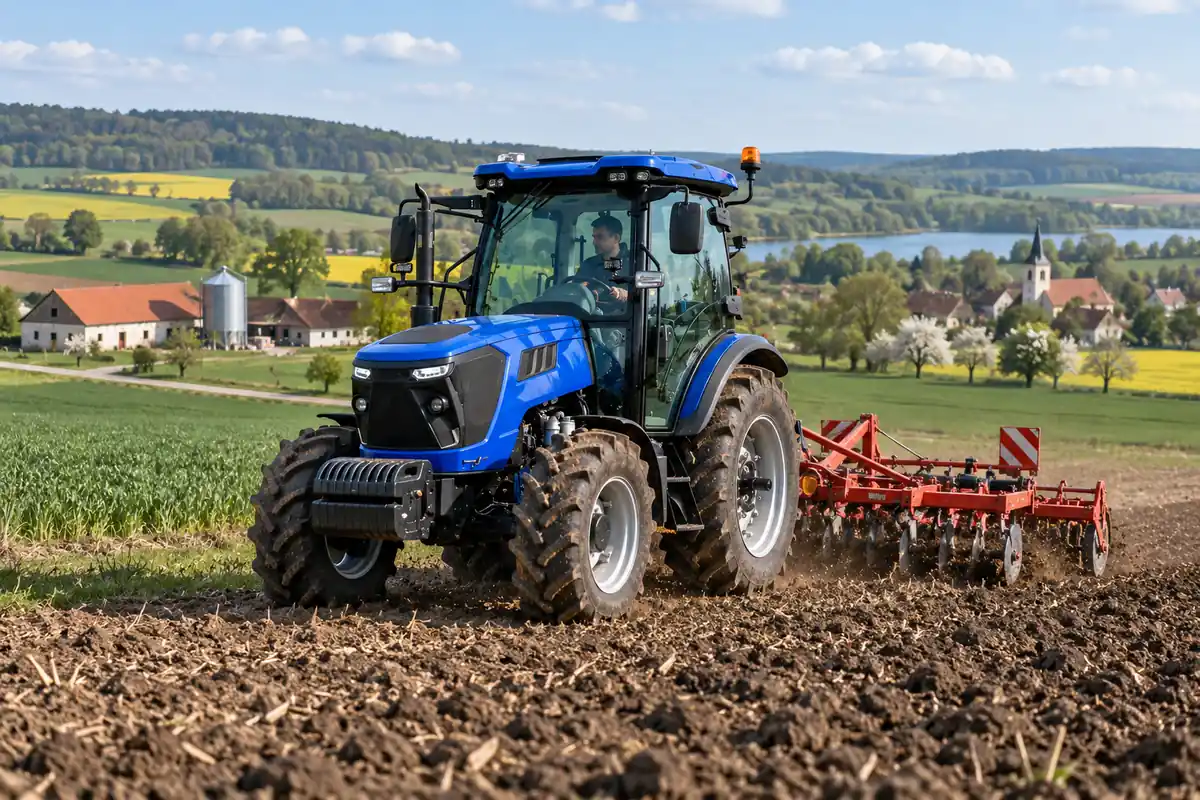
A practical buyer’s guide to traction, horsepower, implement matching, field productivity and 25-70 HP tractor selection in Poland.
A buyer searching for a 4wd tractor Poland solution can easily start with the wrong question: ‘How much horsepower do I need?’ Horsepower matters, but it is not the first variable to size. The more reliable starting point is the work itself – the heaviest recurring implement, the soil and slope conditions, the available field access, the amount of road transport, the annual operating hours, and the time window in which seasonal work must be completed.
That distinction matters in Poland because farm structure is highly varied. Poland’s Agency for Restructuring and Modernisation of Agriculture reported an average agricultural land area of 11.75 hectares per farm in 2025, but regional averages ranged from 4.40 hectares in Malopolskie to 34.04 hectares in Zachodniopomorskie. The European Commission also describes Polish agriculture as highly diverse in farm structure and development potential, with approximately 1.4 million farms. A single ‘hectares-to-horsepower’ rule therefore cannot describe the whole market. For buyers researching agricultural tractor Poland options, that regional spread is a strong reason to avoid universal sizing rules.
The practical objective is simpler: choose the smallest tractor platform that can complete the farm’s repeated work at an acceptable field rate, with enough traction, PTO and hydraulic reserve to avoid operating at the limit every day.
I. Polish Farm Conditions Change the Tractor Sizing Problem
Farm Area Is Only One Input
Two farms with the same 12 hectares can need very different machines. One may mainly mow grass, spread fertiliser and tow a light trailer. Another may use a plough, rotary tiller and disc harrow on heavier soil. A third may be a dairy operation where loader work and feed transport consume more tractor hours than cultivation. The surface area is identical; the dominant load case is not.
For Polish buyers, it is therefore more useful to divide the farm into working conditions rather than hectares alone: field work, grassland, livestock yard, orchard or wider-row horticulture, farm-road transport, and winter or property-maintenance duties. Each condition stresses a different part of the tractor.
Field Shape and Travel Time Can Be as Important as Field Size
A larger tractor can raise theoretical output with a wider implement, but that advantage falls when the operator spends a large share of the day turning on short headlands, moving between separate parcels, entering narrow gates or travelling on local roads. On compact or fragmented holdings, manoeuvrability and access may produce more usable work per day than an extra 10 or 20 HP.
Conversely, when a farm has larger continuous fields and repeated soil preparation, a very small tractor can create a different cost: too many passes, narrow implements, longer workdays and missed weather windows. The sizing question is therefore a throughput problem, not a simple engine-rating problem.
II. What 4WD Actually Changes – and What It Does Not
4WD Converts More Available Power into Useful Traction
An engine can produce power without producing useful field work. For draft operations, the tractor must convert engine torque through the transmission, axles and tyres into tractive force at the soil surface. When the tyres slip excessively, fuel is being burned without producing equivalent forward travel.
Wheel slip (%) = (theoretical travel – actual travel) / theoretical travel x 100
If tyre rotation indicates that the tractor should have travelled 100 metres but the machine actually travels only 88 metres, the slip is approximately 12%. Four-wheel drive helps because the front and rear axles share the tractive task instead of relying primarily on the rear axle. This can be valuable on damp grass, cultivated soil, uneven farm tracks and sloping access routes.
Four Common Problems 4WD Cannot Fix
- An oversized implement. More driven wheels cannot compensate for a plough, harrow or cultivator that creates more draft than the tractor can sustain.
- Insufficient PTO power. 4WD improves traction; it does not create additional PTO horsepower for a mower, rotary tiller or other powered implement.
- Poor ballast and tyre setup. Incorrect weight distribution, inappropriate tyre pressure or unsuitable tyres can still cause slip, instability and premature tyre wear.
- Excessive soil pressure. Adding weight improves traction only to a point. Too much ballast or inappropriate inflation pressure can increase compaction and damage soil structure.
This is why a 4wd farm tractor should be evaluated as a complete working system: engine, transmission, chassis mass, tyres, ballast, linkage, PTO, hydraulics and implement. Buying ‘4WD’ as a specification checkbox is not enough.
III. Tractor Size Matters as Much as Tractor Power
Width and Wheelbase Determine Access and Stability
Overall width determines whether the tractor can pass through gates, buildings, orchard rows and livestock areas. Wheelbase affects stability and ride, but it also changes turning space. A longer, heavier platform can be more stable under draft, transport and loader loads, while a shorter compact platform can be much easier to position in small yards and narrow headlands.
Weight Helps Traction, but Weight Has a Cost
A light tractor with high engine output may struggle to transmit that output to the soil. Additional mass and suitable ballast can improve drawbar performance. The trade-off is that unnecessary weight raises rolling resistance on the road, increases tyre and soil loading, and can be especially undesirable when fields are wet. The right target is not maximum weight; it is enough usable axle load and tyre footprint for the intended task.
Do Not Compare Two 50 HP Tractors by HP Alone
Two tractors can both be rated at 50 HP while differing in wheelbase, tyre size, three-point linkage category, transmission ratios, hydraulic capacity and total mass. Those differences can matter more than the badge when the work shifts from mowing and trailer movement to repeated soil preparation or loader operation.
IV. Size the Tractor Around Three Workload Limits
1. Draft-Limited Work: Ploughing, Harrowing and Heavy Soil Preparation
Draft-limited jobs are dominated by traction. The implement creates horizontal resistance, and the tractor must overcome it without excessive slip or constant operation at maximum engine load. Here, 4WD, tractor mass, tyre choice, ballast and implement width work together. A wider implement is not useful if the tractor must slow dramatically or spin the tyres to pull it.
2. PTO-Limited Work: Mowing, Rotary Tillage and Other Powered Implements
PTO-limited work depends less on drawbar traction and more on maintaining the correct shaft speed while the implement is under load. The buyer should confirm the implement’s required PTO speed, input power and driveline specification. In this case, a heavier tractor is not automatically better. What matters is adequate PTO reserve and a transmission ratio that allows the desired ground speed while the engine remains in its useful operating range.
3. Hydraulic and Stability-Limited Work: Front Loaders and Material Handling
Loader work introduces a different engineering problem. Raising a bale, pallet or loose material shifts the centre of gravity forward and upward. Buyers must therefore consider hydraulic flow, pressure, loader geometry, front-axle loading, rear ballast, tyre capacity and stability – not merely engine horsepower. A machine can have enough engine power and still be a poor loader platform if the chassis, hydraulics or counterweight arrangement are not suitable.
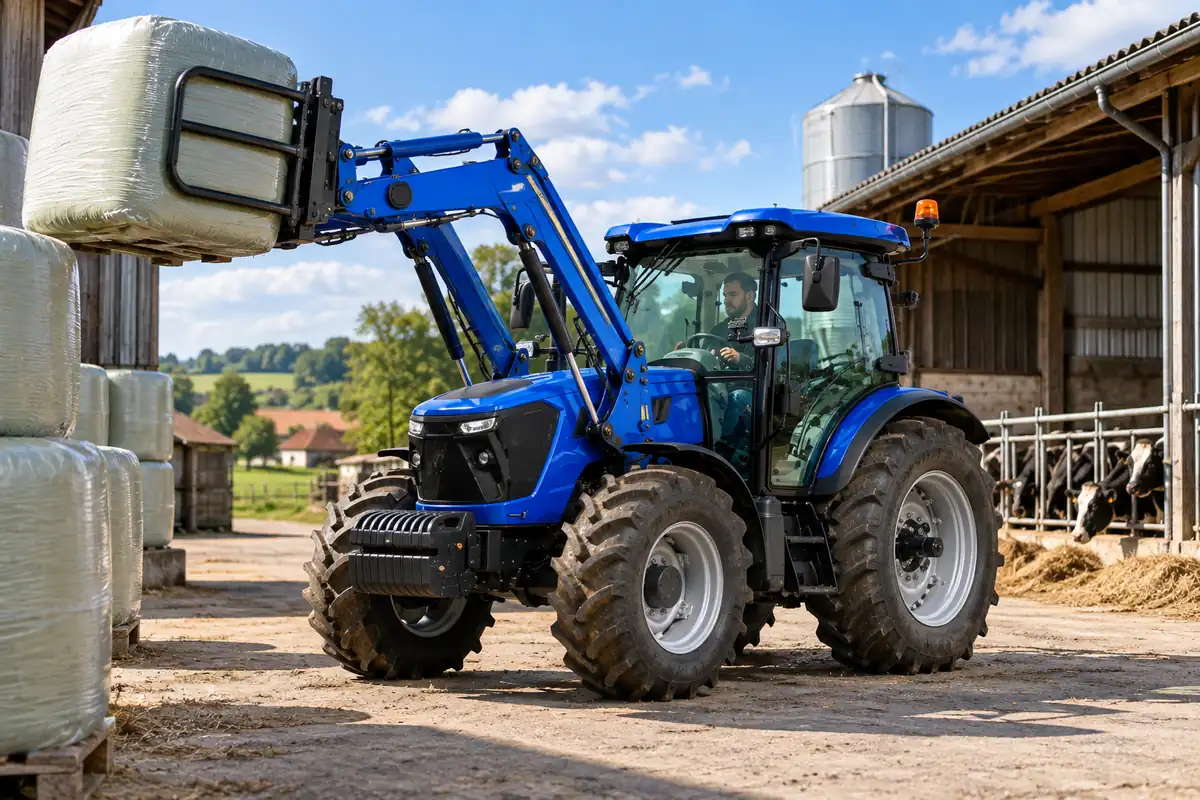
Illustrative loader application. Loader capacity, hydraulic demand, ballast and axle loading should be confirmed for the exact tractor and attachment configuration.
V. Use Field Productivity to Check Whether More HP Creates Real Value
Calculate Effective Field Capacity
A practical way to test a tractor-implement combination is to estimate effective field capacity rather than focusing on rated horsepower. A simplified calculation is:
Effective field capacity (ha/h) approximately = implement width (m) x working speed (km/h) x field efficiency / 10
Assume a 1.5 m implement works at 6 km/h with 75% field efficiency. The effective field capacity is about 0.675 ha/h. Covering 30 hectares once would therefore require roughly 44.4 field hours.
Now increase implement width to 2.0 m while keeping 6 km/h and 75% efficiency. Capacity rises to approximately 0.90 ha/h, reducing the same 30-hectare pass to about 33.3 hours – an 11-hour saving.
But a Bigger Implement Can Produce Zero Productivity Gain
Suppose the smaller tractor cannot comfortably handle the 2.0 m implement. Working speed falls to 4.8 km/h and field efficiency drops to 70% because of more gear changes, slower turns and difficult load control. Effective capacity becomes approximately 0.672 ha/h – essentially the same as the original 1.5 m setup.
That example illustrates an important purchasing principle: a wider implement and a higher horsepower label do not guarantee higher productivity. The whole system must sustain the target working speed. The correct tractor is the one that achieves the required seasonal field capacity with reasonable fuel use, slip and mechanical reserve.
VI. Hidden Costs: Where Cheap Tractor Decisions Become Expensive
Too Much Tractor Ties Up Capital
Oversizing increases acquisition cost and can also raise fuel consumption, tyre cost, storage requirements and the price of future replacement parts. If the additional capability is used only a few days per year, the farm is paying for idle capacity. On a small operation, a compact tractor that fits more jobs can have a better utilisation rate than a larger tractor that is technically more capable but operationally unnecessary.
Too Little Tractor Consumes Time
Undersizing creates the opposite risk: slower field speed, narrow implements, more passes, high engine load and insufficient power reserve in difficult conditions. The most expensive consequence may be lost time during short weather windows. Fuel cost is visible on an invoice; a delayed cultivation, mowing or harvest-support operation can create a much larger business impact.
The TCO Equation Should Include Downtime
A practical total-cost-of-ownership view includes purchase price, financing, fuel, planned maintenance, tyres, wear parts, unplanned repair, logistics for parts, downtime and residual value. For B2B procurement, the question is not simply ‘Which tractor costs less?’ It is ‘Which tractor delivers the required annual work at the lowest risk-adjusted cost per productive hour or per hectare?’
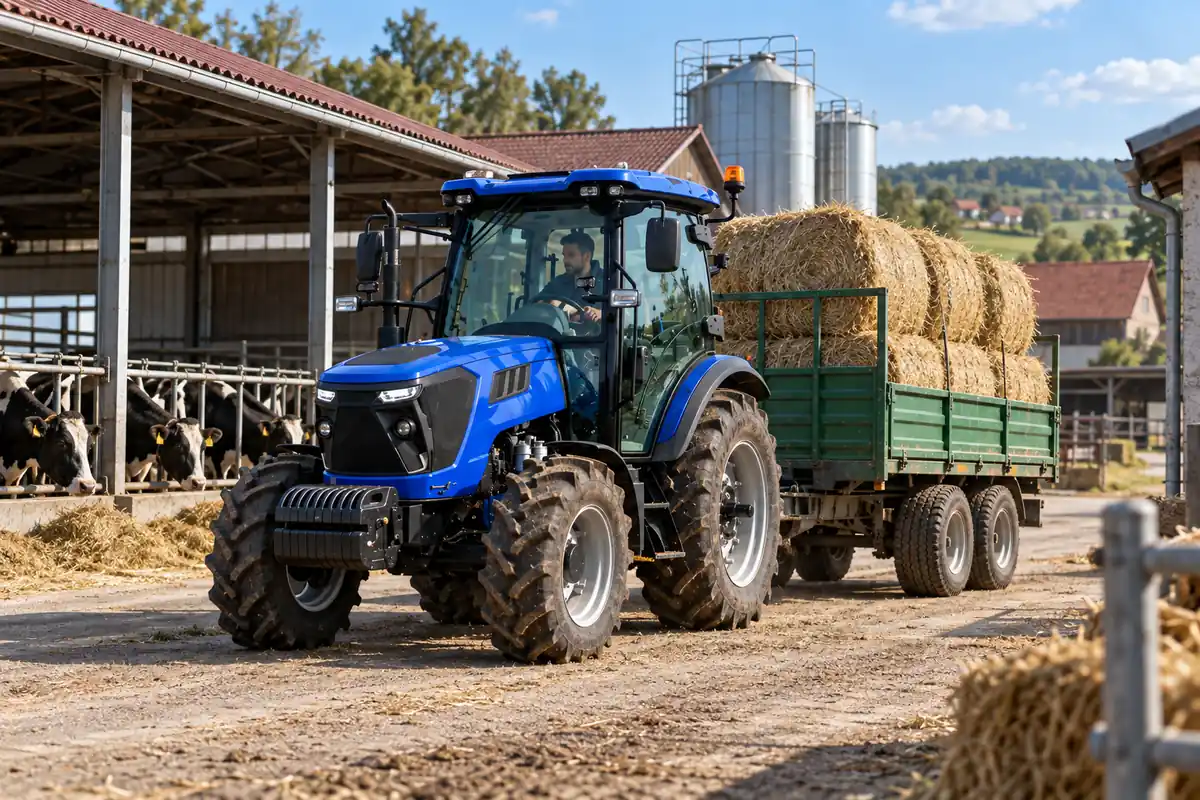
Illustrative mixed-farm transport application. Transport frequency, trailer mass, braking requirements and road use should be included in tractor sizing.
VII. How OXPLO Positions Its 25-70 HP 4WD Tractor Range
Only after the workload has been defined does model selection become useful. The current OXPLO tractor range covers six 4WD power levels from 25 to 70 HP. OXPLO divides the range into a compact Category I group and a larger Category II utility group, which is a more useful distinction than horsepower alone.
OXPLO OXT254 and OXT304: Compact 25-30 HP 4WD Tractors
The OXPLO OXT254 and OXPLO OXT304 are intended for small farms, wider-row orchards, paddocks, mowing, light cultivation and general property maintenance. Their published product pages list a compact 1,560 mm overall width, 1,800 mm wheelbase, Category I rear linkage and 8F + 8R transmission. This group makes sense when access, manoeuvrability and light-to-moderate implement work are more important than high drawbar output.
Model links: OXPLO OXT254 25 HP 4WD Tractor | OXPLO OXT304 30 HP 4WD Tractor
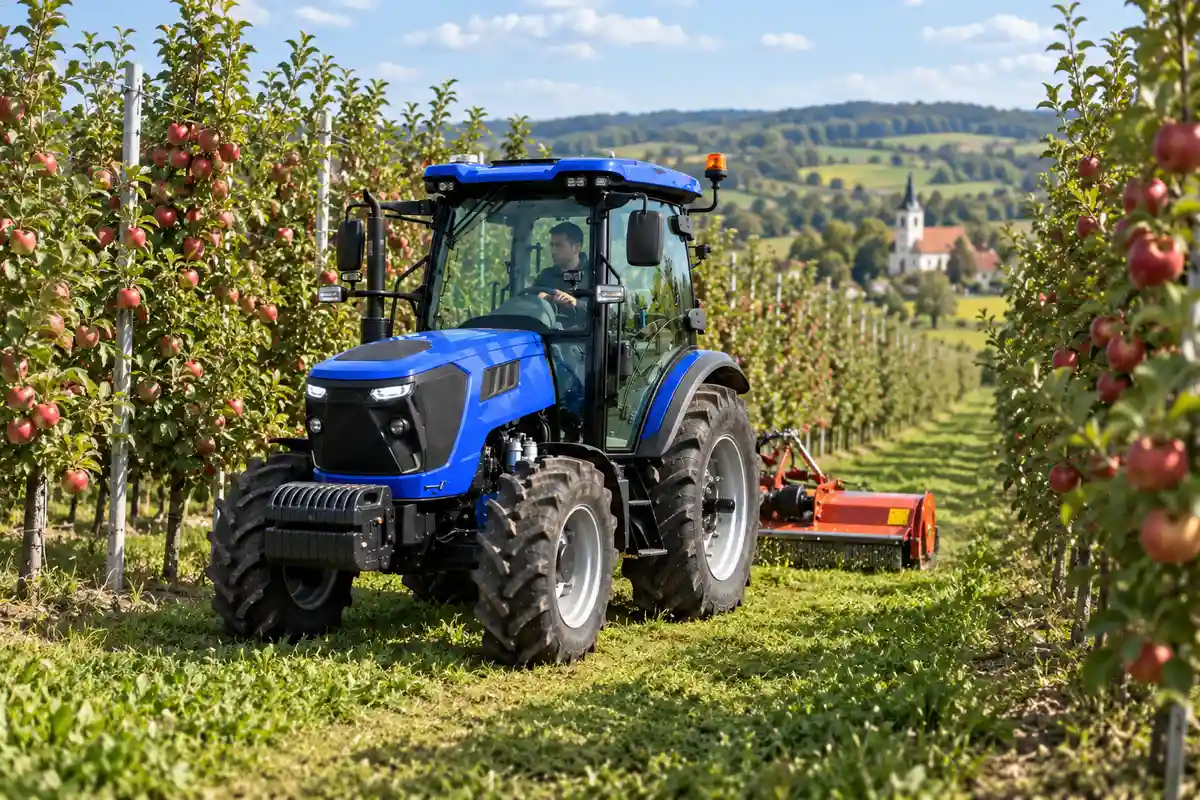
Illustrative compact 4WD orchard application. Row width, turning area, canopy clearance and implement envelope should be checked before selection.
OXPLO OXT404 and OXT504: Compact Utility Power at 40-50 HP
The OXPLO OXT404 and OXPLO OXT504 move into more frequent mixed-farm work while retaining the compact OXPLO chassis concept. This is a useful range for mowing, grassland maintenance, light-to-medium soil preparation, spreading, trailer transport and livestock support where the farm still benefits from compact access. The OXPLO OXT504 is particularly relevant when a buyer wants more power reserve but still uses Category I implements and does not yet need the larger OXPLO OXT604 platform.
Model links: OXPLO OXT404 40 HP Compact Tractor | OXPLO OXT504 50 HP 4WD Farm Tractor
OXPLO OXT604 and OXT704: A Larger Category II Utility Platform
The step from OXPLO OXT504 to OXPLO OXT604 is not merely a 10 HP increase. The OXPLO OXT604 and OXPLO OXT704 move to Category II linkage, a 12F + 12R transmission, a published 2,010 mm wheelbase and larger utility-tractor dimensions. That platform change matters when the farm uses heavier implements, performs more demanding transport or loader work, or needs a more stable chassis for higher annual workloads.
For a Polish buyer, the OXPLO OXT604 can be a logical entry point when compact Category I compatibility becomes the limitation. The OXPLO OXT704 adds further engine reserve for heavier recurring work, but the same principle still applies: OXPLO does not recommend selecting the highest horsepower simply because it is available. The implement set and required field capacity should justify the larger platform.
Model links: OXPLO OXT604 60 HP 4WD Utility Tractor | OXPLO OXT704 70 HP 4WD Farm Tractor
OXPLO Platform Selection at a Glance
Model | Power | Drive | Transmission | Linkage | Practical Fit |
OXT254 | 25 HP | 4WD | 8F + 8R | Cat. I | Small farms, mowing, light cultivation |
OXT304 | 30 HP | 4WD | 8F + 8R | Cat. I | Small mixed farms, orchards, utility work |
OXT404 | 40 HP | 4WD | 8F + 8R | Cat. I | Mixed farming, tillage, mowing, transport |
OXT504 | 50 HP | 4WD | 8F + 8R | Cat. I | Higher-frequency PTO work and livestock farms |
OXT604 | 60 HP | 4WD | 12F + 12R | Cat. II | Heavier implements, loader work, larger workloads |
OXT704 | 70 HP | 4WD | 12F + 12R | Cat. II | More demanding cultivation, transport and mixed farming |
Specification note: OXPLO product pages and overview pages may be updated at different times. The final quotation and model-specific specification sheet should confirm transmission, PTO speed, tyres, hydraulics, engine/emissions configuration, attachments and destination-market documentation before order placement.
For application-based model and attachment matching, see OXPLO 25-70 HP Tractor and Attachment Selection. OXPLO currently presents six power options and up to 48 attachment options for different agricultural tasks, subject to model compatibility.
VIII. Poland and EU Compliance: Confirm the Vehicle, Not Just the Brochure
CE Is Not the Entire Road-Registration Question
European agricultural-vehicle compliance should be handled as a model-specific procurement task. Regulation (EU) No 167/2013 establishes type-approval and market-surveillance requirements for agricultural and forestry vehicles, including wheeled tractors in category T and track-laying tractors in category C. For a tractor intended for Poland, buyers should confirm the approval route and the documentation required for the exact vehicle and intended use, rather than treating a generic ‘CE’ statement as the only compliance check. This is especially important in an agricultural tractor Poland sourcing process where registration and intended road use may be part of the purchase decision.
Confirm the Final Configuration Before Shipment
- Exact tractor model and engine configuration, including applicable emissions requirements.
- Transmission, PTO speed and shaft configuration for the intended implements.
- Three-point linkage category and implement compatibility.
- Tyres, ballast and loader configuration if material handling is required.
- Lighting, braking, operator-protection and road-use equipment where applicable.
- Model-specific conformity, type-approval or other documents required for the destination and intended registration route.
- Pre-shipment photos, inspection records, packing and commercial shipping documents.
OXPLO buyers can review the current order-support process on the OXPLO Support page and should request a confirmed model-specific documentation package before production or shipment.
IX. A Practical 4WD Tractor Buying Checklist for Polish Farms
Before requesting a quotation for a 4WD tractor Poland project, prepare the operating data first. This reduces the chance of comparing machines that are not technically equivalent.
Step 1: Define the Work
- Farm area and number of separate working parcels.
- Main crops, grassland, livestock or orchard application.
- The three most demanding recurring jobs, not just occasional tasks.
- Required seasonal field capacity and available weather window.
- Approximate annual tractor operating hours.
Step 2: Define the Implements
- Working width and implement mass.
- PTO speed and required input power.
- Three-point linkage category.
- Hydraulic flow/pressure demand and number of services.
- Transport dimensions and storage constraints.
Step 3: Define the Site Constraints
- Soil type and wet-ground risk.
- Slope and uneven access tracks.
- Gate, building and orchard-row width.
- Headland turning space.
- Road-transport distance and trailer requirements.
Step 4: Select the Platform, Then the HP
If the work is light and access is the limiting factor, a small 4wd tractor in the 25-30 HP class may be the efficient choice. If the farm needs one machine for mowing, PTO work, transport and moderate tillage, 40-50 HP can provide a stronger utility balance. When Category II implements, heavier loader work or higher annual field throughput become the constraint, the 60-70 HP class deserves closer attention.
The final decision should be checked against field productivity and TCO. A tractor that costs less but requires 20% more hours to complete recurring work may not be the lower-cost machine. Equally, a larger machine that saves only a few hours per year may never recover its additional acquisition and operating cost.
X. FAQ: 4WD Tractors for Polish Farms
Is a 4WD tractor necessary for every small farm in Poland?
Not automatically. 4WD becomes most valuable when traction is a recurring constraint – for example on damp grass, loose soil, slopes, cultivation work or uneven farm tracks. A small farm doing mainly light yard and maintenance work may not use the full traction benefit every day. However, for a multipurpose farm tractor that must work across changing surfaces, 4WD provides useful operational reserve.
What HP tractor is suitable for a 10-20 hectare Polish farm?
There is no reliable answer based on hectares alone. A 10-hectare orchard, a 15-hectare dairy operation and a 20-hectare arable farm impose different loads. Start with implement width, soil condition, PTO demand, loader use and required completion time. For a 4WD tractor Poland comparison, 40-70 HP may be worth evaluating in many mixed-farm cases, but the correct platform depends on the workload, not the farm area by itself.
When is a 40-50 HP small 4WD tractor enough?
A compact 40-50 HP machine can be a strong fit when the farm uses Category I implements, needs good access around buildings or narrow areas, and performs mowing, spreading, light-to-medium tillage and transport. If the operation moves into heavier Category II implements, more intensive loader work or higher sustained field throughput, a larger utility platform may be more appropriate.
What is the practical difference between Category I and Category II?
The category affects the geometry and pin dimensions of the three-point linkage and therefore the implement class the tractor is designed to handle. Category II is commonly associated with larger, heavier implements and larger tractor platforms. Buyers should not assume that an implement is compatible simply because the tractor has enough engine horsepower; linkage geometry, implement mass and lift capacity must also match.
Which OXPLO tractor should a Polish buyer start comparing?
For compact access and lighter recurring work, start with the OXPLO OXT254 or OXPLO OXT304. For a broader mixed-farm role, compare the OXPLO OXT404 and OXPLO OXT504. If Category II implements, heavier handling or higher annual workloads are part of the requirement, compare the OXPLO OXT604 and OXPLO OXT704. OXPLO can then confirm the final model, PTO, tyres, attachments and available destination-market documents against the actual application.
XI. Conclusion: Choose the Working System, Not Just the Horsepower
The strongest 4wd tractor Poland purchasing decisions follow a clear sequence: farm conditions -> recurring tasks -> implements -> traction -> chassis size -> horsepower -> configuration -> compliance -> price. Reversing that sequence is how buyers end up with tractors that are either too large to utilise efficiently or too small to complete the work on time.
For Polish farms, the wide variation in farm structure makes this system approach especially important. A small 4wd tractor can be the right business tool where access and versatility dominate. A larger 60-70 HP utility tractor becomes more rational when heavier implements, Category II compatibility, loader stability or seasonal throughput are the true constraints.
OXPLO offers a 25-70 HP 4WD tractor range designed around these different workload levels. Instead of selecting an OXPLO model from horsepower alone, buyers can send OXPLO their farm type, main implements, terrain, annual workload and destination country. OXPLO can then help narrow the tractor platform, confirm attachment compatibility and review the available model-specific configuration and documentation before order placement.
Explore OXPLO: OXPLO Official Website | 25-70 HP OXPLO Tractors | OXPLO Tractor & Attachment Selection