
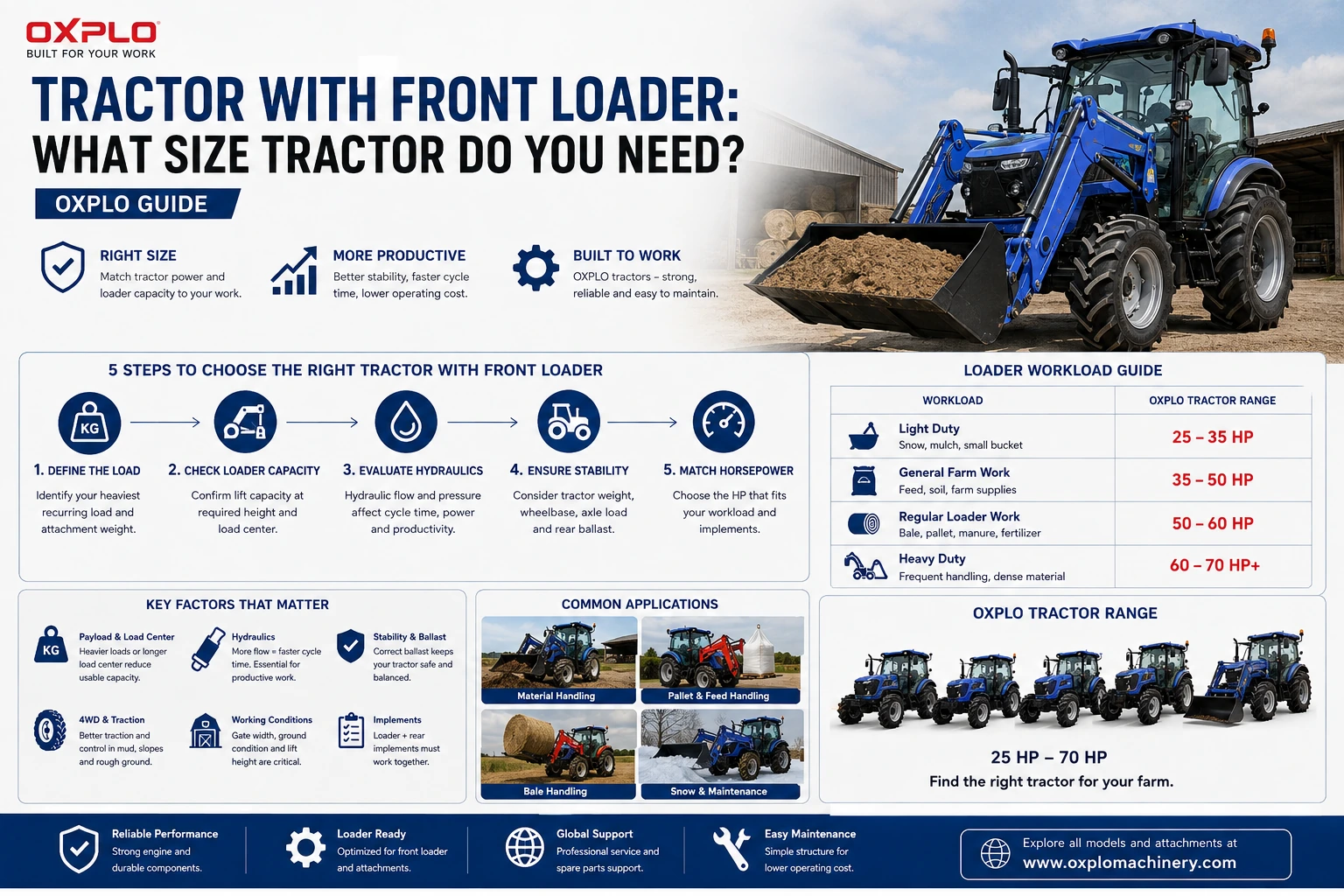
I. Start With the Loader Job, Not the Horsepower Number
A livestock farmer moving round bales, a mixed farm unloading fertiliser, an orchard handling soil and a contractor loading materials may all search for a tractor with front loader. Their operating requirements are not the same, even when the heaviest object on the farm looks similar on paper.
The first mistake is therefore starting with a horsepower target such as 40 HP, 50 HP or 70 HP. Engine power tells you how much work the engine can support, but a front loader also depends on the hydraulic circuit, loader geometry, tractor operating mass, front axle loading, wheelbase, tyres, rear ballast and the position of the payload relative to the loader pivot.
For European buyers, another constraint frequently appears at the same time: the tractor still has to enter barns, gateways, orchards or older farmyards. A larger platform can provide useful loader reserve, yet it can also add width, turning space, tyre cost and soil compaction. That is why the real purchasing question is not “What is the biggest tractor I can afford?” It is “What is the smallest tractor platform that can repeatedly perform my real loader workload without creating a stability, access or productivity problem?”
A loader tractor is a system, not an engine plus a bucket
Treat the machine as one working system: tractor + loader frame + attachment + payload + hydraulics + tyres + rear ballast. If one part is underspecified, the whole combination can become slow, unstable or uneconomic. If the whole package is oversized, the buyer carries unnecessary ownership cost every day the tractor is used for lighter work.
Typical Loader Work | Starting Tractor Class | Primary Buying Question |
Snow, mulch, light soil, property maintenance | 25-35 HP | Is compact access more important than loader reserve? |
Occasional feed, soil and farm supplies | 40-50 HP | Can one compact tractor cover loader, PTO and transport work? |
Regular bucket, pallet and feed handling | 50-60 HP | Is the chassis heavy and stable enough for repeated loader cycles? |
Bale handling and heavier mixed-farm work | 60-70 HP | Do you need a larger utility platform, not just more engine HP? |
Several hours of intensive loading every day | 60-70 HP+ or dedicated loader | Is a farm tractor still the lowest-TCO machine? |
II. Calculate the Real Loader Requirement Before You Compare Tractors
1. Start with the heaviest recurring payload
Do not size a front end loader tractor around a rare emergency lift. Start with the heaviest load that the machine will handle repeatedly during normal work: the round bale used every day, the typical fertiliser pallet, the usual bucket of wet soil, or the normal feed load. Recurring work drives fatigue, cycle time, tyre wear and total cost of ownership.
Material density matters as much as bucket size. A bucket that is comfortable with dry mulch can become a very different load when filled with wet soil, gravel or compacted manure. For this reason, bucket volume alone is not a reliable loader-sizing metric.
2. Add attachment weight before judging capacity
A 700 kg pallet does not create a 700 kg demand if the pallet fork frame itself weighs 120 kg. The loader system is already handling approximately 820 kg before load-centre effects are considered. The same rule applies to bale grabs, grapple buckets and other hydraulic attachments.
3. Ask where the loader capacity is measured
A brochure may publish lift capacity at the pivot pin, at a specified distance forward of the pivot, or at a particular lift height. These values are not interchangeable. Pallet forks and bale attachments usually move the load centre farther forward than a bucket load, increasing the leverage acting against the loader.
Procurement rule Do not accept “the loader lifts 1,000 kg” as a complete answer. Ask: 1) where is the capacity measured, 2) at what lift height, 3) with which attachment, and 4) at what load centre? |
4. Define the required lift height and forward reach
Moving manure across a yard is different from placing a pallet onto a trailer or lifting feed above a mixer. A machine may raise the required load at low height but have less usable capacity close to maximum loader height. Lift height, reach and remaining capacity at that point should therefore be checked together.
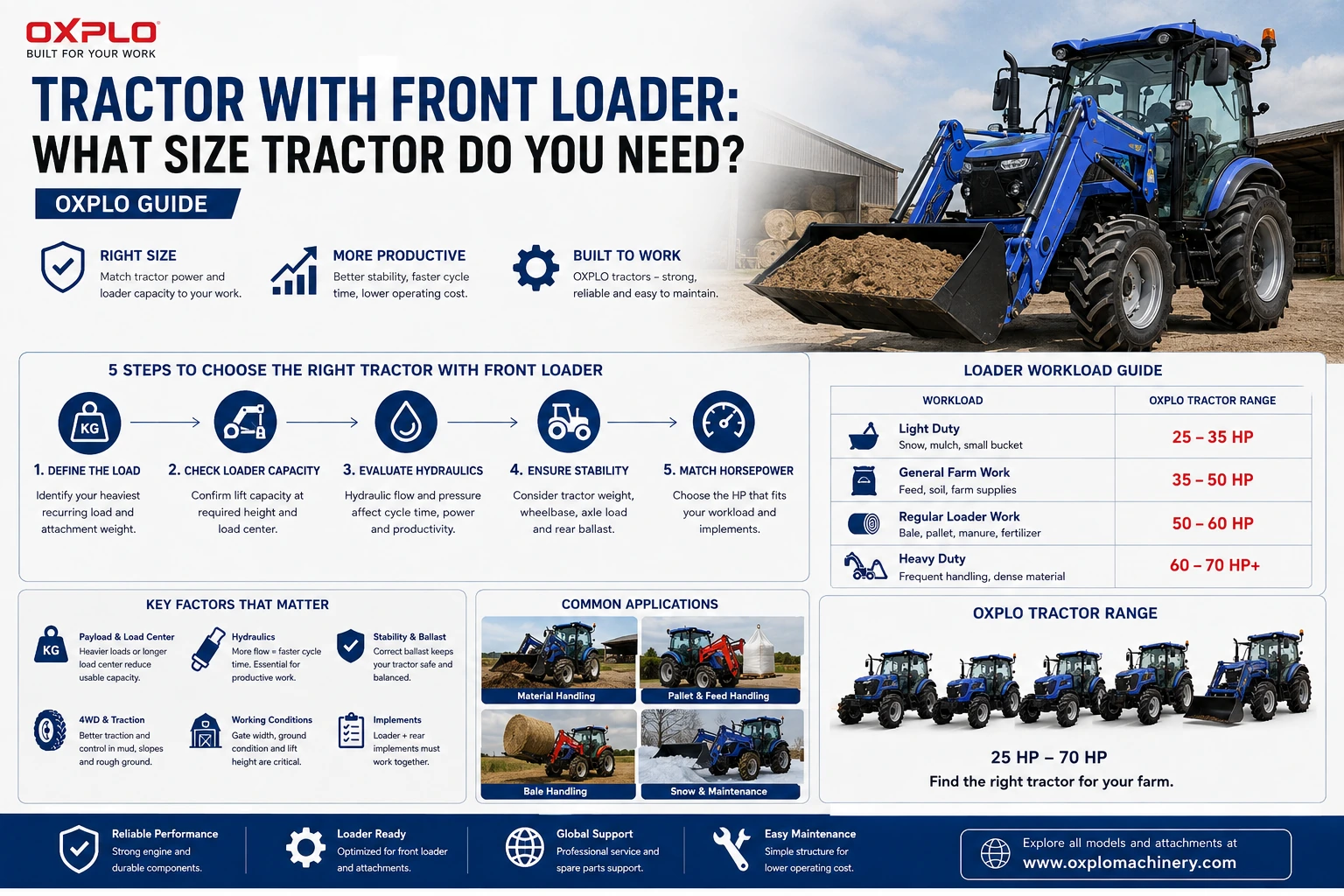 Figure 1. OXPLO front-loader configuration for bale handling. Payload mass, attachment weight, load centre and required lift height should be evaluated together.
III. Why Similar-Horsepower Tractors Can Behave Very Differently With a Loader
Tractor weight and wheelbase change the stability margin
A front loader moves mass ahead of the front axle. As the loader rises, the combined centre of gravity moves forward and upward. That is why loader work is partly a stability problem. A tractor with more chassis mass and a longer wheelbase can provide a more appropriate base for recurring loader work than a lighter tractor with similar engine power.
The trade-off is important for Europe. A heavier utility tractor can feel more planted while lifting or transporting materials, but extra width and mass may reduce access in narrow barns, vineyards, orchards and older farmyards. Buyers should measure the site before increasing tractor size simply for more theoretical reserve.
Rear ballast belongs in the original specification
Rear ballast is not a cosmetic accessory. It helps maintain rear-axle loading, traction and stability when a front payload shifts weight forward. Depending on the approved tractor-loader configuration, ballast may be provided through rear weights, wheel ballast, a ballast box or a suitable three-point-mounted counterweight. The correct method and amount should be confirmed with the machine configuration rather than improvised after delivery.
4WD helps the tractor remain useful on real farm surfaces
Four-wheel drive does not increase hydraulic lifting capacity, but it is particularly valuable when a farm tractor with front loader works on mud, wet grass, loose gravel, slopes or uneven tracks. Loader work continually changes axle loading; maintaining traction across those changing conditions directly affects control and cycle consistency.
Transmission ratios affect loader productivity
Loader work contains constant direction changes. The operator approaches the material, fills the attachment, reverses, turns, travels, positions, dumps and returns. A useful range of forward and reverse speeds can therefore matter more than the maximum road speed shown on a specification sheet. Farms with frequent loader work should evaluate how easily the operator can select low working speeds and change direction through the full cycle.
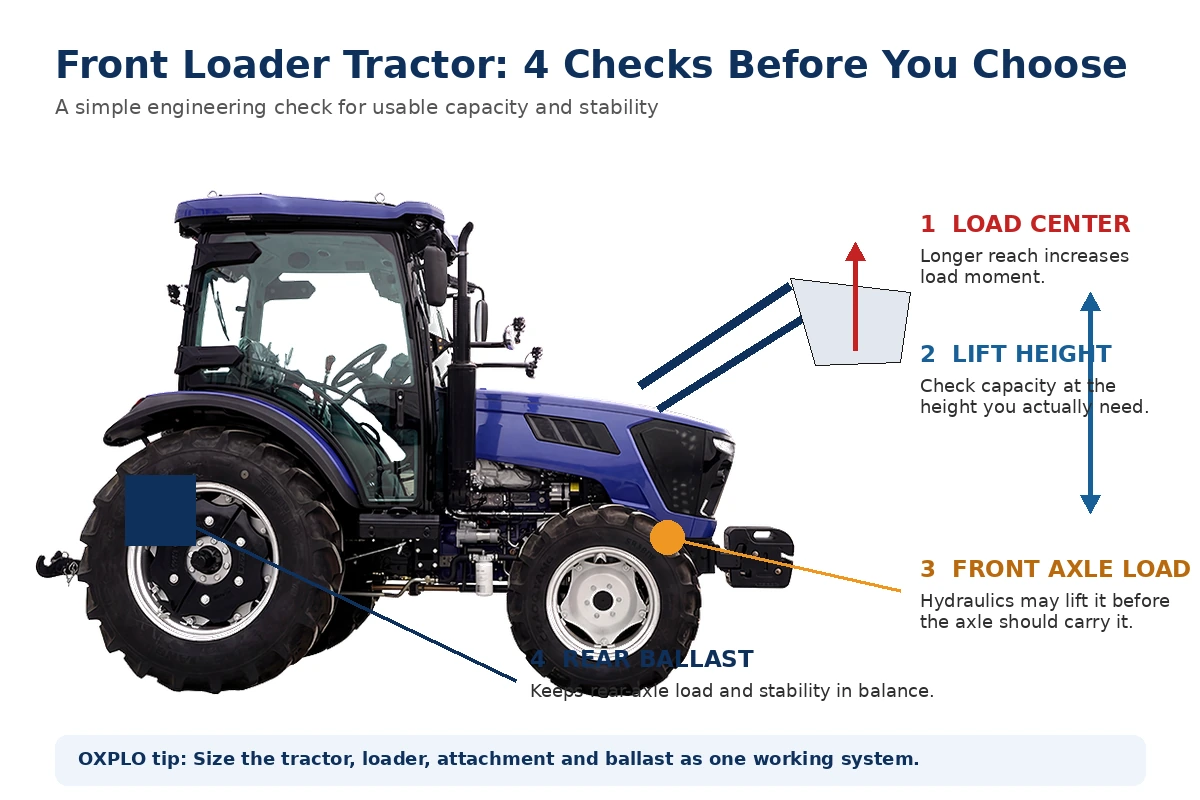
Figure 2. OXPLO tractor with front loader during dense-material handling. Bucket load, traction, axle loading and rear ballast all affect practical performance.
IV. Hydraulic Performance Can Cost More Time Than a Small Horsepower Difference
Pressure determines force; flow influences speed
Hydraulic pressure and hydraulic flow are often discussed as though they were the same specification. They are not. Pressure contributes to the force available at the hydraulic cylinders, while flow strongly influences how quickly those cylinders move. A loader may technically raise the load but still produce slow raise, curl and dump cycles.
Turn seconds per cycle into annual operating hours
Consider an illustrative livestock operation completing 120 loader cycles during a busy day. If a slower hydraulic combination adds only 20 seconds to each complete cycle, that is 2,400 seconds – about 40 minutes – of additional machine time per day. Across 150 comparable working days, the difference approaches 100 operating hours. The exact result varies by operator, load and machine, but the business logic is clear: small cycle-time penalties become large when repeated every day.
Plan third-function hydraulics before delivery
A standard bucket mainly requires lift and curl functions. A grapple, hydraulic bale grab or multifunction bucket may require an additional hydraulic function. Discovering this only after delivery can mean extra valves, hoses, controls and installation work. The efficient sequence is: choose the work, choose the attachment, confirm hydraulic requirements, then configure the tractor and loader.
V. 25 HP, 40 HP, 50 HP, 60 HP or 70 HP: Where Do the Boundaries Change?
25-35 HP: access first, loader work second
This class makes sense when manoeuvrability is critical and loader work is light or occasional: snow, mulch, small quantities of soil, property maintenance and lighter farm supplies. Its advantage is access. Its limitation is reserve. A compact tractor should not be expected to become a high-duty material handler simply because a loader can be mounted to it.
40-50 HP: the mixed-farm compromise
For many small and medium European farms, 40-50 HP is attractive because the tractor must remain useful for mowing, tillage, PTO work, trailer transport and seasonal loading. A 50 HP tractor with front loader can be an effective multi-purpose machine when loader work is important but not the only job the tractor performs.
The boundary appears when the operator spends several hours per day handling dense material, repeated pallets or large bales. At that point, the correct question is often not “Would another 10 HP help?” but “Should I move from a compact tractor chassis to a larger utility platform?”
60-70 HP: loader work becomes part of daily production
The 60-70 HP class becomes increasingly relevant for livestock feed operations, bale handling, larger buckets, farm-supply pallets, heavier transport and contractors who need broader implement compatibility. The advantage normally comes from more than engine output: the tractor platform itself may gain chassis mass, wheelbase, larger tyres, more transmission ratios and a stronger rear linkage category.
Do not oversize for the rarest job
Buying a much larger tractor “just to be safe” can raise purchase cost, tyre cost, storage requirements, soil compaction and turning-space demand. If an unusually heavy task occurs only a few times per year, hiring a telehandler, wheel loader or other machine for that task can be cheaper than owning an oversized tractor for every lighter job throughout the year.
VI. Match the Tractor to the European Customer, Not Just the Farm Size
Livestock farms: frequency often matters more than hectares
Feed, bedding, manure and bales move every day regardless of field size. A 20-hectare livestock farm can therefore place more loader hours on a tractor than a much larger arable property. For livestock customers, loader cycle frequency, building access, bale weight, yard surface, visibility and operator fatigue should be treated as primary selection variables.
Mixed farms: maximise annual utilisation
Mixed farms often cannot justify a separate machine for each task. Their business case is based on utilisation: one tractor may load feed today, operate a mower tomorrow and pull a trailer during harvest. The best platform is the one that covers the majority of recurring work with sensible reserve without becoming awkward for everyday jobs.
Orchards, vineyards and estates: dimensions can overrule horsepower
Measure gateway width, row spacing, turning area, building entrances, door height and canopy clearance before moving into a larger chassis. A technically more capable tractor has little value if it cannot reach the work area. In these applications, compact dimensions are an operating specification, not a convenience feature.
Contractors: duty cycle changes the TCO calculation
A contractor earns money from productive machine hours. When loader work is daily, under-specifying the machine can create more cost through slower cycles, limited attachment compatibility and higher operator fatigue than the initial purchase saving. Contractors should place greater emphasis on working reserve, transmission flexibility, hydraulic configuration, serviceability and multi-implement compatibility.
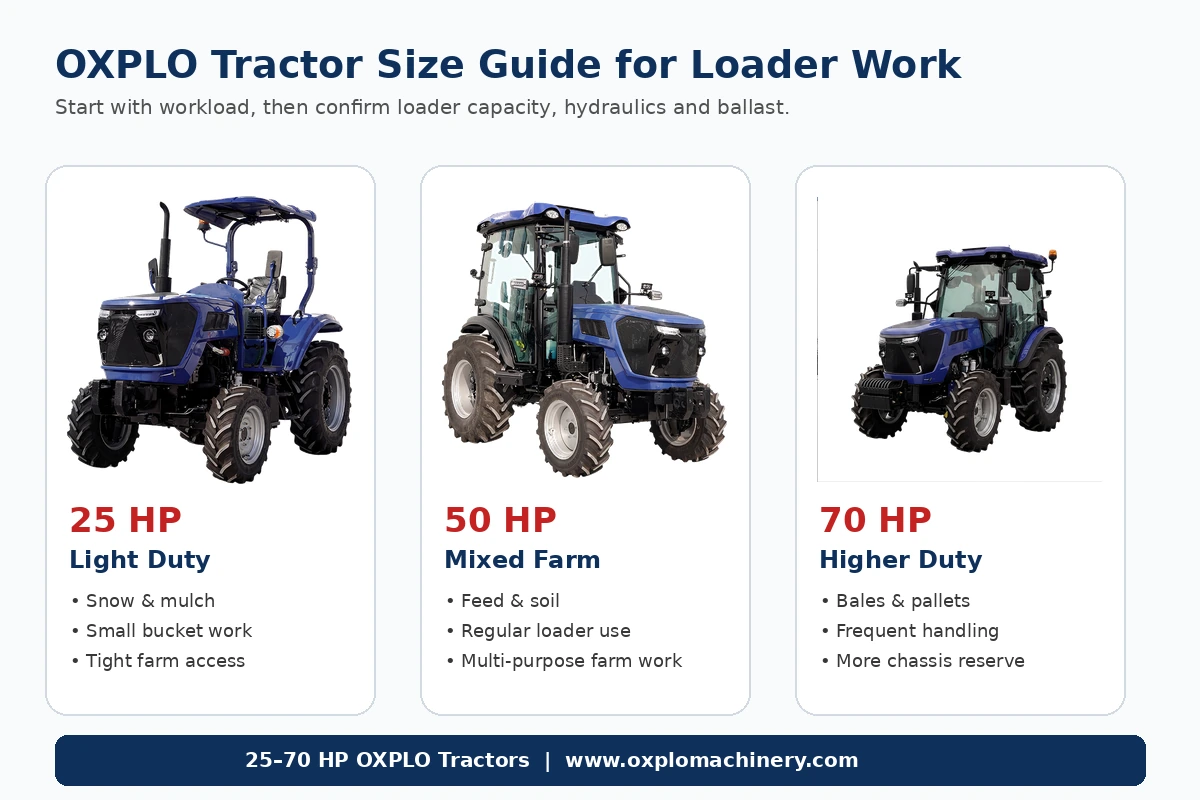
Figure 3. OXPLO front-loader tractor in winter conditions. European buyers should consider year-round traction, tyre configuration, visibility and seasonal attachment requirements.
VII. When a Bigger Tractor – or a Different Machine – Makes More Sense
Do not use tractor horsepower to solve a duty-cycle problem
If the loader is used for several continuous hours every day, the farm may be approaching the point where the machine is no longer primarily a tractor. Frequent stockpile loading, high stacking, dense aggregates, repeated work near the loader limit and high-volume pallet handling can favour a purpose-built loader or telehandler.
This is an important TCO boundary. A larger tractor may still be the right answer when the business also needs PTO, three-point linkage and field traction. But if 80-90% of the machine hours are pure loading, paying for tractor features that are rarely used may not be efficient.
A practical decision test
- If loader work is occasional and field work dominates, stay focused on a multi-purpose tractor platform.
- If loader work is daily but the tractor also performs substantial PTO, transport and rear-implement work, evaluate a heavier utility tractor with correctly matched loader and ballast.
- If the machine spends most of its life loading, stacking or handling dense materials, compare the TCO of a dedicated loader or telehandler before automatically moving to more tractor horsepower.
VIII. How OXPLO Positions Its 50-70 HP Loader-Capable Tractor Platforms
Once the workload has been defined, the current OXPLO tractor range becomes easier to evaluate. OXPLO offers 25-70 HP tractors for European farm applications, while the OXPLO tractor configuration guide places OXT504, OXT604 and OXT704 in the 50-70 HP material-handling range for front loader, bucket and bale-fork work.
Explore the OXPLO 25-70 HP tractor range or review the OXPLO tractor configuration and attachment guide for current application guidance.
Figure 4. OXPLO 50-70 HP front-loader selection concept: OXT504, OXT604 and OXT704 represent different starting points for compact mixed-farm, utility and higher-power workloads. Final loader specifications should be confirmed for the actual configuration.
OXPLO Model | Power | Drive | Transmission | Wheelbase | Listed Weight | Rear Linkage | Loader-Buyer Starting Point |
OXT504 | 50 HP | 4WD | 8F + 8R | 1,800 mm | 2,200 kg | Category I | Compact mixed-farm work where access still matters |
OXT604 | 60 HP | 4WD | 12F + 12R | 2,010 mm | 2,500 kg | Category II | Regular utility and loader work with broader implement needs |
OXT704 | 70 HP | 4WD | 12F + 12R | 2,010 mm | 2,500 kg | Category II | Higher-power mixed-farm, transport and loader workloads |
OXPLO OXT504: when compact access still has economic value
The OXPLO OXT504 is the highest-powered model in the compact OXT chassis group. OXPLO currently publishes 50 HP, 4WD, an 8F + 8R transmission, a 1,800 mm wheelbase, 2,200 kg listed weight, 1,560 mm overall width and Category I rear linkage. For buyers working around tighter buildings or access points, this compact footprint can be more valuable than moving immediately to a larger tractor.
The OXPLO OXT504 therefore makes sense when loader work is moderate and the same tractor must also perform grassland maintenance, PTO work, cultivation and transport. If heavy loader cycles become a core daily task, however, the farm should evaluate whether a utility-platform step is more appropriate than continuously operating a compact chassis near its practical boundary.
View the OXPLO OXT504 product page for current specifications and configuration notes.
OXPLO OXT604: the important platform step
The OXPLO OXT604 is not simply the OXT504 with another 10 HP. OXPLO publishes a 2,010 mm wheelbase, approximately 2,500 kg listed weight, larger tyres, a 12F + 12R transmission and Category II rear linkage. Those changes alter the working character of the tractor.
For a customer who says, “My 50 HP tractor has enough engine power, but loader work feels light and I need larger rear implements,” the OXPLO OXT604 may solve the actual problem more directly than choosing another compact tractor with a slightly larger engine. The additional chassis mass, longer wheelbase, broader gear range and Category II compatibility can all matter during recurring loader and mixed-farm work.
View the OXPLO OXT604 product page for current published specifications.
OXPLO OXT704: more engine reserve on the larger utility platform
The OXPLO OXT704 uses the larger 70 HP utility platform with 4WD, a 2,010 mm wheelbase, approximately 2,500 kg listed weight, 12F + 12R transmission and Category II linkage. OXPLO also lists optional front-loader capability, with loader capacity, hydraulic connections, attachment type and counterweight to be confirmed as part of the final configuration.
The reason to step from OXPLO OXT604 to OXPLO OXT704 should therefore be broader engine and PTO reserve for the farm’s total workload – for example heavier field implements, transport and seasonal work – rather than assuming that 70 HP automatically means a higher loader rating. The approved loader specification still needs to be checked separately.
View the OXPLO OXT704 product page or browse OXPLO tractor attachments and support.
What OXPLO is trying to solve for European buyers
The central OXPLO selection logic is application first. OXPLO asks buyers to define destination country, farm type, terrain, intended work and attachments before the final tractor configuration is confirmed. That approach is particularly useful for a tractor with front loader because the loader, hydraulics, tyre choice, rear ballast, PTO and linkage requirements interact with one another.
For an OXPLO buyer, the goal should not be to receive a generic quotation for “one 60 HP tractor + loader.” The goal should be to have OXPLO confirm the tractor model, loader requirement, attachment interface, hydraulic configuration, tyres, ballast approach and destination-market documentation as one purchasing package.
IX. European Procurement Checklist: What to Send OXPLO Before You Ask for a Quote
A supplier can only make a precise recommendation when the enquiry contains operating data. For European customers, OXPLO can use the following information to narrow the tractor platform and identify the loader questions that must be confirmed before production or shipment.
Information to Provide | Example | Why OXPLO Needs It |
Heaviest recurring load | 650 kg round bale | Establishes the real loader demand |
Material | Feed, manure, soil, gravel, fertiliser | Density changes bucket and payload mass |
Attachment | Bucket, pallet forks, bale spear, grapple | Changes weight, geometry and hydraulic demand |
Required lift height | Transport height, trailer, feeder or stacking | Determines usable capacity and loader geometry |
Loader frequency | 30 min/week or 4 h/day | Defines duty cycle and required working reserve |
Terrain | Concrete, grass, mud, slope | Affects traction, tyres and stability |
Access dimensions | 1.70 m barn entrance | May rule out a larger tractor platform |
Rear implements | Mower, plough, tiller, spreader | Defines PTO and linkage compatibility |
Transport work | Trailer size and frequency | Influences chassis and power reserve |
Destination country | Poland, France, Germany, Spain, etc. | Drives market-specific engine, lighting, braking and documentation checks |
Confirm European market configuration before shipment
European orders require more than horsepower confirmation. OXPLO recommends confirming the exact engine emissions configuration, available model-specific CE documentation, operator-protection equipment, lighting, braking, tyres, loader specification and any destination-country road-use or registration requirements that apply to the intended use.
OXPLO also supports pre-shipment configuration checks, photos or videos and shipping coordination. For a B2B buyer, this is valuable because discrepancies are far cheaper to correct before the tractor and attachments leave the factory than after they arrive at the farm or dealer yard.
See OXPLO Support, learn more About OXPLO or start from the OXPLO homepage.
X. Conclusion: Choose the Complete Loader-Tractor System, Not a Horsepower Number
The right tractor with front loader is not automatically the tractor with the highest horsepower or the largest headline loader figure. It is the tractor that can repeatedly perform the farm’s real material-handling workload while still fitting the rest of the operation.
For lighter or occasional loader work, a 25-40 HP compact tractor may be entirely appropriate. For mixed farming, 40-50 HP can provide a useful balance between manoeuvrability, PTO work and loading. When bales, pallets, feed and heavier material handling become recurring production tasks, a 50-70 HP utility platform deserves closer evaluation. When loading becomes the dominant full-day job, buyers should also compare the TCO of a dedicated loader or telehandler.
Within the current OXPLO line, the OXPLO OXT504 provides a compact 50 HP starting point, while the OXPLO OXT604 represents the important step into a longer, heavier Category II utility platform. The OXPLO OXT704 adds more engine reserve on that larger platform for farms that also need broader PTO, transport and field capability.
The final decision should follow one sequence: payload -> attachment -> load centre -> lift height -> hydraulic requirement -> tractor platform -> tyres -> ballast -> destination-market configuration. OXPLO can then evaluate the tractor and loader as one working system rather than a collection of unrelated options.
Need an OXPLO Tractor With Front Loader Recommendation? Send OXPLO your load weight, attachment, lift height, daily loader hours, terrain, access dimensions, rear implements and destination country. |
XI. Frequently Asked Questions
What size tractor do I need for a front loader?
For light and occasional work, start by evaluating roughly 25-40 HP. Mixed-farm loader work commonly moves into 40-50 HP, while regular bale, pallet and heavier material handling often justifies evaluating 50-70 HP utility platforms. Final selection still depends on the actual loader rating, load centre, tractor weight, hydraulics, lift height and ballast.
Is a 50 HP tractor big enough for a front loader?
Yes, a 50 HP tractor can be suitable for many mixed-farm loader applications. The OXPLO OXT504 is one example of a 50 HP 4WD compact platform intended for customers who still value compact access. If heavy loader work occurs for several hours every day, evaluate whether a larger utility platform such as the OXPLO OXT604 is a better long-term fit.
Should I choose a 50 HP or 60 HP tractor with loader?
Do not compare only the extra 10 HP. Compare chassis mass, wheelbase, tyres, transmission, linkage category, dimensions and loader compatibility. In the OXPLO range, moving from OXT504 to OXT604 also means moving from the compact Category I platform to a larger Category II utility platform.
Is 4WD important for a tractor with front loader?
4WD is particularly useful on grass, mud, loose soil, slopes and uneven farm tracks. It does not increase hydraulic lift capacity, but it helps the tractor maintain traction and control when a front-loader payload changes axle loading.
Why does rear ballast matter?
A loader payload shifts weight toward the front axle. Correct rear ballast helps preserve rear-axle loading, traction and stability. Ballast should be matched to the approved tractor-loader combination, attachment and real working load.
Can I select a loader from the maximum kilogram rating?
No. Ask where the capacity is measured, at what lift height and with what load centre or attachment. Pivot-pin capacity can be materially different from usable capacity farther forward on pallet forks or bale attachments.
Which OXPLO tractors should I evaluate for material handling?
OXPLO currently positions the OXT504, OXT604 and OXT704 in the 50-70 HP range for material handling with front loaders, buckets and bale forks. The correct OXPLO model still depends on workload, access restrictions, rear implements, hydraulic requirements and desired working reserve.
What should European buyers confirm before ordering from OXPLO?
Confirm the destination-market engine configuration, available model-specific CE documentation, loader compatibility, hydraulic requirements, tyres, ballast, operator-protection equipment, lighting, braking and any applicable local road-registration requirements before shipment.
OXPLO Home | All OXPLO Tractors | Tractor Configuration & Attachments | OXPLO Support