
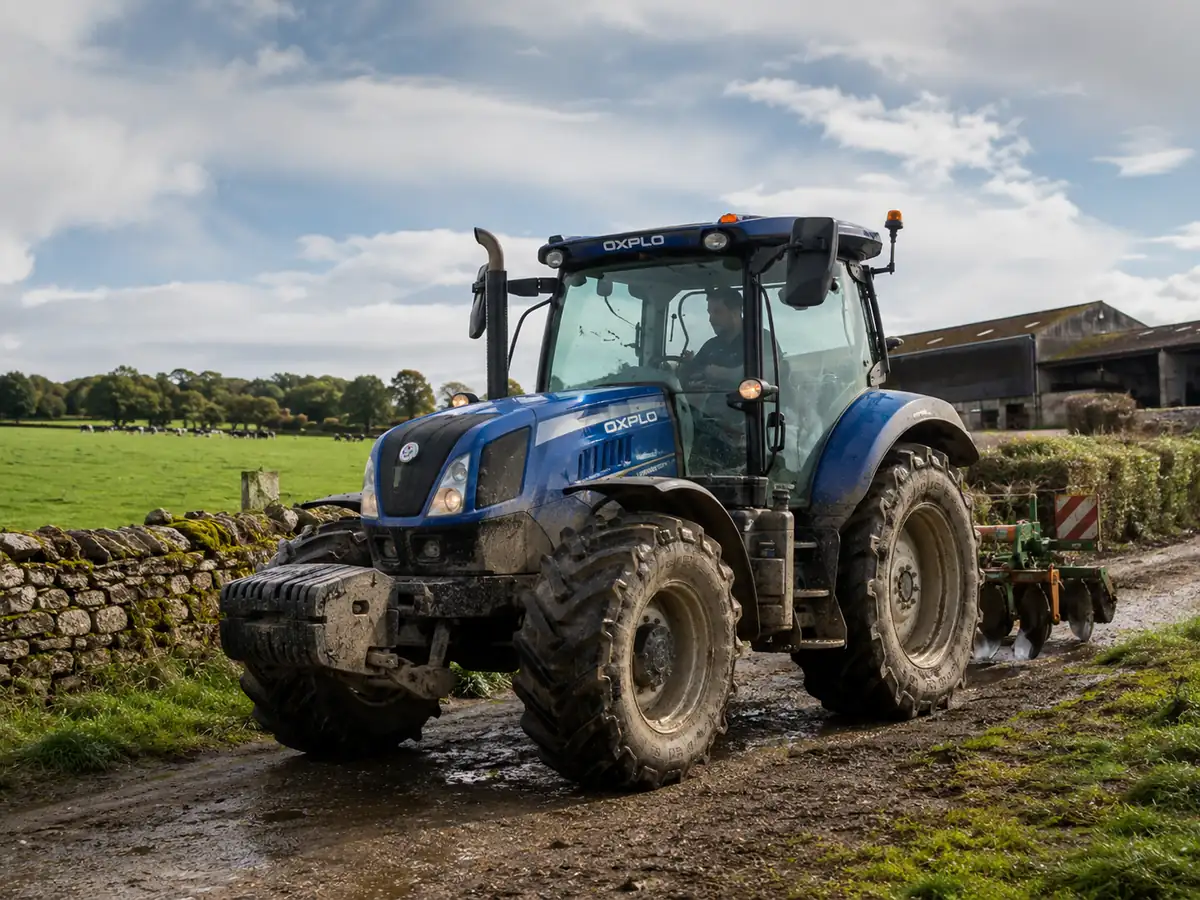
Buying a 4WD tractor for a small or medium farm sounds straightforward until you start matching the machine to real work. A 30 HP tractor can be perfectly adequate on one 15-hectare property and frustratingly undersized on another. A 70 HP tractor may save hours every week on a busy mixed farm, yet spend most of its life carrying unnecessary weight on a smaller livestock holding.
Farm size matters, but it is only the first filter. The more useful questions are what implements the tractor must run, how often it will work under load, whether loader work is part of the job, what the soil is like after rain, and how much room there is around gateways, barns and field headlands.
For light maintenance and compact-access work, 25-30 HP is often enough. Around 40-50 HP tends to suit small farms doing regular mowing, tillage and transport. Once the farm depends on larger implements, heavier loader work or high annual utilisation, 60-70 HP becomes easier to justify. The difficult part is deciding when a farm has actually crossed that line.
I. Why Small Farms Still Get 4WD Tractor Sizing Wrong
Most buyers who ask for a 4WD tractor have a sensible reason for doing so. Wet fields, loose cultivated soil, grassland, trailer work, loader operation and muddy farm tracks all create situations where front-axle drive can make a practical difference.
The buying process often goes wrong one step later. Once 4WD has been selected, attention moves immediately to engine horsepower: Is 40 HP enough? Should I pay a little more for 50 HP? Would 70 HP be safer so I never run out of power?
That line of thinking leaves several important variables unresolved. Engine output still has to travel through the transmission, axles and tyres before it becomes useful drawbar pull. If the tyres cannot transmit the available power to the ground, another 10 or 20 HP will not fix the problem.
Wheel slip illustrates the point. Agricultural tractors need some slip to develop traction, but excessive slip turns fuel into tyre spin instead of forward travel. Under many field conditions, operators aim to keep slip roughly in the high-single-digit to mid-teen range, then adjust ballast, tyre pressure and implement setup if it climbs well beyond that. The exact target depends on tyre type, soil condition and the tractor manufacturer’s recommendations.
Before assuming a tractor needs more horsepower, check the simpler causes: tyre pressure, ballast, implement draft, soil moisture and actual axle load. Quite often the engine is not the part that is short of capacity.
II. What 4WD Actually Changes in Farm Work
A 4WD system allows the front axle to contribute to propulsion rather than leaving most of the pulling work to the rear tyres. You notice the difference most when traction is limited.
A tractor mowing dry, level ground may not ask much from the front axle. Move that same tractor onto wet grass with a trailer behind it, or into recently cultivated soil with a tillage implement, and the value of additional driven wheels becomes much clearer.
For a small or medium farm, 4WD is particularly useful when the normal workload includes wet ground, loose soil, loader operation, grassland, farm tracks, slopes, trailer work or soil preparation. It is not automatically the highest-priority feature for every farm, however.
When 4WD May Not Be the Priority
Suppose a tractor spends almost all of its time mowing firm, level ground in dry conditions. Loader work is rare, pulling loads are modest and cultivation is limited. In that situation, the return on paying for additional traction capability may be smaller than it would be on a mixed farm that has to keep moving through a wet spring.
The calculation changes quickly once the tractor is expected to do several jobs. Loader work is a good example. Weight in the bucket increases demand on the front axle, while rear counterweight may be required to maintain a workable balance. A driven front axle becomes much more useful here than it is during light mowing.
There is also a safety boundary that should not be blurred. More traction does not change the basic stability limits of a tractor on a slope. Stability still depends on centre of gravity, track width, speed, terrain and the position of mounted equipment. Raising a loader raises the combined centre of gravity. 4WD can improve control and traction; it does not make an unstable operating position safe.
III. The Bigger Risk Is Often Buying Too Much Tractor
Under-sizing gets attention because the symptoms are obvious. The tractor struggles with an implement, working speed falls and the operator quickly realises the machine is too small. Over-sizing is harder to spot because the work still gets done. The cost appears elsewhere.
Extra Weight Follows the Tractor Everywhere
A heavier tractor can be useful when traction is required, but that weight remains on the machine during jobs that do not need it. On wet soil, higher axle loads increase the risk of deeper compaction. A 4WD chassis may distribute load more effectively than a comparable two-wheel-drive arrangement, but total machine weight still matters.
Tyre pressure matters as well. Running tyres harder than required reduces the contact patch and can worsen traction, ride quality and soil loading. Pressure should be matched to tyre specification, axle load and working speed rather than treated as a fixed number for every job.
Bigger Tractors Also Need More Room
Consider a livestock farm with narrow gateways, an older barn and several awkward headlands. Moving from a compact tractor to a larger utility chassis may provide more pulling capacity, but the operator now has to manoeuvre a longer and wider machine through the same buildings every day.
If every loader cycle requires another reverse manoeuvre, or one field becomes difficult to access, some of the theoretical productivity gain disappears. Before buying, measure the narrowest gate, barn entrance, working row, turning area and any height restriction the tractor will use regularly. Those measurements are free. Discovering the problem after delivery is not.
IV. Start With the Implements, Not the Tractor Brochure
A reliable selection process starts with the work already being done on the farm. List the five jobs that account for most annual tractor hours. On a mixed farm, that might be grass cutting, rotary tilling, fertiliser spreading, trailer transport and loader work.
Then identify the most demanding regular implement. The word regular matters. If a heavy cultivator is borrowed once every three years, it probably should not determine the specification of a tractor that will spend 500 hours a year mowing, transporting feed and working around livestock buildings.
PTO Horsepower Is Only the First Check
A mower or rotary tiller may appear compatible because its power requirement falls inside the tractor’s horsepower range. That is only the first check. The buyer still needs to confirm PTO speed, shaft type, linkage category, implement weight, hydraulic flow, hydraulic connections and physical clearance.
Three-point linkage deserves particular attention because the move from a compact Category I platform to a Category II utility tractor can affect the implement fleet a farm already owns. Replacing the tractor and then discovering that several existing implements need adaptation or replacement is exactly the sort of hidden cost that rarely appears in the original quotation.
Transmission Ratios Matter More Than Maximum Road Speed
Field work is sensitive to whether the gearbox offers a usable gear at the speed the implement actually needs. Rotary tilling, mowing and soil preparation may require the tractor to hold engine and PTO speed while travelling at a narrow range of ground speeds. If one gear is too slow and the next is too fast, the operator spends the season working around the transmission.
For relatively straightforward work, an 8F + 8R gearbox can be entirely adequate. As the tractor takes on more jobs and conditions vary, additional ratios become more useful. This is one reason the transition from a compact tractor to a larger utility platform should not be judged from horsepower alone.
V. A Practical Horsepower Guide for Small and Medium Farms
Acreage is useful as a starting filter, but it should never be the final sizing rule. A 15-hectare vineyard running a mower and sprayer has a very different power requirement from a 15-hectare mixed farm moving feed, cultivating ground and handling trailers. A more useful starting framework is shown below.
Farm Profile | Typical Work | Practical Starting Range | Main Reason | What to Check |
Smallholding / estate | Mowing, light transport, property maintenance | 25-30 HP | Compact size and lower utilisation | Access, Category I implements |
Small mixed farm | Mowing, tilling, spreading, trailer work | Around 40 HP | Useful balance of size and capacity | PTO demand and implement weight |
Busy livestock / grassland farm | Mowing, feed work, transport, regular PTO use | 50-60 HP | Higher annual workload | Loader needs and chassis size |
Medium mixed farm | Cultivation, larger implements, transport, loader work | 60-70 HP | Greater implement and workload capacity | Category II compatibility |
Contractor / multi-purpose operation | Several seasonal jobs and high utilisation | Around 70 HP or application-specific | Productive hours matter more than minimum size | Duty cycle and implement fleet |
25-30 HP: Best When Access Is the Constraint
This range suits properties where the tractor spends much of its time mowing, maintaining paddocks, performing light cultivation or moving small trailers. The main advantage is manoeuvrability. There is little business case for carrying a larger chassis around all year if the farm does not have regular work for it.
Around 40 HP: The Useful Middle Ground
A 40 HP 4WD tractor begins to make more sense when mowing and cultivation are regular rather than occasional. For many small mixed farms, this is enough power to handle useful implements while keeping the machine manageable around buildings and smaller fields.
Around 50 HP: More Output Without Necessarily Going Bigger
A 50 HP tractor becomes interesting where seasonal workloads are increasing but compact dimensions still matter. That could mean longer mowing days, more regular PTO operation, heavier transport or repeated grassland work. The critical question is whether the farm needs more engine capacity or a larger tractor platform. Those are different purchases.
60-70 HP: When the Chassis Needs to Grow With the Work
Once Category II implements, heavier loader work, more transport and higher annual utilisation enter the picture, a larger utility tractor begins to earn its size. At this point, wheelbase, operating weight, tyre size, gearbox ratios and linkage category matter at least as much as the difference between 60 HP and 70 HP.
VI. Three Farm Scenarios That Show Why Horsepower Alone Is Misleading
Scenario A: A 12-Hectare Livestock Farm
The tractor cuts pasture, moves feed, pulls a small trailer and occasionally uses a front loader. The owner is considering 70 HP because he does not want to buy twice.
That may be unnecessary. If the existing implements are Category I, gates and livestock buildings are relatively tight, and loader work is moderate, a 40-50 HP tractor could spend a larger percentage of its operating hours doing work that actually uses its capacity. The bigger tractor would still work, but it may not earn its additional size and capital cost.
Scenario B: A 30-Hectare Mixed Farm
This tractor will mow grass, run a rotary tiller, pull trailers, move materials and work for several hundred hours each year. Here the argument for 50-60 HP is much stronger.
If the farm still relies on Category I implements and access is tight, a higher-output compact machine may remain the better fit. If the implement fleet is moving toward Category II, loader work is becoming routine and soil preparation is getting heavier, stepping into a 60 HP utility platform is usually the cleaner long-term decision.
Scenario C: A 45-Hectare Mixed Farm Using One Main Tractor
Now one machine is expected to cover field preparation, mowing, trailer transport, material handling and seasonal livestock work. Annual utilisation is high enough that slow field capacity and downtime become expensive.
A 60-70 HP utility tractor starts to make more sense because the farm is using the larger chassis, implement compatibility and broader working range rather than simply paying for unused horsepower. The justification comes from workload and equipment utilisation, not acreage by itself.
VII. Where OXPLO Draws the Line Between Compact and Utility Tractors
The current OXPLO tractor range covers six 4WD power options from 25 HP to 70 HP: OXT254, OXT304, OXT404, OXT504, OXT604 and OXT704. For buyers, however, it is more useful to view the OXPLO range as two platform groups rather than six isolated horsepower numbers.
OXPLO OXT254 and OXT304: Keep the Tractor Small When the Work Is Small
The OXPLO OXT254 and OXPLO OXT304 sit at the compact end of the range. Both use 4WD, an 8F + 8R transmission and Category I rear linkage, with a published overall width of 1,560 mm. They are a logical fit where mowing, light cultivation, small trailers and property maintenance account for most operating hours.
For OXPLO buyers with genuinely light workloads, moving to a larger machine simply because it is available usually adds cost and bulk without adding enough productive hours to justify the change.
OXPLO OXT404: A Practical Small-Farm Workhorse
The OXPLO OXT404 brings the compact-platform idea to 40 HP. Its published specification retains 4WD, 8F + 8R transmission, Category I linkage and a 1,560 mm overall width. That combination is useful for farms that have moved beyond occasional maintenance but still value manoeuvrability.
For routine mowing, soil preparation, spreading and transport, OXPLO would normally treat 40 HP as a serious starting point rather than automatically pushing a buyer into a larger utility chassis.
OXPLO OXT504: More Power Without Immediately Moving to a Larger Chassis
The OXPLO OXT504 is one of the more interesting points in the range because it delivers 50 HP while retaining the compact platform’s published 1,560 mm width, 1,800 mm wheelbase, Category I linkage and 8F + 8R transmission.
For a farm that needs more PTO and engine capacity but still has compact buildings, gateways and Category I implements, this is a very different proposition from simply buying a physically larger tractor. The value of the OXT504 lies in power density within the compact OXPLO chassis, not in the number 50 by itself.
OXPLO OXT604: The More Important Step Is Category I to Category II
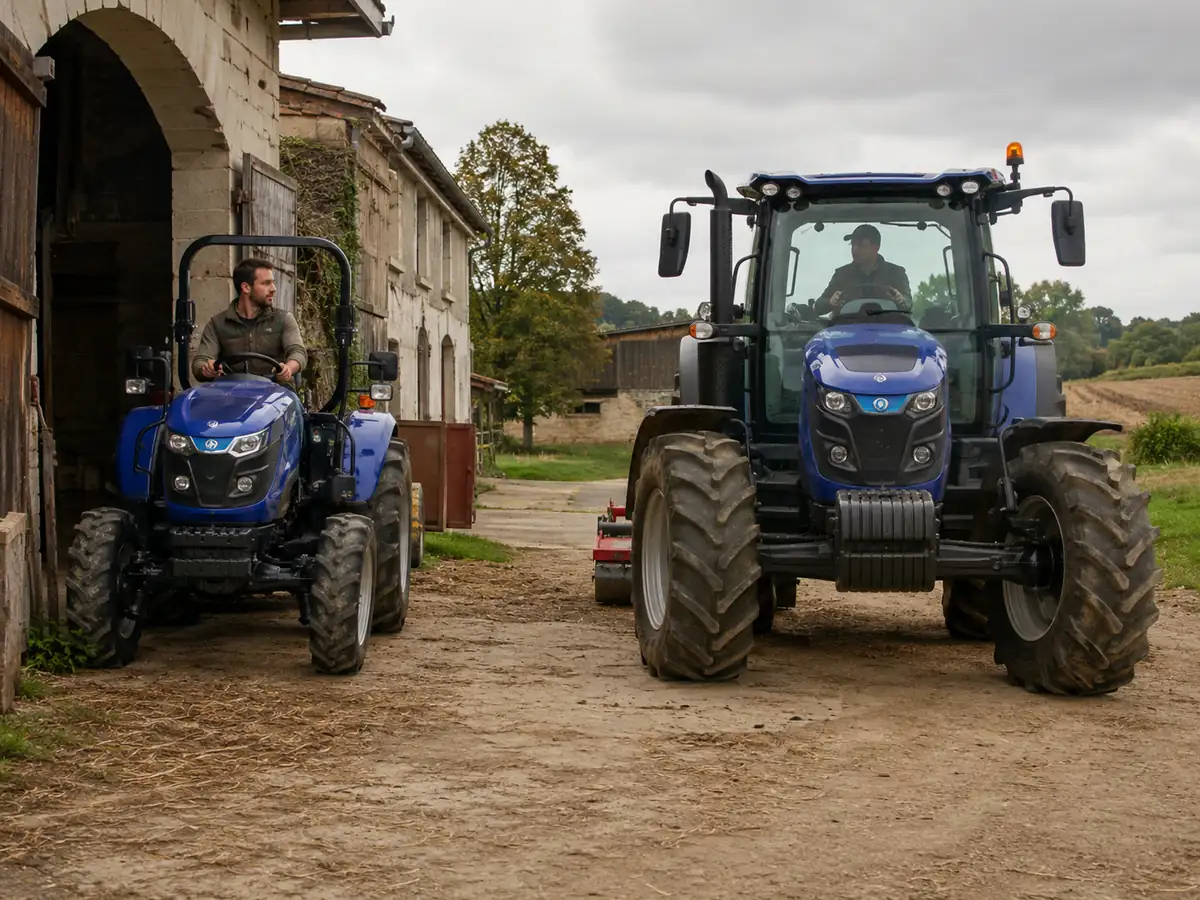
The OXPLO OXT604 is rated at 60 HP, but the extra ten horsepower tells only part of the story. It moves to a 2,010 mm wheelbase, approximately 1,760 mm overall width, 12F + 12R transmission and Category II rear linkage, with a published listed weight of about 2,500 kg.
For many buyers, this is the real threshold in the OXPLO range. A farm moving from OXT504 to OXT604 is not merely purchasing another 10 HP; it is moving from a compact Category I platform to a larger Category II utility platform.
Specification | OXPLO OXT504 | OXPLO OXT604 |
Rated Power | 50 HP | 60 HP |
Overall Width | 1,560 mm | 1,760 mm |
Wheelbase | 1,800 mm | 2,010 mm |
Transmission | 8F + 8R | 12F + 12R |
Rear Linkage | Category I | Category II |
Platform Logic | Higher-output compact | Mid-size utility |
OXPLO OXT704: When One Tractor Has to Cover Several Jobs
The OXPLO OXT704 stays on the larger Category II platform and raises rated output to 70 HP. Its current published configuration includes 12F + 12R transmission, a 2,010 mm wheelbase and 1,760 mm listed overall width.
OXPLO positions this tractor for operations where one machine has to work across several parts of the farm: cultivation in one season, mowing in another, trailer transport, loader support and general utility work in between. On a farm that only needs light mowing and occasional transport, much of that capacity may sit idle. On a busy mixed farm, the same OXPLO tractor can accumulate productive hours across far more of the year.
VIII. Think in Cost per Productive Hour, Not Purchase Price Alone
The cheapest tractor on quotation day is not always the cheapest tractor to own. A more useful management measure is annual ownership and operating cost divided by productive working hours.
Ownership cost includes depreciation and financing. Operating cost includes fuel, scheduled maintenance, wear parts, tyres, attachments and downtime. A smaller tractor may save money at purchase but take noticeably longer to complete every mowing, tillage and transport job. If that difference repeats for several hundred hours each year, the initial saving becomes less important.
The reverse is also true. A larger tractor purchased ‘for the future’ but used only 120 hours a year carries a lot of capital cost through relatively few productive hours. OXPLO therefore recommends estimating annual working hours and the share of those hours that genuinely require the selected horsepower and chassis class before finalising a configuration.
A correctly sized 4WD tractor should spend a high percentage of its life doing work that actually benefits from its power, traction and implement capacity. That is a much better indicator of value than purchase price alone.
IX. What to Confirm Before Requesting a Tractor Quotation
A supplier can only recommend a useful configuration if the buyer provides useful operating information. Before asking OXPLO – or any tractor supplier – for a final quotation, prepare the following details.
Farm and Access
- Farm type and approximate working area
- Narrowest gate, road, row spacing and building entrance
- Presence of slopes, wet ground, loose soil or muddy tracks
- Any height restriction around barns, orchards or storage buildings
Workload
- The five most frequent tractor jobs
- Estimated annual tractor hours
- Heaviest regular implement rather than the heaviest implement used occasionally
- Expected loader, trailer and transport workload
Implement Compatibility
- Category I or Category II three-point linkage requirement
- PTO speed and shaft requirement
- Implement weight and centre-of-gravity considerations
- Hydraulic flow, valve and connection requirements
Destination-Market Configuration
- Engine emissions requirement
- Operator protection, lighting and braking requirements
- Road-use or registration requirements where applicable
- Required conformity and commercial documentation
For OXPLO customers, the quickest starting point is the 25-70 HP tractor configuration page. Buyers who already know the intended implement can also review the OXPLO attachments and support page before requesting a matched tractor-and-implement quotation.
X. FAQ
Q1. Is a 4WD tractor worth it for a small farm?
Usually, if the tractor regularly works on wet grass, loose soil, slopes, farm tracks, with a front loader or under meaningful pulling load. For mostly light work on firm, level ground, the financial benefit can be smaller.
Q2. Is 40 HP enough for a small farm?
For many small farms, yes. Around 40 HP can be a practical choice for mowing, spreading, light-to-medium soil preparation and trailer work. The answer still depends on implement requirements and annual hours rather than acreage alone.
Q3. Is a 50 HP tractor enough for 20 hectares?
It can be. Twenty hectares of grassland, vineyard or mixed farming can create very different workloads. Check the heaviest regular implement, annual working hours, terrain and loader requirement before choosing.
Q4. What is the practical difference between a 50 HP and 60 HP tractor?
Sometimes the difference is mainly engine output; sometimes it marks a change in chassis class. In the current OXPLO range, OXT504 uses a compact Category I platform, while OXT604 moves to a larger Category II platform with a longer wheelbase and 12F + 12R transmission. That platform change is often more important than the ten-horsepower gap.
Q5. Is a 70 HP tractor too large for a small farm?
It can be. If annual hours are low and the farm mainly performs light Category I work, much of the tractor capacity may never be used. If the same farm performs heavier loader work, transport, cultivation or contract work, a 70 HP tractor can still be justified.
Q6. Does 4WD reduce tractor wheel slip?
4WD can improve available traction by allowing the front axle to contribute to pulling effort, particularly on loose or slippery ground. Wheel slip still depends on tyre pressure, ballast, soil condition, machine weight and implement draft, so 4WD is not a substitute for correct tractor setup.
Q7. Which OXPLO 4WD tractor should I choose?
OXT254 and OXT304 suit lighter compact work; OXT404 is a balanced small-farm option; OXT504 provides more output while retaining the compact Category I platform; OXT604 moves into the larger Category II utility class; and OXT704 is better suited to farms that need one tractor to cover a wider range of recurring jobs. Final selection should be based on implements, access, annual hours and destination-market requirements.
XI. Conclusion: Choose the Tractor Class Before You Choose the Horsepower
The most useful tractor specification is rarely the largest number on the brochure. A small farm that values access and uses Category I implements may be better served by a 30-50 HP compact 4WD tractor than by a larger 70 HP machine. A busier mixed farm may eventually reach the point where continuing to use a compact tractor costs more in working time and implement limitations than moving to a 60-70 HP utility platform.
That threshold is what a buyer should identify before ordering. OXPLO’s current 25-50 HP models cover the compact side of the decision, while the OXPLO OXT604 and OXT704 move into the larger Category II utility platform.
When OXPLO reviews a tractor enquiry, the most useful information is not simply acreage. Farm type, primary implements, annual working hours, terrain, narrowest access point, loader requirement and destination market all affect the recommendation. With those details, it becomes much easier to decide whether the job belongs with an OXT254, OXT304, OXT404, OXT504, OXT604 or OXT704.
Sometimes the correct recommendation will be the smaller OXPLO tractor. That is not a compromise. A tractor that fits the workload, implements and access constraints will usually create more value over its working life than one selected because it looks stronger on a specification sheet.
Explore the full OXPLO tractor range, review configurable farm applications on the OXPLO tractor solutions page, or visit the OXPLO website to discuss a tractor configuration for your farm.