
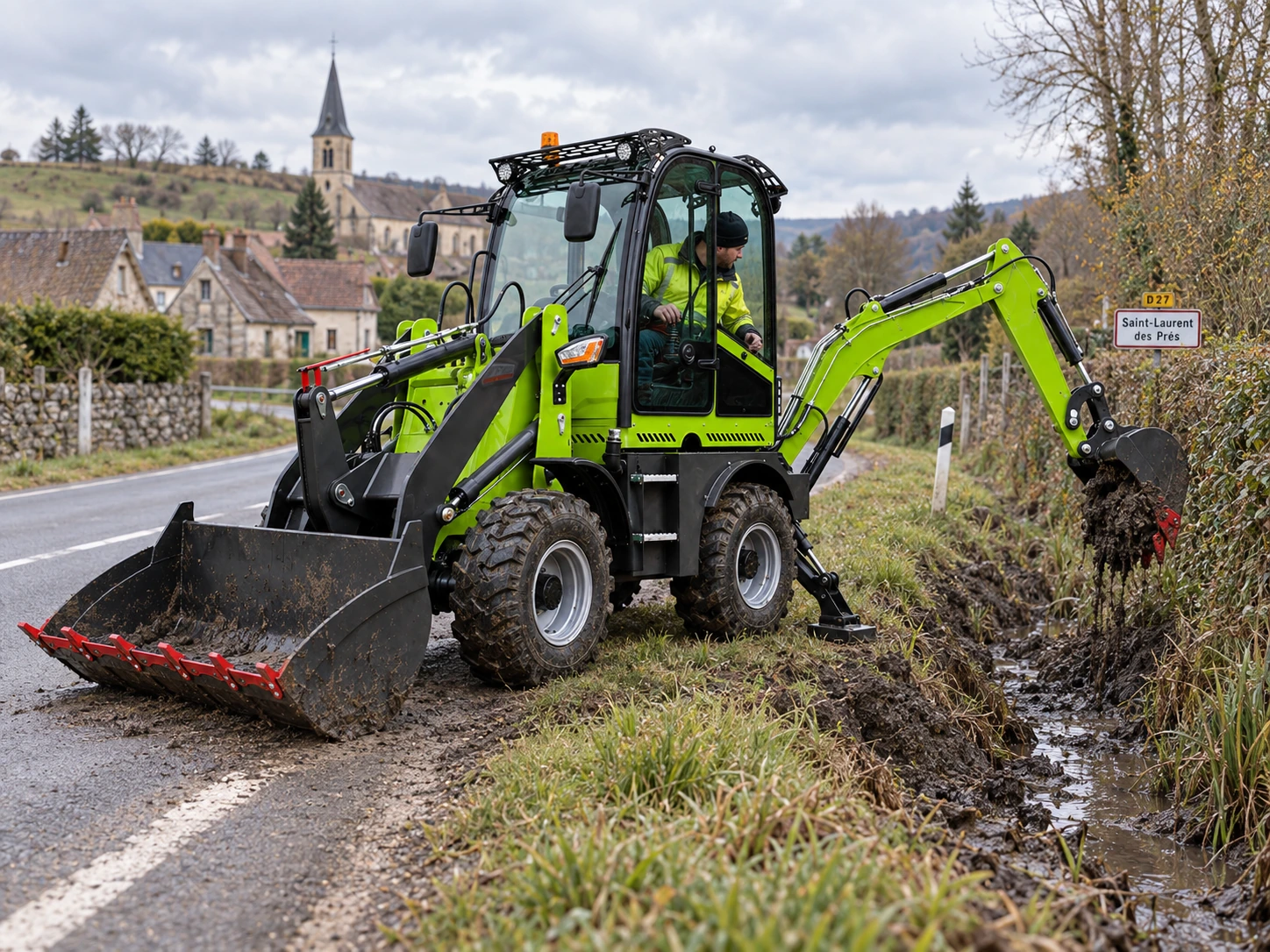
Rural road maintenance rarely becomes expensive because a contractor cannot excavate soil. It becomes expensive because the work is fragmented.
A crew may clean a blocked ditch in the morning, replace a culvert 2 km away before lunch, load gravel in the afternoon, then repair a washed-out shoulder before leaving the area. None of those jobs is necessarily large. The cost comes from moving equipment, changing machines, waiting for the right attachment and handling the same material twice.
That is why selecting a wheeled backhoe loader should begin with the work sequence, not with engine power or the largest number in a brochure. For dispersed rural jobs, the machine has to connect digging, loading, backfilling, material handling and short-distance repositioning into one practical workflow.
The central buying question |
I. Why Rural Road Work Consumes More Time Than It Appears
A rural road project is often a chain of small interventions rather than one continuous earthmoving operation. The machine may spend part of the day digging and a surprisingly large part of the day repositioning, loading spoil, shaping shoulders, clearing access and waiting for another machine.
The real work cycle is not “digging”
A more realistic cycle is: inspect → excavate → remove spoil → bring in aggregate → backfill → grade → reposition. When every stage requires a different machine, mobilisation and idle time accumulate even if each machine is highly productive at its specialist task.
This is where a backhoe loader for road maintenance can make economic sense. Its advantage is not that it out-digs a dedicated excavator or out-loads a dedicated wheel loader. Its advantage appears when one machine can finish a sequence of moderate tasks before moving on.
Small jobs can carry high mobilisation cost
Consider a day consisting of 300 m of ditch cleaning, one culvert replacement, a short gravel repair and several shoulder washouts. Bringing a mini excavator, a loader, a trailer and two operators may deliver excellent peak production. But if the sites are scattered and each intervention is short, transport, loading/unloading and waiting can consume the margin.
This is why the economics of a wheeled backhoe loader generally improve as task variety and site dispersion increase. When the job becomes one long, high-volume excavation, the balance shifts back toward specialist equipment.
II. Start With Drainage Function, Not Machine Specifications
For rural roads, water management is often the first engineering question. A road can tolerate traffic better than it can tolerate uncontrolled water. Blocked side ditches, damaged outlets and undersized or obstructed culverts allow water to saturate shoulders and subgrade, accelerating rutting, erosion and edge failure.
So when buyers evaluate drainage equipment, “maximum digging depth” should not be the first and only filter. The machine must create or restore a continuous drainage path while working within the road width, soil condition and access limitations.
Four common drainage jobs require different priorities
- Existing ditch cleaning: low-speed control, a suitable bucket width, reach, visibility and the ability to remove wet spoil without destroying the ditch profile.
- New side-ditch excavation: usable digging geometry, trench width, slope control, working stability and enough reach to reduce constant machine repositioning.
- Culvert installation or replacement: excavation, bedding preparation, pipe placement, backfilling and final road-surface restoration—often within a very small work area.
- Post-storm repair: rapid response to blocked outlets, local washouts, shoulder erosion and debris, followed by quick movement to the next damaged point.
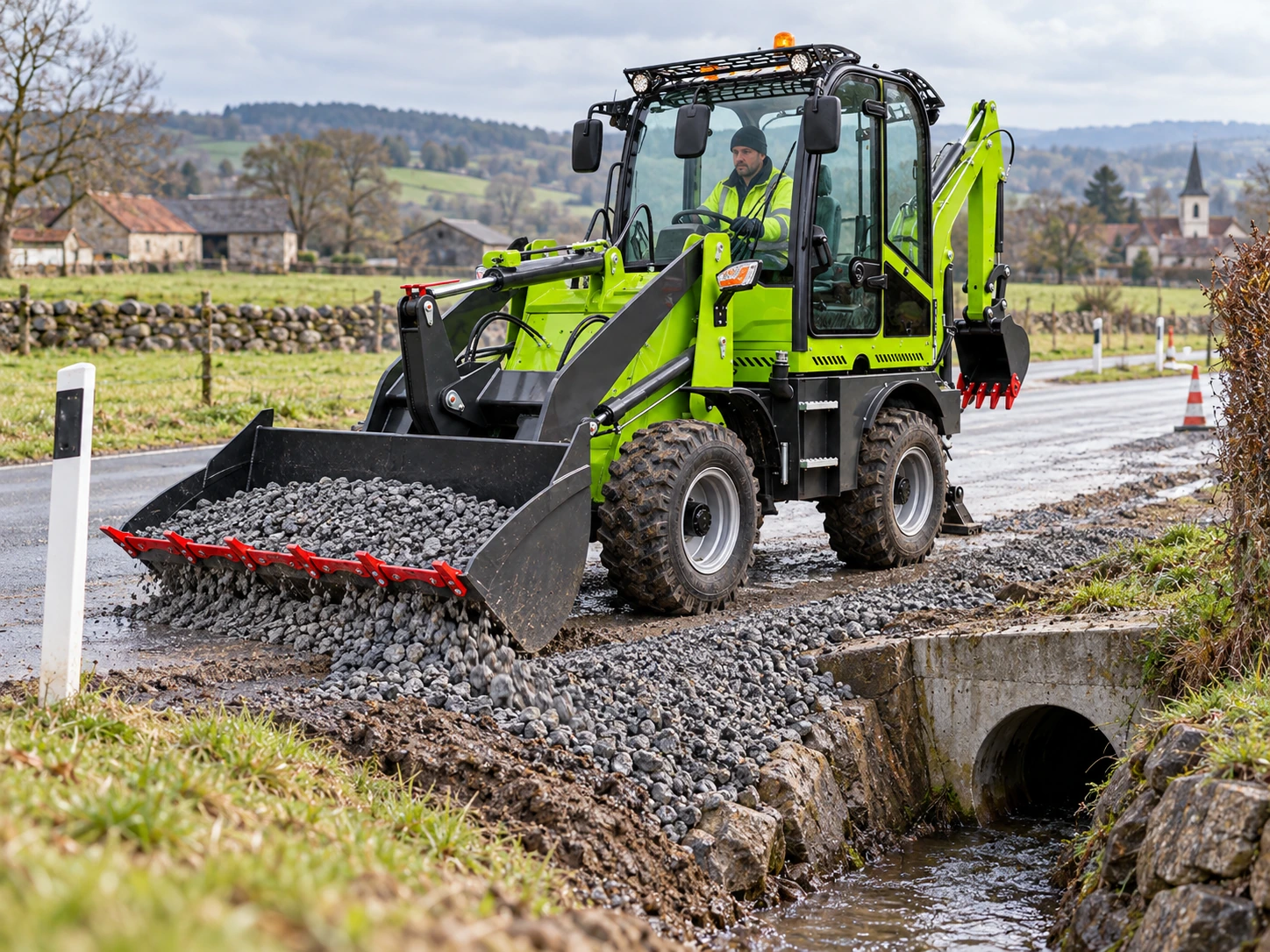
Culvert work is a good test of machine versatility because excavation, pipe handling, backfilling and surface restoration happen in one compact work zone.
Do not confuse maximum depth with productive depth
A machine may technically reach the required depth and still be a poor daily choice. When an operator works near the geometric limit of the backhoe, bucket angle, breakout position, clean-up control and cycle time can deteriorate. Frequent repositioning then removes the apparent advantage of the specification.
A useful rule is to treat maximum digging depth as a boundary, not as the preferred continuous operating point. If most projects demand deep utilities, major drainage structures or sustained excavation near the machine’s limit, a dedicated excavator should be evaluated instead.
III. The Hidden Costs Buyers Often Miss
1. Over-excavation
The wrong bucket width can quietly add cost to every metre of trench. If a ditch or utility trench only needs a narrow bottom, a much wider bucket removes more material than the design requires. The crew then has more spoil to handle, more aggregate or soil to replace and a larger area to compact and restore.
For this reason, rear-bucket width can matter more than nominal bucket capacity on drainage work. Ask what widths are available, how quickly buckets can be changed and whether the chosen width matches your most common trench profile.
2. Double handling
A common inefficient sequence is: excavate spoil → place it on the road edge → return later with a loader → load it into a truck. The soil has been handled twice before leaving the site.
Where site geometry permits, the better target is to connect excavation and material handling so spoil is removed or reused once. This is one reason a loader bucket on the same chassis can be valuable on small drainage jobs.
3. Road-edge and shoulder damage
Machine size is not only a transport issue. On narrow roads, excessive width, poor manoeuvrability or repeated turning can damage shoulders, verges and recently restored areas. The cost of repairing damage created by the equipment itself is rarely shown in the purchase price.
4. Downtime and parts delay
Low purchase price is not the same as low total cost of ownership. Hydraulic hoses, seals, filters, pins, bushings, brakes and wear parts are ordinary service items. If routine components are difficult to identify or slow to supply, a small failure can remove the machine from a time-sensitive road-maintenance schedule.
TCO reminder |
IV. Eight Specifications That Actually Affect Rural Productivity
A useful specification sheet should be read as a set of operational questions. The table below translates the usual numbers into field decisions.
Specification | What it controls on site | What buyers often miss |
Digging depth & radius | Trench reach and how often the machine must reposition | Maximum reach is not the same as comfortable continuous working geometry |
Rear bucket width | Actual trench section and spoil volume | A wider bucket can create avoidable excavation and backfill cost |
Loader bucket capacity | Material handling per cycle | Capacity matters only if the site has space to manoeuvre and dump |
Dump height & reach | Whether spoil or aggregate can be placed directly into the intended truck/trailer | Truck-body height is often never checked before purchase |
Overall width | Access through narrow lanes, gates and roadworks | A compact machine can reduce the need to widen the work zone |
Turning radius & steering | Repositioning in confined work areas | Repeated three-point moves consume time and damage verges |
4WD, tyres & clearance | Traction on unpaved, soft or uneven sites | 4WD improves capability but does not eliminate ground-pressure or tyre limitations |
Travel speed | Movement between nearby work points | Top speed is a productivity metric; it is not automatic public-road approval |
Mobility is a production parameter
For dispersed road maintenance, productive time can be expressed more usefully as: shift time minus repositioning, waiting, attachment changes, refuelling/service and unplanned downtime. A machine that is slightly less productive during pure excavation can still complete more work points per day if it dramatically reduces non-productive time.
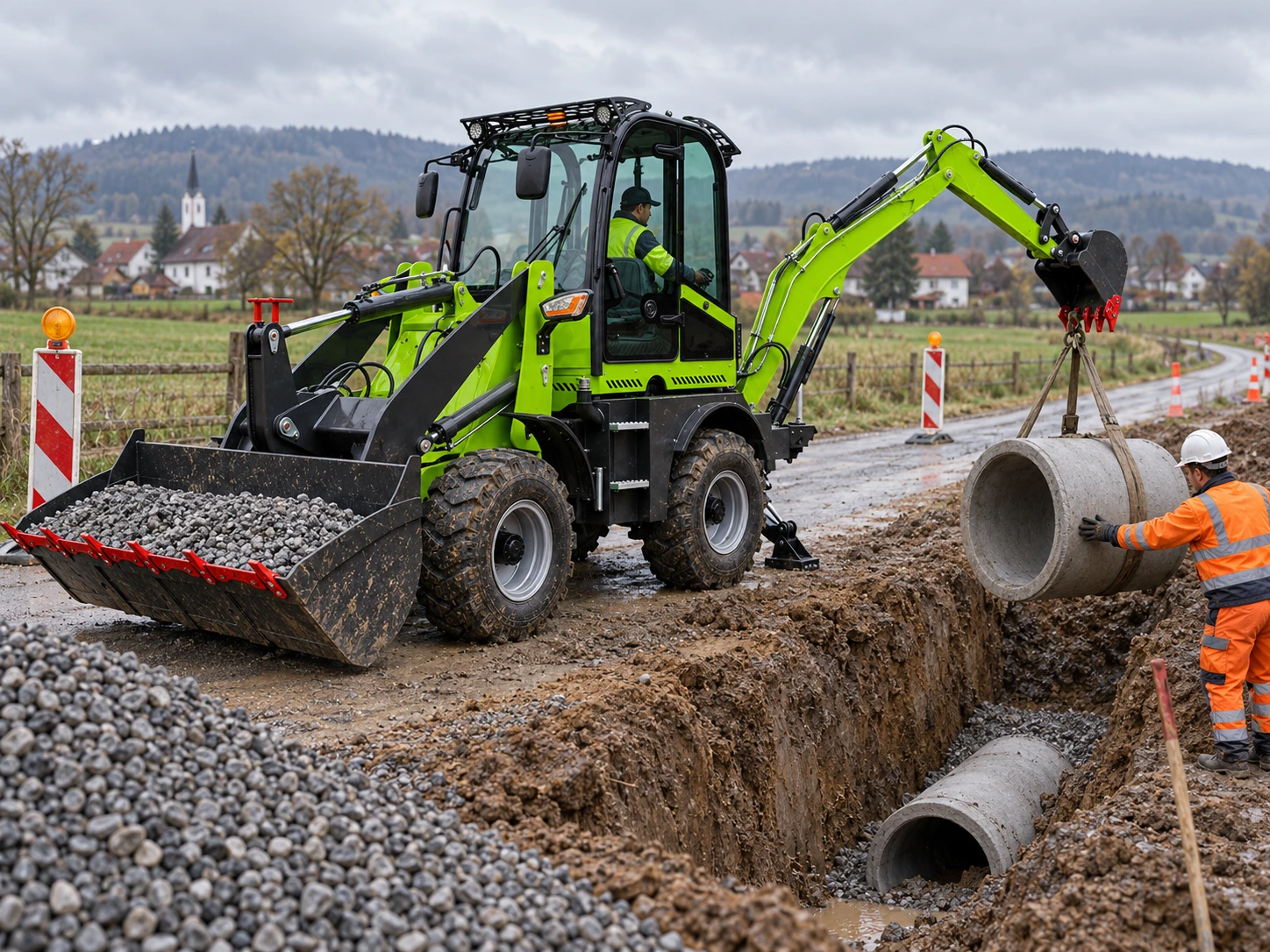
Short-distance repositioning is part of the production cycle on dispersed rural road work. Always distinguish site mobility from legal public-road use.
V. Build the Work Sequence Before You Buy the Machine
The best equipment selection starts with the workflow. Map the day before comparing brands.
Step 1: Inspect the drainage path before excavating
Record where water enters the road, where it should leave, where sediment has accumulated and whether the true blockage is at a culvert inlet or outlet. Standing water is the symptom; the cause may be tens of metres away.
Step 2: Define the required cross-section
Specify trench depth, bottom width, side slope and outlet level before selecting the bucket. The machine should reproduce the required drainage geometry with as little over-excavation as practical.
Step 3: Decide where every bucket of material goes
Excavated mud left beside a ditch can wash straight back into the drainage system. Decide whether spoil will be loaded out, spread, reused or stockpiled—and whether the machine can execute that material flow without calling another loader.
Step 4: Restore the shoulder and surface
The drainage repair is not finished when the trench is open. Backfill around culverts, reinstate aggregate, recover the shoulder profile and leave the water path stable. A machine that can switch from rear excavation to front loading and grading helps close this loop.
Step 5: Move to the next point with minimum reset time
Measure the average distance between work points. If most moves are short and occur on private lanes, worksites or local access routes, mobility can materially change daily output. If long public-road transfers are routine, transport and registration requirements become a separate procurement issue.
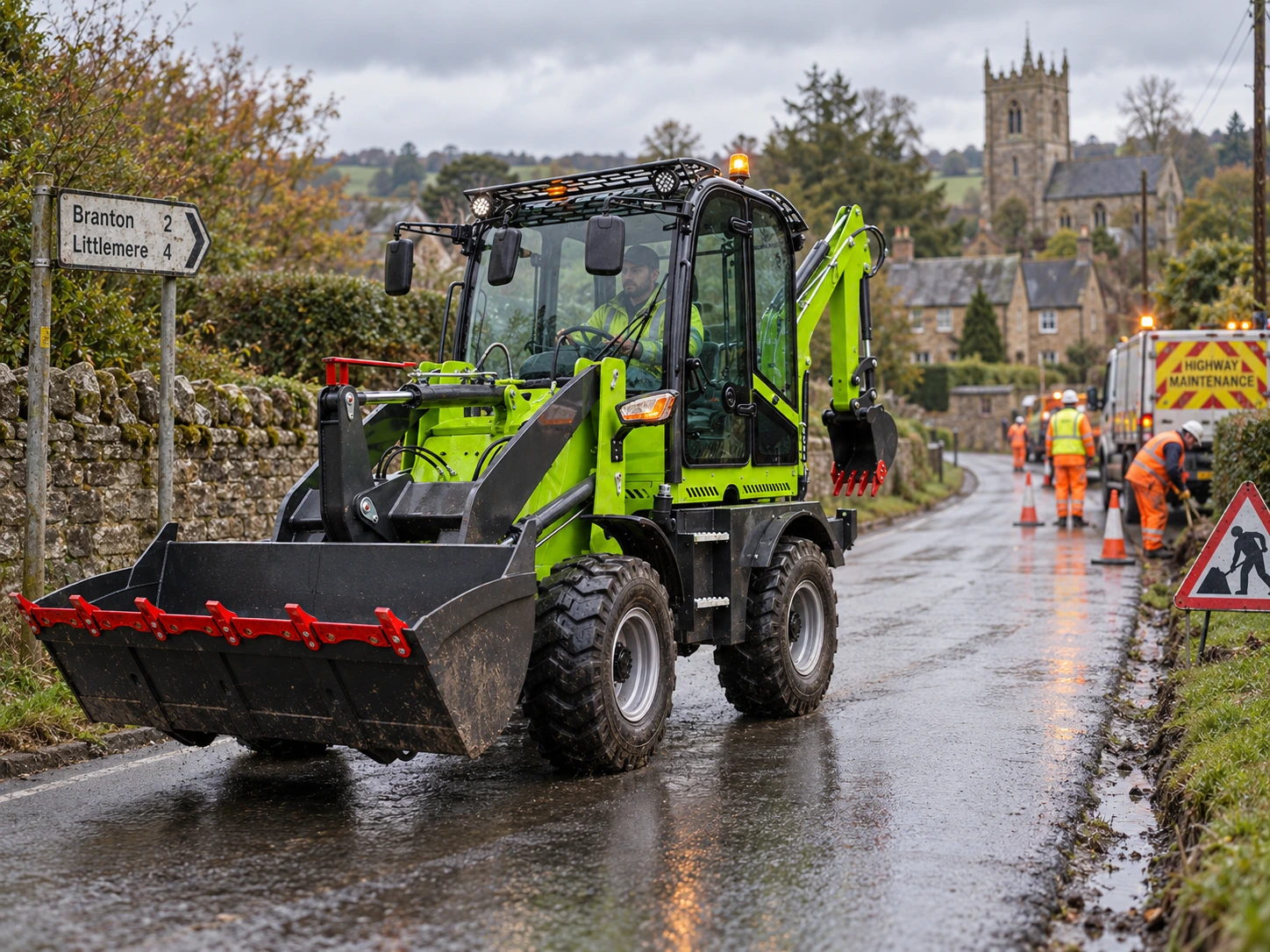
The productive value of a multi-purpose machine appears when excavation is followed immediately by aggregate handling, backfill and shoulder restoration.
VI. Wheeled Backhoe Loader vs Mini Excavator + Loader: Use the Job Mix
There is no universal winner. The right choice depends on how concentrated the work is and how often the task changes.
Job pattern | Wheeled backhoe loader tends to fit | Specialist machine combination tends to fit |
Many small jobs across several locations | Strong fit: fewer machine changes and mobilisation events | Often under-utilised between short tasks |
Ditch cleaning + loading + backfill in one day | Strong fit: front and rear functions close the work loop | Higher peak output but more coordination |
Continuous deep trenching | Possible only within machine limits | Usually stronger fit for a dedicated excavator |
High-volume loading for most of the shift | Useful but not optimal | Wheel loader usually offers better sustained loading productivity |
Confined rural lanes and farm access | Compact models can be practical | Two machines need more working and parking space |
Rock excavation / heavy demolition | Attachment dependent and limited by machine class | Specialist excavator is usually more suitable |
A compact backhoe loader is therefore most defensible when the project is defined by task switching. As the job becomes more repetitive, deeper, harder or higher-volume, specialist equipment becomes easier to justify.
VII. What European Buyers Should Verify Before Ordering
European procurement adds another layer: the machine must match not only the work, but also the destination market. Do not reduce this check to one question—“Does it have CE?” The exact machine, engine, options and intended use matter.
Machinery documentation
Machinery placed on the EU market before 20 January 2027 remains subject to the current machinery framework, while Regulation (EU) 2023/1230 applies from 20 January 2027. Buyers should confirm the conformity documentation for the exact configuration and destination country rather than assuming that documentation for another model or engine applies. See the European Commission machinery guidance and the EUR-Lex text of Regulation (EU) 2023/1230.
Engine emissions
Internal-combustion engines installed in non-road mobile machinery are covered by EU emissions/type-approval rules under Regulation (EU) 2016/1628. Ask which engine is installed in the quoted machine and what engine documentation accompanies that exact unit. See Regulation (EU) 2016/1628 on EUR-Lex.
Public-road movement
A wheeled machine with a stated travel speed should not automatically be treated as road-legal. Registration, lighting, braking, insurance and road-use requirements can vary by country and machine status. If public-road travel is part of the duty cycle, confirm local requirements before ordering and do not use top speed as a substitute for legal approval.
Service and parts
Ask for the spare-parts process before the first failure occurs: model/serial identification, recommended service parts, hydraulic and filter references, response channel, warranty evidence required and typical shipping arrangement. These questions are not after-sales details; they are part of the machine’s economic specification.
VIII. Where the OXPLO OX18-25 Fits in This Work
Only after the duty cycle is clear does it make sense to look at a specific machine. The current OXPLO OX18-25 wheeled backhoe loader is a 3,400 kg compact machine positioned for combined loading, digging, material handling and light construction work.
The full specification table is available on the OXPLO OX18-25 product page. The points below translate those specifications into job-site meaning rather than simply repeating the brochure.
OX18-25 specification | What it means for rural road & drainage work |
3,400 kg operating weight | Compact enough to consider for dispersed light works, while still carrying both loader and backhoe functions on one chassis. |
1,680 mm overall width | Relevant for narrow farm lanes, gateways, village access and road-edge work where working width is limited. |
2,310 mm minimum turning radius | Helps reduce repeated multi-point manoeuvres when the machine must reposition in confined rural work zones. |
2,350 mm maximum digging depth / 3,500 mm radius | Useful for many roadside ditches, shallow utility trenches and small culvert jobs, but not a reason to force the machine into sustained deep excavation. |
420 mm rear bucket / 0.12 m³ capacity | A relatively narrow standard bucket can suit controlled trench work where avoiding excessive excavation matters. |
0.6 m³ front loader bucket | Allows the same OXPLO machine to remove spoil, handle gravel, backfill and support road-shoulder restoration after digging. |
3,200 mm maximum dump height / 800 mm dump distance | Should be checked against the customer’s actual trailer or tipper geometry if direct loading is part of the workflow. |
Four-wheel drive / 260 mm ground clearance | Supports work on unpaved and uneven access routes, while tyre choice and ground conditions still need to be assessed. |
25 km/h maximum travel speed | Useful for repositioning between nearby work points; OXPLO buyers should separately verify public-road requirements in the destination country. |
42 kW engine / hydraulic power-shift transmission | The relevant question is whether the powertrain supports the customer’s combined digging, loading and travel duty cycle—not the engine number in isolation. |
What problem is OXPLO actually solving here?
For the right customer, the OXPLO OX18-25 is not primarily a “cheaper excavator.” Its value proposition is the ability to connect multiple moderate tasks on one compact wheeled platform: dig a ditch, clear the spoil, bring aggregate, backfill, reshape the work area and then reposition to another small site.
That makes the OXPLO configuration most relevant to contractors, rural estates, farms and local maintenance teams whose daily workload is mixed rather than dominated by one high-output earthmoving task.
It is equally important to state the boundary. OXPLO should not position the OX18-25 as a substitute for a dedicated excavator on deep, continuous trenching, major earthworks, hard-rock excavation or sustained heavy loading. Being clear about that boundary makes the recommendation more useful and reduces the risk of selling the wrong machine into the wrong duty cycle.
IX. Attachments, Utilisation and Long-Term Support
Attachment strategy matters because many buyers are not trying to maximise hourly digging output; they are trying to keep one machine useful across more months of the year.
The current OXPLO Support page lists wheeled backhoe loader attachments including 4-in-1 and 6-in-1 buckets, a tilting bucket, auger, hydraulic breaker, loader- and excavator-end quick couplers, pallet forks, sweeper, snow brush and snow pusher. Final compatibility should be confirmed for the exact machine configuration.
Think in utilisation seasons, not attachment counts
- Spring: ditch cleaning, culvert maintenance, wet-ground repairs and property drainage.
- Summer: trenching, gravel handling, farm-road improvement, landscaping and light construction.
- Autumn: drainage preparation, shoulder repair, material handling and property maintenance.
- Winter: selected snow-management attachments where the machine and local operating conditions are suitable.
The useful procurement question is therefore not “How many attachments can OXPLO sell me?” It is “Which two or three attachments remove another machine from my normal job mix and increase annual utilisation enough to justify their cost?”
Service process should be part of the quotation
OXPLO states that its support covers attachments, replacement parts, warranty information and technical guidance. Buyers should still turn that promise into a practical process: confirm the machine model and serial-number method, service intervals, recommended wear parts, warranty evidence, parts ordering channel and the information needed when a fault occurs.
For broader company and market documentation information, see OXPLO About Us. For the wider equipment range, see OXPLO Products or return to the OXPLO homepage.
X. Before Requesting a Quote: Give the Supplier the Work Conditions
A useful quotation cannot be built from “Please send your best price for a wheeled backhoe loader.” For OXPLO—or any supplier—to recommend the right configuration, the buyer should provide the engineering context.
- Destination country and whether the machine must travel on public roads.
- Typical trench depth, bottom width and the deepest recurring job.
- Soil conditions: dry soil, clay, wet silt, mixed ground, broken pavement or rock.
- Narrowest road, gateway or work-zone width.
- Average number of work points per day and typical distance between them.
- Whether excavated material is loaded into a truck, spread locally or reused as backfill.
- Truck/trailer body height if direct loading is required.
- Expected annual operating hours and seasonal workload.
- Required attachments and how often each one will be used.
- Required machinery and engine documentation for the destination market.
- Local service capability and the spare parts the buyer wants to hold in stock.
A better quotation request |
FAQ
Is a wheeled backhoe loader better than a mini excavator for drainage work?
Not automatically. A mini excavator is often stronger when the job is mostly continuous excavation. A wheeled backhoe loader becomes attractive when drainage work is mixed with loading, backfilling, shoulder repair and frequent repositioning.
What digging depth should I choose for roadside drainage?
Start from the deepest recurring trench rather than the exceptional maximum. Keep operating margin instead of choosing a machine that must work at its geometric limit every day.
Why does rear bucket width matter so much?
Because trench width controls how much material you remove and later replace. Oversizing the trench increases spoil handling, backfill and compaction work.
Can the OXPLO OX18-25 load trucks after excavation?
The OXPLO OX18-25 has a 0.6 m³ front bucket and a stated maximum dumping height of 3,200 mm. Buyers should compare those figures with the actual truck or trailer geometry before confirming the configuration.
Is 25 km/h enough for rural road maintenance?
It can be useful for short-distance site repositioning. Public-road legality is a different question and must be checked against local registration, safety and road-use rules.
What information should I send OXPLO before asking for a quote?
Send trench dimensions, soil conditions, access width, daily job mix, travel requirements, truck height, attachments, annual hours and destination country. This gives OXPLO enough context to discuss a configuration rather than only a base-machine price.
Conclusion: Buy for the Work Sequence, Not the Biggest Specification
The value of a wheeled backhoe loader is not that it beats an excavator at excavation or a wheel loader at loading. Its value appears when one compact machine can complete a sequence of small jobs without repeatedly changing machines, operators or transport arrangements.
For rural roads and drainage, that means looking beyond headline power. Digging geometry, bucket width, dump height, manoeuvrability, site mobility, attachment strategy, parts support and destination-market documentation all affect the real cost per completed work point.
The OXPLO OX18-25 is most logically evaluated in this context: a compact wheeled platform for mixed digging, loading, material-handling and light-construction tasks. For dispersed road, farm and property-maintenance work, the OXPLO machine can be compared against the cost and complexity of mobilising several specialist machines. For deep, repetitive or high-volume earthmoving, specialist equipment may still be the better engineering decision.
Planning a rural road or drainage project? Review the OXPLO OX18-25 specifications, explore attachments and support, or visit OXPLO and send your actual work conditions for a configuration discussion.