
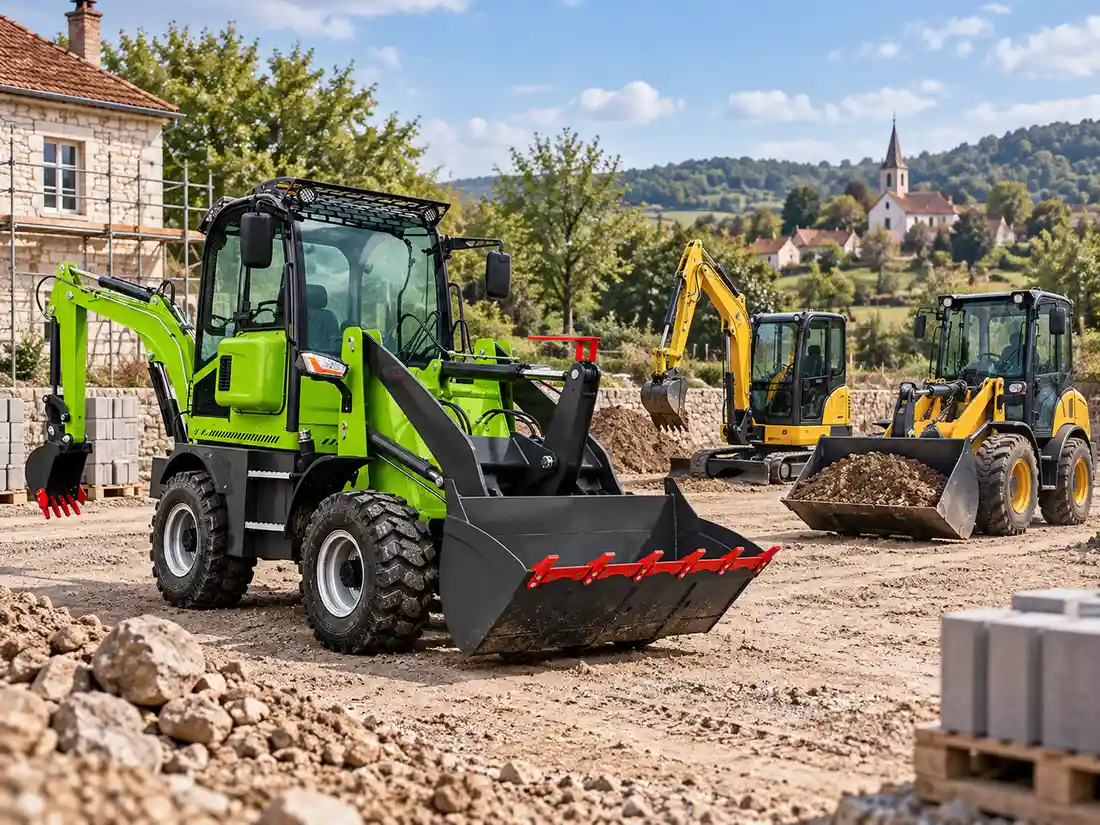
A practical buyer’s guide to utilisation, operators, transport, attachments, European compliance and total cost of ownership.
Small construction projects are where equipment decisions often look easiest on paper and become expensive in practice. A contractor may need trenching in the morning, gravel handling after lunch, backfilling the next day and cleanup before handover. The instinct is to compare digging depth, bucket capacity and engine power. Those figures matter, but they rarely explain whether the machine will earn its keep across the full project.
The real backhoe loader vs excavator decision is therefore not simply about which machine can dig faster. It is about whether your workload is better served by one multi-purpose machine or by two specialised machines that can work independently. That depends on the sequence of tasks, the number of operators, transport frequency, space constraints, attachment demand and how much idle capacity your business can afford.
Core decision rule: Buy specialised capacity only when your workflow can use it often enough. A machine that is technically superior at one task can still be the more expensive choice if it spends too much of the week waiting. |
I. Why Small Projects Are Easy to Over-Equip
Large civil projects can keep excavators, loaders, dump trucks and graders working in dedicated cycles for long shifts. Small contractors rarely have that luxury. Their jobs are more fragmented: drainage repair, rural road maintenance, landscaping, utility work, farm improvements, property maintenance and small building sites often combine several short-duration tasks in the same day.
That changes the economics of construction equipment. The relevant question is not how much capacity the fleet owns. It is how much of that capacity can be productively used.
Peak capability is not the same as average utilisation
A mini excavator may be the more specialised digging machine. A wheel loader may move loose material more efficiently. But if one operator alternates between the two, the second machine does not create parallel production. It creates another asset that must be purchased or rented, transported, serviced, insured and stored.
For a one-operator business, two machines can easily become a serial workflow: excavate first, park the excavator, move to the loader, handle material, then switch back again. In that situation the mini excavator vs backhoe comparison should focus heavily on utilisation rather than peak cycle performance.
Start with three operational questions
- How many hours per day are genuinely excavation work, and how many are loading, backfilling, grading, carrying or cleanup?
- Can those activities happen at the same time, or are they naturally sequential?
- How many trained operators are actually available on a normal job, not only on the busiest day of the year?
If the answer is “one operator, mixed tasks, mostly sequential,” a compact backhoe loader deserves serious consideration. If the answer is “two operators, continuous trenching and continuous material removal,” two specialised machines start to make much more sense.
II. What Each Machine Is Actually Optimised to Do
Backhoe loader: one platform for mixed work
A backhoe loader combines a front loader and a rear excavating assembly on one wheeled chassis. Its strength is not that it beats a dedicated excavator at excavation or a dedicated wheel loader at high-volume loading. Its strength is reducing machine changes when a job repeatedly moves between digging, handling, backfilling and cleanup. This is why a mini excavator vs backhoe decision cannot be answered from digging specifications alone.
Typical work includes trenching, drainage, small foundations, loading aggregate, moving soil, backfilling, grading and site cleanup. With compatible attachments, the same carrier may also support auger work, breaking, pallet handling, sweeping or grapple tasks.
Mini excavator: dedicated excavation in a compact footprint
A mini excavator is built around excavation. The upper structure rotates through 360 degrees, tracked undercarriages provide a stable digging base, and zero-tail-swing or reduced-tail-swing designs can be valuable in constrained sites. When trenching quality, precise positioning and continuous digging dominate the job, this architecture has clear advantages.
The limitation is equally straightforward: once the spoil has to be carried across the site, loaded repeatedly into trucks or used for broader material-handling work, another machine may be required.
Wheel loader: high-frequency material flow
A wheel loader is optimised for repeated load-carry-dump cycles. If a project must continuously move soil, gravel, rubble or other bulk material, a dedicated loader can outperform a backhoe loader in that role because more of the machine is designed around front-end material handling.
This is the key distinction behind wheel loader vs backhoe decisions: a wheel loader is usually selected for sustained material flow, while the backhoe loader is selected when material handling is only one part of a mixed workload. In a wheel loader vs backhoe comparison, the threshold is not whether loading occurs, but whether loading volume is high enough to keep a dedicated machine productive.
III. Backhoe Loader vs Excavator: Compare the Workflow, Not the Brochure
Serial work favours flexibility
Consider a small drainage contractor with one operator. A typical day may include three hours of trenching, two hours of loading and backfilling, and one hour of cleanup or material movement. Two specialised machines provide more task-specific capability, but they cannot both be productive at the same time without a second operator.
If each machine is available for a six-hour productive window but only one can be driven at a time, the contractor owns twelve machine-hours of theoretical capacity while staffing only six operator-hours. The exact economics depend on rental or ownership costs, but the utilisation problem is obvious.
Parallel work favours specialisation
Now change the job. A long utility trench is being opened while spoil must be removed continuously. Two operators are available. The mini excavator keeps digging while the wheel loader clears spoil, feeds bedding material and manages truck loading. Here, two machines create genuine parallel production and may shorten the schedule enough to justify the additional capital, transport and maintenance burden.
Practical test: If removing one machine stops a second crew from working, specialised equipment may be justified. If removing one machine simply means the same operator changes tools less often, utilisation deserves more weight than machine count. |
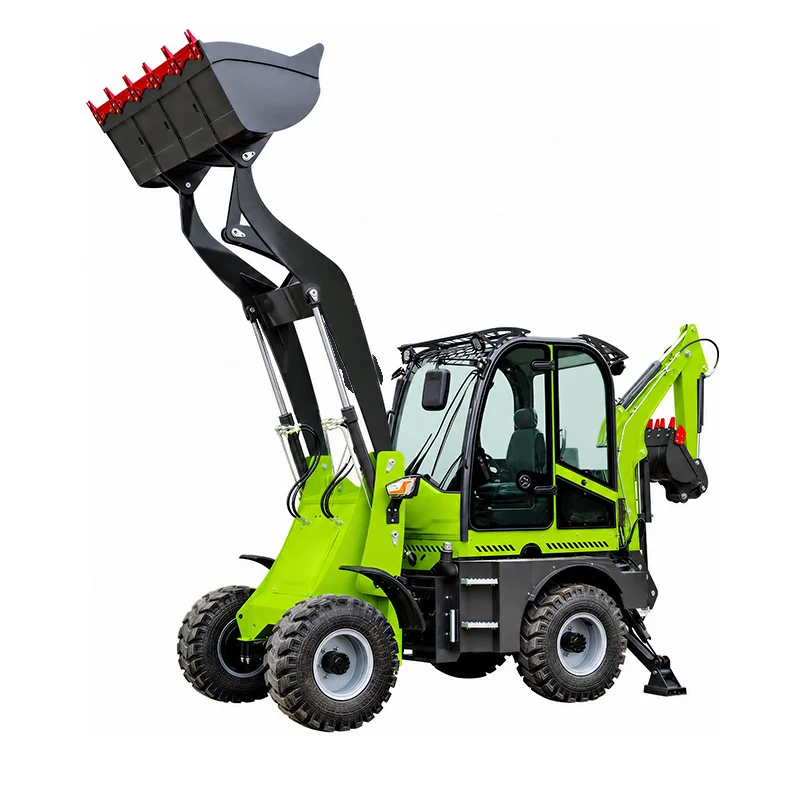
A compact backhoe loader combines loading and excavation functions on one carrier, but one operator still performs the tasks sequentially rather than in parallel.
IV. The Hidden Costs That Change the Answer
1. Mobilisation and transport
Small contractors often move equipment more frequently than large civil contractors. Every extra machine can add trailer capacity, loading and tie-down time, driver coordination, fuel, delivery charges and scheduling risk. For European buyers, transport width, weight, trailer or low-loader capacity and national road rules should be checked before assuming that a machine can simply move between jobs under its own power.
A wheeled backhoe loader can simplify short-distance site movement, but road registration, insurance and legal road use vary by country and configuration. Buyers should verify the actual local requirements rather than treating road mobility as automatic.
2. Idle capital
In this construction equipment decision, an idle machine still carries depreciation or rental cost. It still needs maintenance and inspection. It still ties up capital. This is why “cost per completed job” is often more useful than comparing purchase prices. A lower-priced machine can be expensive if it spends most of the month parked.
3. Operator availability
Two machines only deliver two-machine output when there are two competent operators and enough simultaneous work. Labour availability should therefore be part of the equipment calculation, especially for smaller contractors, rural businesses and municipal crews with limited staffing.
4. Attachment economics
Attachments can expand a carrier’s useful hours without adding another complete power unit, but they must be evaluated as engineering components, not accessories. Hydraulic flow and pressure, connection dimensions, coupler type, attachment mass, residual lifting ability and hose routing all affect whether an attachment is genuinely usable.
The correct question is not “Can this attachment be fitted?” It is “Can it perform the required work safely and productively on this exact machine configuration?”
5. Schedule delay
A single multi-purpose machine can become a bottleneck when excavation and loading must happen at the same time. This is the boundary of versatility. If schedule value is high and two work fronts must stay active, the cost of a second machine may be lower than the cost of extending the project.
Decision factor | Compact backhoe loader | Mini excavator + wheel loader |
Best workflow | Mixed, sequential tasks | Continuous, parallel tasks |
Typical staffing | One operator can cover the main cycle | Two operators unlock the main advantage |
Excavation focus | General trenching, drainage and small works | Higher excavation specialisation |
Confined digging | Depends on machine footprint and stabiliser space | Compact/zero-tail machines can be stronger |
Material handling | Good for intermittent loading and backfilling | Stronger for sustained high-volume loading |
Transport burden | One machine to mobilise | Two machines to mobilise |
Idle-capacity risk | Lower when tasks change frequently | Higher if one machine lacks enough dedicated work |
Attachment strategy | One carrier can cover more job types | Attachments divided across two platforms |
Best business fit | Owner-operators, rural contractors, maintenance teams | Larger crews with stable specialist workloads |
V. What European Buyers Should Check Before Comparing Quotations
For European buyers, equipment selection cannot stop at performance. The machine must also arrive with the correct market configuration and documentation. This is especially important when comparing imported construction equipment, because two quotations that appear similar may not include the same engine, safety equipment, manuals, labels or conformity documents.
Confirm the exact compliance package for the delivered machine
The current EU machinery framework is transitioning to the new Machinery Regulation (EU) 2023/1230, which applies from 20 January 2027. Buyers should confirm what conformity route applies at the time the machine is placed on the market, and verify the Declaration of Conformity, CE marking, manuals, labels and machine-specific documentation supplied with the actual serialised unit.
Check the diesel engine configuration, not just the engine brand
Diesel engines used in non-road mobile machinery can fall under Regulation (EU) 2016/1628, including Stage V emission requirements for covered engine categories. The practical purchasing question is therefore not simply “Is it Stage V?” but “Which exact engine model and EU type-approval documentation are included in this configuration?”
Match documents to destination country and intended use
The destination country, operating environment and intended application matter. Buyers should also confirm the required manual language, safety labels, lighting, guarding, operator protection, tyres and any market-specific configuration before production or shipment. If the machine may travel on public roads, road-registration requirements should be checked separately with the relevant local authority or dealer.
Quotation check: Ask suppliers to identify the exact engine, machine configuration, conformity documents, manuals, labels, attachment interfaces and optional equipment included in the quoted unit. Do not compare two prices until you know the technical scope is actually the same. |
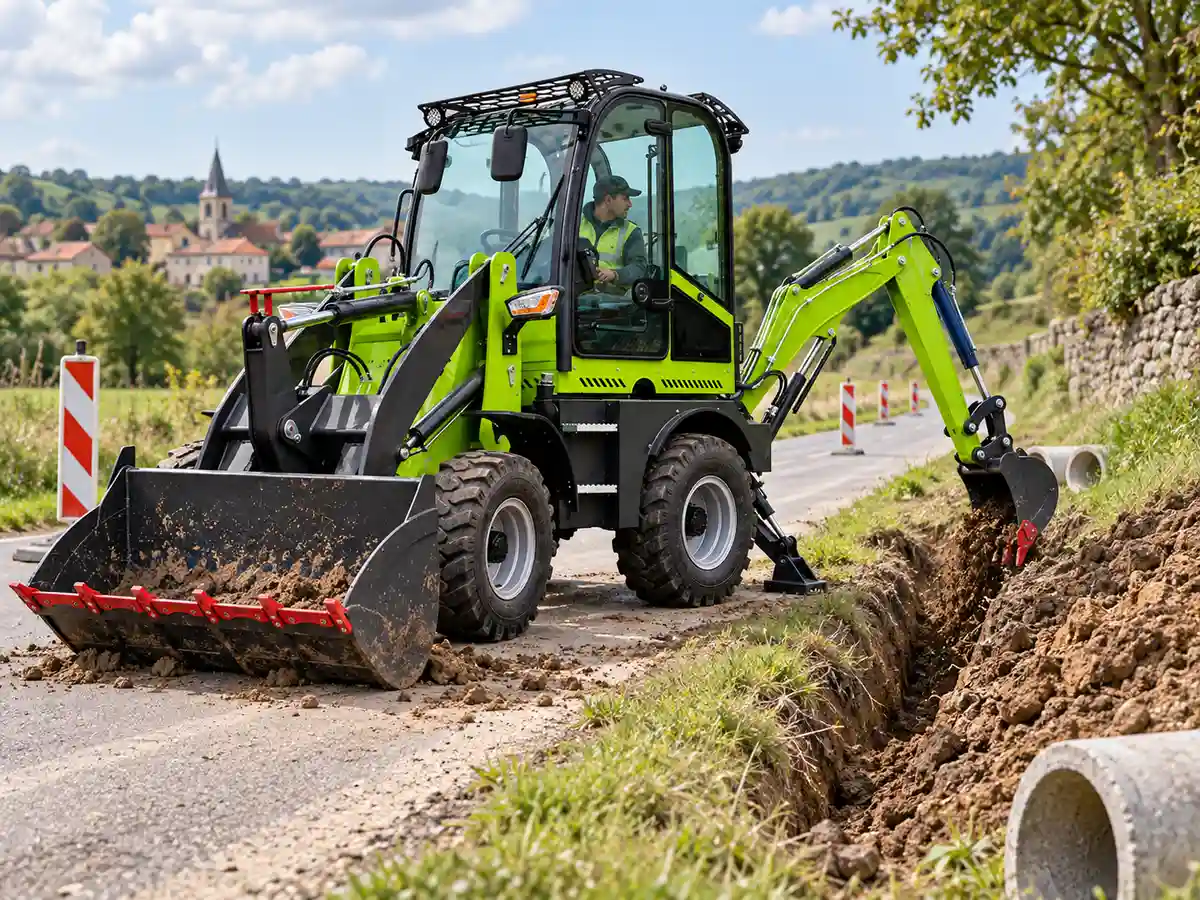
A mixed rural drainage job is a typical case where digging, backfilling, loading and site movement occur in the same workflow.
VI. A Practical Decision Framework for Small Projects
A compact backhoe loader usually deserves priority when…
- One operator handles most of the work.
- Digging, loading, backfilling and cleanup occur in short, changing cycles.
- Projects are distributed across farms, rural properties, small roads, drainage sites or maintenance locations.
- Loading volume is important but not continuous enough to keep a dedicated wheel loader busy all day.
- A single carrier with multiple attachments can replace occasional use of additional machines.
- The business wants to reduce transport events, maintenance points and fleet complexity.
A mini excavator + wheel loader setup usually deserves priority when…
- Excavation represents most of the productive machine hours.
- The digging area is highly constrained and a compact or zero-tail-swing excavator materially improves access.
- Material must be loaded or moved continuously at high volume.
- Two operators are available and both machines can stay productive at the same time.
- Finishing the job faster has enough commercial value to justify the extra machine, transport and maintenance cost.
- The fleet already owns one of the machines, changing the marginal cost of the two-machine setup.
This is why a backhoe loader vs excavator article – and the related mini excavator vs backhoe choice – should never end with a universal winner. The technically correct answer depends on utilisation. The commercial answer depends on whether the extra specialisation converts into enough additional completed work to pay for itself.
VII. How to Evaluate a Supplier Beyond the Machine Price
For imported construction equipment, the supplier evaluation should be part of the machine evaluation. The same applies when comparing wheel loader vs backhoe alternatives from different suppliers. A machine can fit the job on paper and still create operating problems if attachments are mismatched, replacement parts are difficult to identify, documentation is incomplete or technical questions take too long to resolve.
Ask these questions before placing an order
- Can the supplier recommend a configuration based on actual workload rather than only a target price?
- Can they confirm attachment compatibility using connection dimensions and hydraulic requirements?
- Can they provide the exact conformity and engine documentation for the destination market before shipment?
- What spare parts should be stocked for the first service period?
- What information is required for parts identification later: model, serial number, part number, photos or drawings?
- What does the warranty cover, and what evidence is required for a claim?
- Can technical support review fault information, operating symptoms, photos or videos remotely?
- Can inspection photos or videos be provided before shipment?
These questions matter because total cost of ownership is not created only by fuel and depreciation. Downtime, wrong parts, repeated international freight and unresolved configuration mistakes can erase the saving achieved by a lower initial purchase price.
VIII. Where OXPLO Fits This Small-Project Decision
For buyers whose workload is dominated by mixed, sequential tasks, OXPLO positions its wheeled backhoe loader range around the same problem described in this guide: one machine covering loading, digging, material handling and everyday site work rather than purchasing separate equipment for every short-duration task.
The current OXPLO product overview lists the OX15-20 Wheeled Backhoe Loader for farm support, rural projects, drainage, landscaping, property maintenance and light construction applications. For a European contractor, the useful question is not whether the OXPLO machine can perform every possible construction task. It is whether the OXPLO configuration can cover enough of the contractor’s recurring paid work to keep one machine productive for more hours.
OXPLO attachment support should be evaluated as a utilisation tool
OXPLO’s support and attachments page currently lists wheeled backhoe loader options including 6-in-1 and 4-in-1 buckets, tilting buckets, quick couplers, augers, hydraulic breakers, pallet forks, grapples, sweepers and snow attachments. The business value is not the length of the attachment list. The value is whether those tools allow an OXPLO carrier to replace low-frequency machine rentals or additional low-utilisation equipment in the customer’s own workflow.
For example, a rural contractor may excavate drainage channels on one job, move gravel and pallets on another, and perform cleanup or seasonal maintenance on a third. In that type of business, attachment compatibility can directly influence annual machine utilisation.
Attachments matter when they convert one machine into more billable tasks without adding another engine, chassis and maintenance schedule.
OXPLO support matters after the first shipment
For European buyers, OXPLO also states that its support process can include parts identification, warranty support, configuration guidance and remote technical assistance. OXPLO advises buyers to provide machine model, serial number, operating hours, issue details, photos or videos when support is required. That process is important because the practical cost of imported construction equipment depends heavily on how quickly the correct component or technical answer can be identified.
OXPLO’s About OXPLO page also describes an application-based selection process that considers load, terrain, working space, operating frequency, climate, attachments and maintenance conditions. That is the right starting point for a backhoe loader vs excavator decision: begin with the work, then select the machine.
European configuration should be confirmed before ordering
OXPLO notes that European-market availability, CE-related documents and engine configurations depend on the product model, destination country and intended application. Buyers should therefore ask OXPLO to confirm the exact machine, engine, conformity documents, manuals and optional equipment included in the quotation before shipment. This is more useful than relying on a generic claim that one configuration fits every European market.
IX. What to Send OXPLO Before Asking for a Price
A useful quotation starts with a useful application brief. Instead of sending only “What is your backhoe loader price?”, provide enough information for OXPLO to determine whether a compact backhoe loader is actually the right platform.
Project type | Drainage, landscaping, farm roads, utilities, property maintenance, light construction, etc. |
Daily task split | Approximate hours for digging, loading, backfilling, carrying and cleanup. |
Digging requirement | Required depth, trench width, soil type and obstacles. |
Material handling | Material type, approximate volume, loading height and carry distance. |
Site constraints | Minimum access width, turning space, slopes, ground condition and surface sensitivity. |
Crew | Number of operators and whether digging/loading must happen simultaneously. |
Attachments | Bucket type, fork, auger, breaker, grapple, sweeper or other required tools. |
Destination | Country, delivery location and any known compliance or road-use requirements. |
With this information, OXPLO can discuss whether the OX15-20 wheeled backhoe loader and a suitable attachment package match the duty cycle, or whether the project is better served by more specialised equipment. That makes the conversation about productivity and lifecycle cost instead of only purchase price.
X. Frequently Asked Questions
Is a backhoe loader better than a mini excavator?
Not universally. A mini excavator is generally the more specialised excavation platform, especially where compact access and continuous digging dominate. A backhoe loader becomes attractive when digging is only one part of a mixed workflow that also includes loading, backfilling, material handling and cleanup.
When does a mini excavator + wheel loader make more sense?
The two-machine setup is strongest when both machines can work at the same time. If two operators can keep excavation and material movement running in parallel, the productivity gain may justify the additional machine cost. If one operator simply alternates between them, the financial case is weaker.
What is the biggest hidden cost in a backhoe loader vs excavator comparison?
Idle capacity is often underestimated. Transport, maintenance and operator time are visible costs; unused machine hours are less visible. For small contractors, a machine that works across several job types can sometimes create better annual utilisation than a more specialised machine that is highly productive only during one stage of the project.
What should European buyers confirm before importing a backhoe loader?
Confirm the exact engine and machine configuration, applicable conformity documentation, CE marking and Declaration of Conformity, manuals and labels, attachment interfaces, spare-parts process and any destination-country requirements. Road use should be checked separately because registration and public-road rules vary by country and machine configuration.
Can OXPLO help select attachments?
Yes. OXPLO states that attachment matching should use the equipment model, connection dimensions, hydraulic requirements and intended application. Buyers can review available options on the OXPLO Support page and confirm compatibility before ordering.
XI. Conclusion: Buy the Workflow, Not the Machine Count
The most useful way to approach backhoe loader vs excavator is to stop asking which machine is “better” and start asking which workflow the business can keep productive.
A compact backhoe loader makes sense when one operator must move repeatedly between digging, loading, backfilling and maintenance work; when projects are small or geographically dispersed; and when a single carrier with well-matched attachments can replace low-frequency equipment. A mini excavator plus wheel loader makes more sense when excavation and material handling are both intensive, two operators can work in parallel, and faster project completion has enough value to support the extra fleet cost.
For European buyers, that operational calculation should be combined with documentation, engine configuration, transport, spare parts and after-sales planning before the quotation is accepted.
If your projects include rural drainage, farm roads, property maintenance, landscaping or light construction, send OXPLO your task split, digging requirements, site dimensions, material-handling demand, attachment list, operator count and destination country. Explore OXPLO machinery or review the OXPLO wheeled backhoe loader range before requesting a configuration. The goal should be simple: select the smallest, simplest equipment setup that can reliably complete the required work without creating avoidable idle capacity.
Technical validation references: EU Machinery Regulation 2023/1230 | EU Regulation 2016/1628 (NRMM engines) | OXPLO Products | OXPLO Support