
An OXPLO Manufacturer Guide to Power, Versatility, Attachments and Long-Term Farm Productivity
For a European mixed farm, choosing a tractor is not the same decision as choosing a machine for a single-crop operation. A mixed farm may combine cereals, grassland, forage, vegetables, livestock, transport and seasonal maintenance, which means the tractor must move between very different jobs throughout the year. OXPLO approaches tractor selection from this real-work perspective: the best machine is not simply the one with the highest horsepower, but the one that completes the widest range of regular jobs efficiently, reliably and at a sensible operating cost.
A tractor may pull a feed trailer in the morning, power a mower in the afternoon, prepare a seedbed the next day and later return to loader work, spraying or road maintenance. That is why a good tractor for mixed farm use must be evaluated as a year-round power platform rather than a single-purpose field machine.
For European buyers, the key questions usually include horsepower, PTO performance, hydraulic capacity, three-point hitch compatibility, traction, manoeuvrability, attachment range, operator comfort, documentation and total cost of ownership. The right balance matters more than any one specification.
I. Start With the Farm Workload, Not the Horsepower Number
Many buyers begin with a simple question: “How much horsepower do I need?” For mixed farming, a better question is: “What are the heaviest jobs I perform regularly, and what are the jobs I perform most often?” This distinction prevents both oversizing and undersizing.
Mixed farms rarely have a single tractor job
A specialist arable farm may size a tractor mainly around tillage, seeding and field transport. A mixed farm has a broader workload. Typical tasks may include:
- Crop operations: ploughing, harrowing, seedbed preparation, planting, spraying and harvest support.
- Livestock operations: feed transport, mowing, hay handling, bale movement and manure handling.
- Utility work: trailer transport, front-loader work, material handling, farm-road maintenance and snow clearing.
This is where a utility tractor becomes especially valuable. It may not be the most powerful machine on the farm, but it can become the machine with the highest annual utilisation because it is suitable for both field work and farmyard work.
Build a simple workload matrix before choosing a model
OXPLO recommends evaluating each regular job by power demand, PTO demand, hydraulic demand and the need for manoeuvrability. A useful starting matrix looks like this:
Farm Task | Power Demand | PTO Demand | Hydraulic Demand | Manoeuvrability |
Mowing | Medium | High | Medium | Medium |
Ploughing | High | Low-Medium | Medium | Low |
Seedbed preparation | Medium-High | Medium-High | Medium | Medium |
Feed transport | Medium | Low | Low | Medium |
Trailer towing | Medium-High | Low | Low | Medium |
Front-loader work | Medium | Low | High | High |
Spraying | Low-Medium | High | Medium | High |
Farmyard maintenance | Low-Medium | Variable | Medium | High |
The best tractor specification is usually the one that covers the most frequent jobs comfortably while still retaining enough reserve for the regular heavy jobs. Buying a machine only for a rare peak-load task can leave too much capital tied up in unused capability.
II. Why the 50-70 HP Range Is So Relevant to European Mixed Farms
For many small and medium mixed farms, the 50-70 HP segment deserves close attention because it can balance machine size, implement compatibility, traction and everyday utility work. The OXPLO tractor range covers multiple horsepower levels up to 70 HP, allowing buyers to match power more closely to their workload instead of jumping directly to an unnecessarily large machine.
When a 50 hp tractor makes more sense
A 50 hp tractor can be a strong fit where light-to-medium work dominates, field sizes are moderate, and the tractor must remain easy to manoeuvre around yards, barns, orchards or smaller plots. Typical jobs may include mowing, spraying, fertilizer spreading, rotary tilling, light ploughing, feed transport, small-trailer work and general farm maintenance.
For a mixed farm, utilisation is a critical part of return on investment. A machine that is slightly smaller but convenient enough to use every day may create more value than a larger tractor that is only efficient during a few heavy field operations.
When a 70 hp tractor becomes the better choice
A 70 hp tractor is more appropriate when the farm regularly handles heavier tillage, wider implements, larger trailers, hilly terrain or more demanding loader and forage work. The additional power reserve can reduce the risk of operating the tractor continuously near its limit and can support a broader range of heavier implements.
However, OXPLO advises buyers not to select 70 HP simply because it is the highest available option. If most tasks use only a fraction of the machine’s capability, the farm may carry extra purchase cost, tyre cost, fuel demand and machine weight without receiving a proportional productivity benefit.
A useful sizing principle
Choose enough horsepower for your demanding regular jobs, not for rare extreme jobs. If a very heavy task occurs only a few days per year, using a contractor or another machine can sometimes be more economical than owning an oversized tractor for the other 360 days.
III. PTO, Hydraulics and the Three-Point Hitch Matter as Much as Engine Power
Mixed farming depends on frequent implement changes. A tractor may operate a mower today, a rotary tiller tomorrow, a fertilizer spreader later in the week and a trailer after harvest. As a result, engine horsepower alone cannot tell you whether a mixed farming tractor will actually suit the farm.
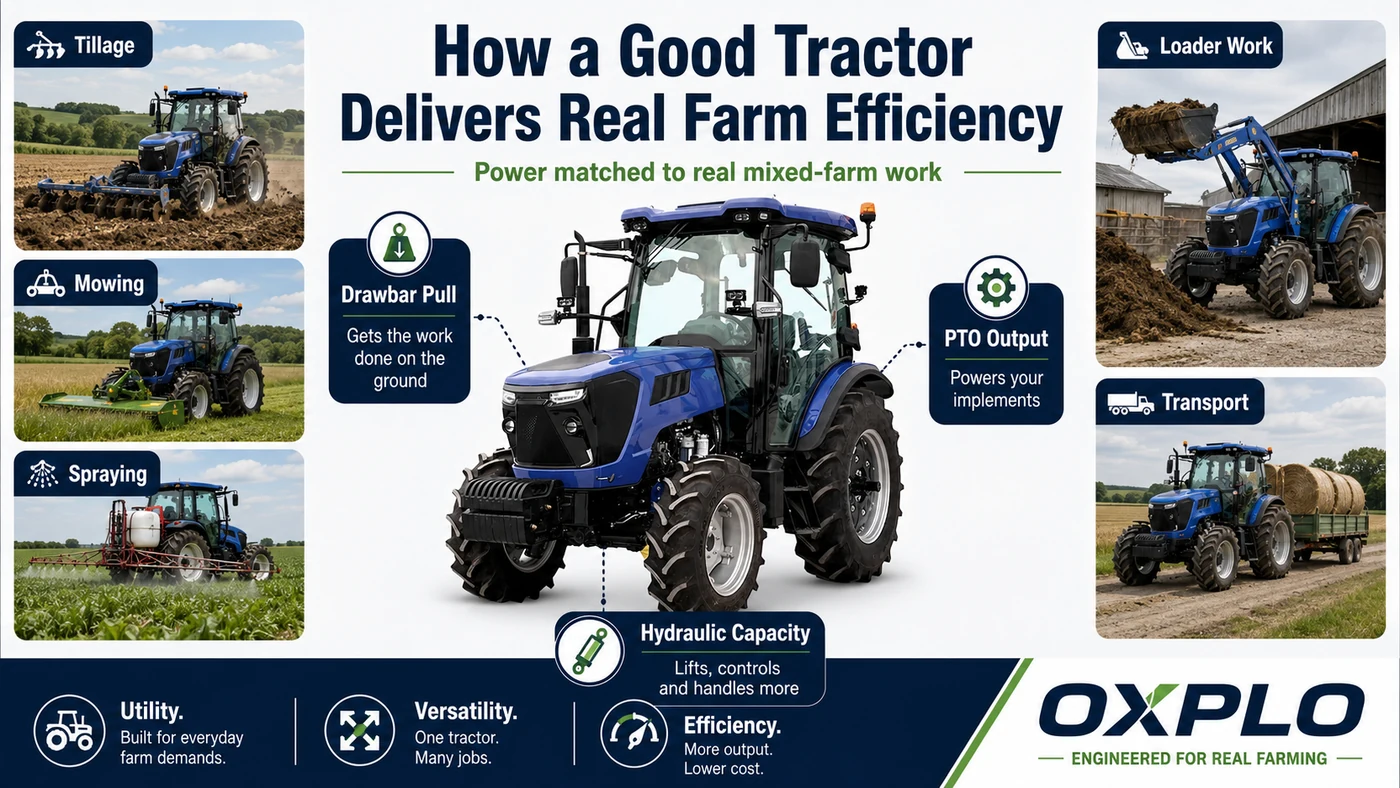
Figure 2. A good tractor converts engine power into drawbar pull, PTO output and hydraulic capability for different mixed-farm jobs.
PTO performance determines what powered implements you can use
PTO-driven equipment can include rotary tillers, mowers, hay equipment, fertilizer spreaders, sprayer pumps, post-hole diggers and some planting equipment. Buyers should therefore confirm PTO speed, PTO power, engagement method and the requirements of each implement. A 50 hp tractor does not deliver all 50 HP through the PTO, so PTO-intensive jobs must be assessed separately from engine rating.
Hydraulic capacity determines utility
Hydraulic flow and lifting capability become especially important for front loaders, hydraulic tipping trailers, bale handling equipment and implements that rely on hydraulic cylinders or motors. An engine can have enough power while the hydraulic system still limits the implement.
The three-point hitch turns the tractor into a multi-purpose platform
OXPLO supports a broad attachment ecosystem for tractor work. Buyers can review the OXPLO Support and Attachments section, which covers implements for soil preparation, mowing, cultivation, planting, transport and crop care. For mixed farming, this attachment compatibility is often more valuable than a small increase in peak horsepower because it allows one tractor to serve multiple seasonal roles.
IV. 4WD, Tyres and Machine Weight Decide How Much Power Reaches the Ground
Horsepower only creates agricultural value when it can be converted into usable traction. Mixed farms expose tractors to cultivated fields, grassland, muddy livestock areas, gravel roads, slopes and wet seasonal conditions. This makes the drivetrain, tyres and weight distribution central to real-world performance.
Why 4WD matters on a mixed farm
Four-wheel drive can improve usable traction where wheel slip would otherwise waste engine power. It is particularly helpful on wet grass, soft soil, slopes, muddy yards and during trailer or tillage work. In these conditions, improving traction can deliver more practical productivity than simply increasing engine horsepower.
Bigger and heavier is not always better
Extra weight can improve traction, but excessive machine mass can also increase soil compaction, turning requirements, tyre costs and difficulty on small plots. European mixed farms often need a compromise: enough weight for stable traction and implement control, but not unnecessary weight for every light job.
Tyre choice and tyre pressure should therefore be part of tractor selection. The same 50 hp tractor or 70 hp tractor can behave very differently depending on tyre type, inflation pressure, ballast and surface condition.
V. Manoeuvrability Is a Productivity Feature, Not Just a Convenience
European agriculture includes many small fields, irregular plot shapes, narrow farm lanes, barns, livestock buildings, orchards and compact yards. In these environments, turning radius, overall width, visibility and machine length directly affect daily productivity.
Mixed farms contain confined working areas
Loader work around feed stores, reversing a trailer into a barn, entering gates and manoeuvring between livestock buildings can consume a significant share of working time. A tractor that is easy to position can shorten every cycle, reduce operator fatigue and make attachment changes less frustrating.
This is one reason OXPLO positions its tractor selection around practical farm tasks rather than only maximum output. A compact utility tractor can be more productive in repetitive yard operations than a substantially larger machine, even when the larger tractor has more horsepower.
Road transport between fields also matters
Many European farms operate non-contiguous plots. The tractor may spend meaningful time travelling between fields, buildings and storage areas. Buyers should consider transport speed, braking, lighting, mirrors, trailer compatibility, operator comfort and any destination-country road-use requirements. Time spent between jobs is still operating cost.
VI. Attachment Versatility Can Be More Valuable Than Extra Horsepower
The strongest mixed-farm tractor is usually the one that remains useful through every season. A machine that performs only two or three jobs may have a low purchase price but poor capital utilisation. A tractor that can switch efficiently between implements can spread ownership cost across many more productive hours.
One tractor can serve multiple seasonal roles
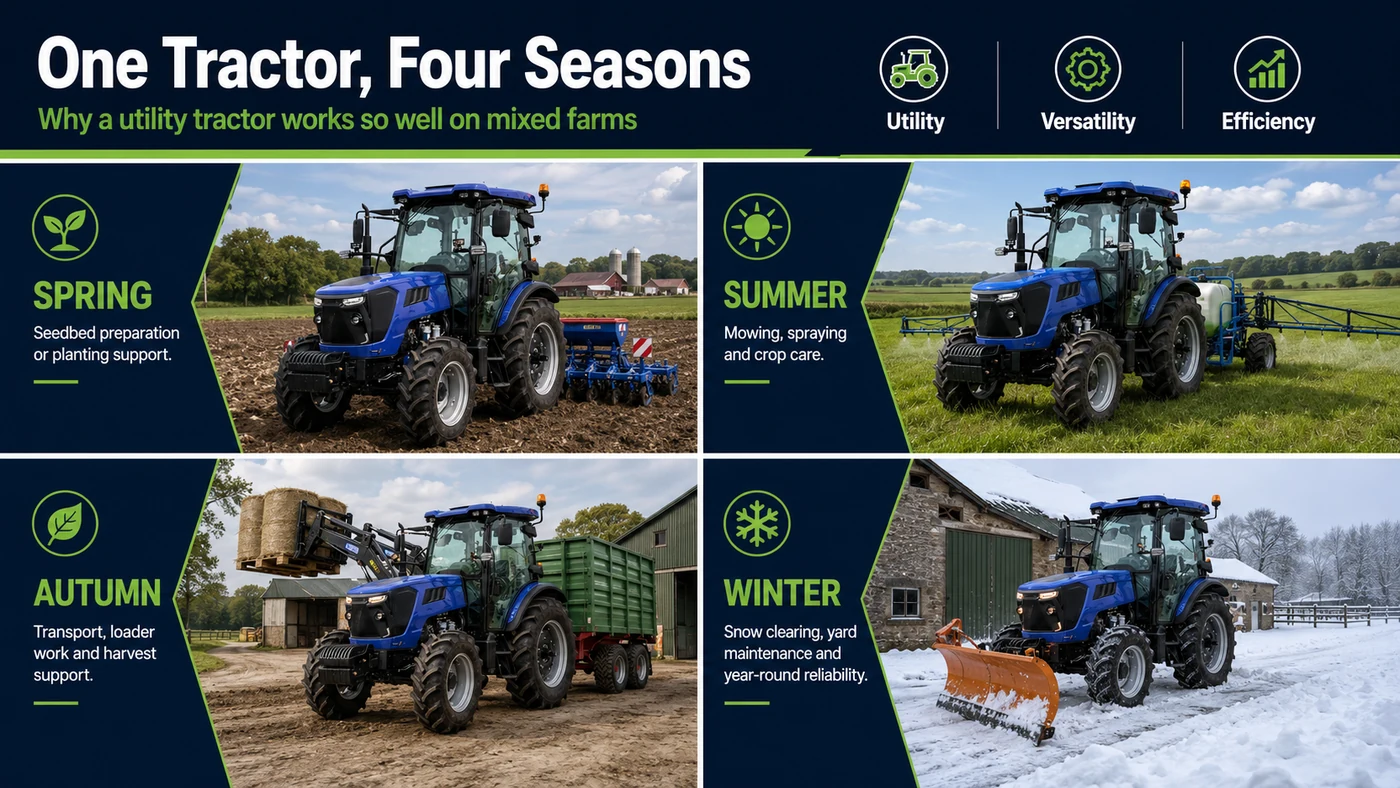
Figure 3. One OXPLO utility tractor can support mixed-farm work across all four seasons when matched with the right attachments.
- Spring: ploughing, harrowing, seed drilling and fertilizer spreading.
- Summer: mowing, spraying, cultivation and trailer work.
- Autumn: harvest support, transport, loader work and soil preparation.
- Winter: feed handling, farmyard maintenance and snow clearing where required.
This is a core reason OXPLO combines tractors with a broad attachment offering. For a mixed farm, the tractor itself is the power platform; the attachment system determines how much of the annual workload that platform can cover.
Questions to ask before ordering implements
- Which implements have been matched to the selected tractor horsepower?
- What three-point hitch category is used?
- Which PTO speeds are available and what PTO power is required by the implement?
- How many rear hydraulic outlets are available?
- Does front-loader installation require a specific hydraulic configuration?
- Which tyre options are suitable for field work, grassland or yard work?
- Which cab, ROPS or operator-comfort configurations are available?
- How are spare parts identified for the tractor model and serial number?
For current compatible implement categories and support information, buyers can use the OXPLO Support page as a starting point before confirming the final tractor-and-implement configuration with the OXPLO team.
VII. Evaluate Cost per Useful Working Hour, Not Purchase Price Alone
Purchase price is only one component of tractor economics. A more useful way to compare machines is cost per productive working hour over the ownership period. That perspective includes acquisition cost, fuel, maintenance, repairs, tyres, downtime and residual value, then relates those costs to the number of hours in which the tractor performs useful work.
Oversizing creates hidden costs
- Higher purchase price and financing requirement.
- Potentially higher fuel use on light jobs.
- Larger and more expensive tyres.
- Pressure to buy larger implements to match the tractor.
- More storage space and reduced manoeuvrability.
- Potentially higher soil pressure in unsuitable conditions.
Undersizing creates a different set of costs
- Slower field speed on demanding operations.
- Excessive wheel slip.
- Higher fuel consumption per hectare when the machine is continuously overloaded.
- Greater stress on the clutch and drivetrain.
- Overheating or reduced component life under sustained heavy load.
- Inability to operate the implement at the correct working width or speed.
The objective is therefore not to choose the cheapest tractor or the biggest tractor. It is to choose the machine that spends most of its life in an efficient working range while maintaining enough reserve for regular peak loads.
VIII. European Buyers Should Confirm Compliance, Documentation and Service Support
Mechanical suitability is only one part of tractor procurement in Europe. Buyers should also verify the documentation and configuration applicable to the exact machine, engine, intended use and destination country before shipment or registration.
What to confirm before placing an order
- Exact tractor model and engine model.
- Applicable engine emissions requirements for the destination market.
- Required conformity and safety documentation for the specific configuration.
- Operating manuals, labels and safety guards.
- PTO protection and hitch configuration.
- ROPS or cab configuration where applicable.
- Lighting, braking and road-use requirements if the tractor will travel on public roads.
- Attachment compatibility and any additional hydraulic or ballast requirements.
OXPLO encourages buyers to discuss the destination country and intended application before finalising a machine. The OXPLO website provides the product and support framework, while final documentation should always be confirmed against the exact ordered configuration.
IX. 50 HP vs 70 HP: Which Tractor Better Fits Your Mixed Farm?
The following comparison is a practical guide rather than a universal rule. Soil type, terrain, implement width, trailer weight and annual working hours can change the correct answer.
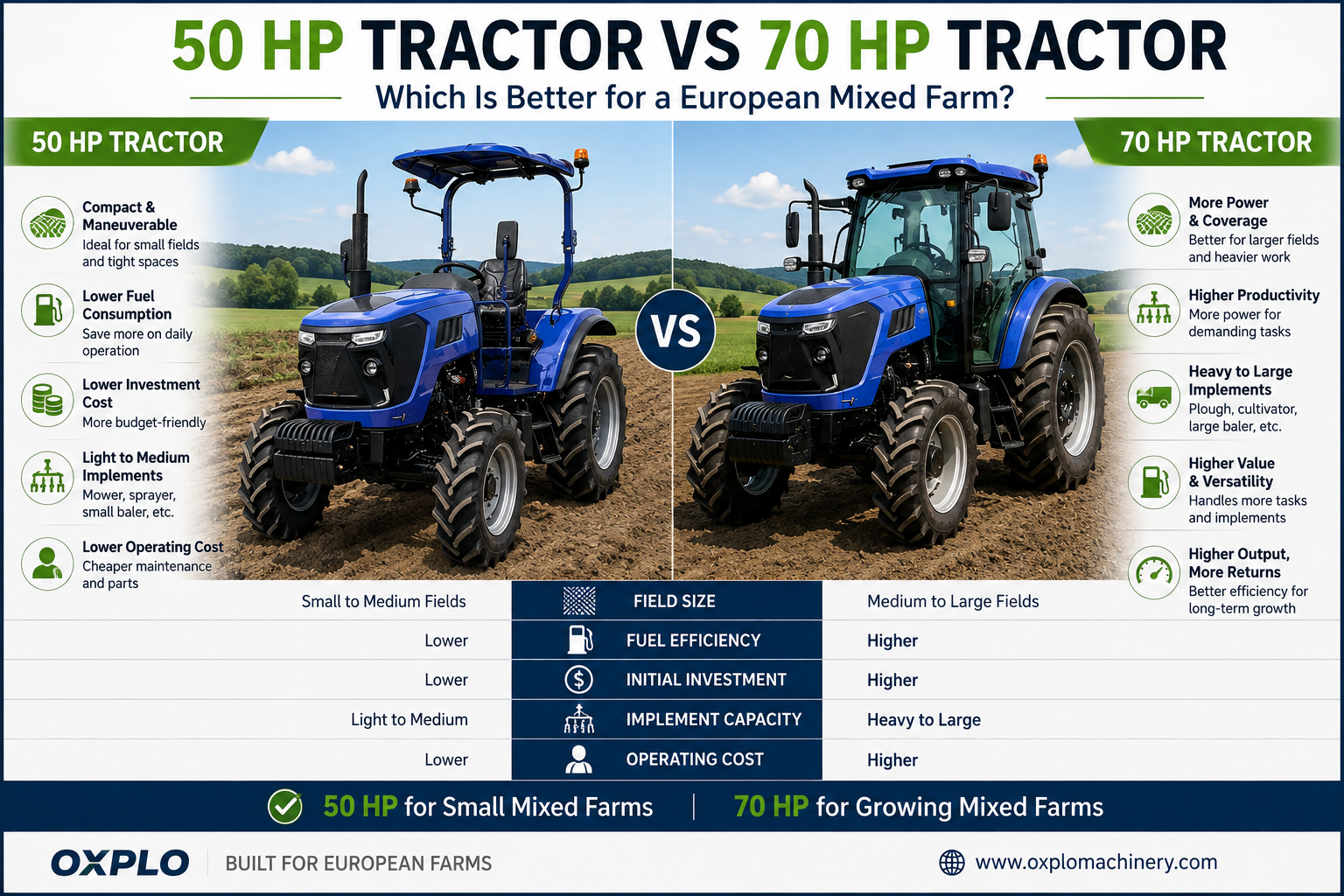
Figure 4. 50 HP vs 70 HP: a practical comparison for European mixed-farm workloads.
Requirement | 50 HP Tractor | 70 HP Tractor |
Small/medium plots | Excellent | Good |
Farmyard manoeuvrability | Excellent | Good |
Orchard/vineyard work | Excellent | Moderate |
Mowing and spraying | Excellent | Excellent |
Light tillage | Excellent | Excellent |
Heavy tillage | Moderate | Excellent |
Large trailer towing | Moderate | Excellent |
Larger implements | Moderate | Excellent |
Loader work | Good | Excellent |
Fuel efficiency on light jobs | Potential advantage | Depends on load |
Power reserve | Moderate | High |
Choose a 50 hp tractor when…
Most work is light to medium duty, plots and yards are relatively compact, attachment changes are frequent, and manoeuvrability plus annual utilisation matter more than maximum drawbar power. In this situation, an OXPLO 50 HP class tractor can function as a highly practical utility machine.
Choose a 70 hp tractor when…
The farm regularly handles heavier tillage, larger implements, higher trailer loads, hills or demanding soil conditions. An OXPLO 70 HP class tractor provides more reserve for these jobs and may be better suited where the machine frequently works at higher drawbar or hydraulic loads.
Consider the middle ground when…
Your workload sits between the two. A 60 HP configuration can be valuable where a 50 HP tractor feels marginal for several recurring tasks but 70 HP would be larger than necessary for most daily work. The advantage of a broader OXPLO horsepower range is that buyers do not have to treat 50 and 70 HP as the only two choices.
X. FAQ: Choosing a Tractor for European Mixed Farming
Is a 50 hp tractor enough for a mixed farm?
For many small and medium mixed farms, yes. A 50 hp tractor can cover mowing, spraying, fertilizer spreading, light tillage, transport and many utility tasks. The final answer depends on soil conditions, implement width, terrain, trailer loads and the frequency of heavy work. OXPLO can help buyers compare the 50 HP class with 60 HP or 70 HP alternatives when the workload is close to the upper limit.
Is a 70 hp tractor too large for a small European farm?
Not necessarily. Heavy clay soil, hills, larger trailers, demanding loader work or larger forage equipment can justify 70 HP even on a modest land area. If most tasks are mowing, spraying, feeding and light transport, however, a smaller utility tractor may deliver higher utilisation and easier manoeuvrability.
What is the most important feature of a mixed farming tractor?
Versatility. Horsepower matters, but PTO capability, hydraulics, three-point hitch compatibility, 4WD, tyre options, manoeuvrability and attachment support determine how many real jobs the tractor can perform. OXPLO therefore recommends evaluating the complete tractor-and-implement system.
Is 4WD necessary for European mixed farms?
It is highly valuable where the tractor works on wet grass, soft soil, slopes, muddy yards, winter surfaces or under higher traction loads. Whether it is essential depends on the farm, but traction should always be evaluated together with tyres, ballast and machine weight.
Which attachments are useful on a mixed farm?
Common examples include mouldboard ploughs, disc ploughs, harrows, rotary tillers, mowers, hay rakes, seed drills, fertilizer spreaders, sprayers, cultivators and trailers. OXPLO offers a broad attachment selection through its support system so buyers can build a configuration around actual seasonal jobs.
Can OXPLO recommend a tractor based on my farm?
Yes. The most useful information includes farm size, country, crops, livestock type, soil conditions, terrain, current implements, required implement width, trailer weight, loader requirements and expected annual working hours. With this information, OXPLO can help identify whether a 50 HP, 60 HP, 70 HP or another tractor configuration is the better starting point.
To compare available machines, visit the OXPLO Tractor product page. For attachments and implement support, visit the OXPLO Support page.
XI. Conclusion: A Good Mixed-Farm Tractor Is a Versatile Power Platform
For a European mixed farm, the best tractor is not the machine that looks strongest on a specification sheet. It is the machine that can move efficiently between ploughing, mowing, feeding, transport, loader work, spraying and general utility jobs throughout the year.
That is why tractor for mixed farm selection should follow a complete sequence: workload, horsepower, PTO, hydraulics, three-point hitch, traction, tyres, attachments, manoeuvrability, compliance and total cost of ownership.
A 50 hp tractor can be an excellent choice where light-to-medium work, compact spaces and high annual utilisation dominate. A 70 hp tractor is often better where heavier tillage, larger implements, trailer loads and demanding terrain require more reserve. For farms between those profiles, a 60 HP class machine may provide the most balanced solution.
OXPLO supports European buyers with a tractor range designed around practical agricultural work and a wide selection of attachments for soil preparation, cultivation, mowing, planting, transport and crop care. Rather than treating horsepower as the only buying criterion, OXPLO focuses on matching the tractor to the real operating environment and the jobs the farm must complete.
If you are evaluating a mixed farming tractor, start with your workload and implement list. Then review the OXPLO tractor range, explore available attachments and support, or visit OXPLO to discuss a configuration for your farm and target market.