
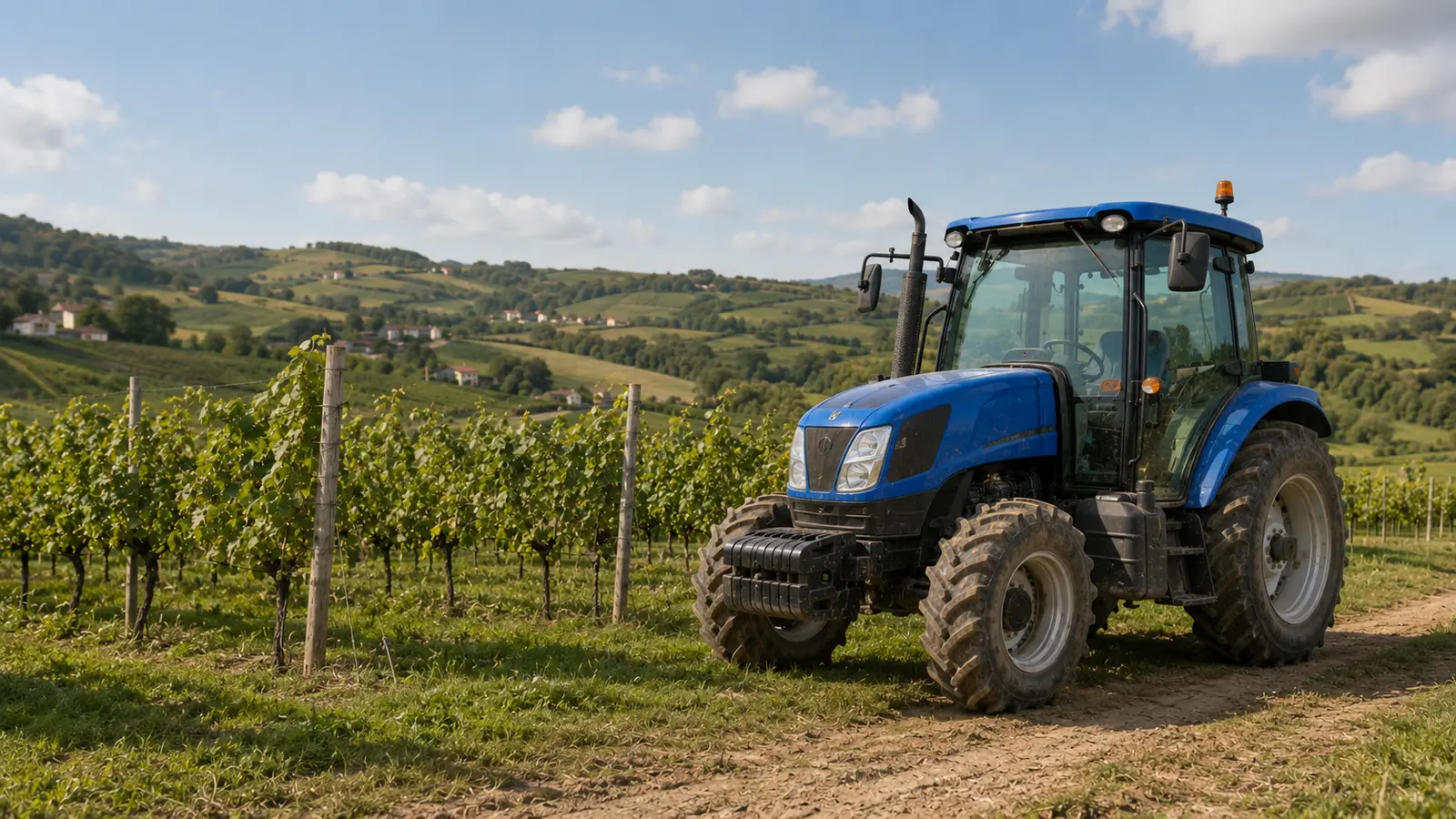
Choosing the right tractor for a small farm is not simply a question of buying the highest horsepower that fits the budget. For a Polish farm, the better decision is to match the tractor to the work: field size, soil conditions, implements, access width, transport distance, seasonal workload and annual operating hours. A machine that is too small may spend too many hours completing routine tasks, while an oversized machine can add purchase cost, fuel demand, tyre expense and unnecessary weight without improving real farm productivity.
This matters in Poland because small and medium-sized holdings remain an important part of the agricultural structure. Statistics Poland reported approximately 1.317 million farms in the 2020 Agricultural Census, with average agricultural area per holding of about 11.1 hectares. That does not mean every 11-hectare farm needs the same tractor. A grassland farm, orchard, mixed crop farm and livestock holding can have completely different power, PTO and hydraulic requirements even when their land area is similar.
For many buyers comparing a tractor for small farm use, the practical decision falls somewhere between compact 25-30 HP machines and more capable 40-70 HP utility tractors. OXPLO covers this range with models from the OXT254 to the OXT704, giving buyers a way to match machine size to actual work rather than choosing by horsepower alone.
This OXPLO guide explains how to select a small farm tractor for Poland, how to think about tractor horsepower, and when a compact tractor or 40 HP tractor makes more sense than moving directly to a larger machine.
Agricultural structure reference: Statistics Poland – Agricultural Census 2020
I. Start With the Farm Work, Not the Horsepower Number
A common buying mistake is to begin with, “Do I need 40 HP or 50 HP?” OXPLO recommends reversing the process. First define the work the tractor must complete throughout the year, then choose the horsepower and chassis that can perform that work with a reasonable reserve.
Map Your Annual Workload
List every recurring task and separate it into field work, PTO work, transport, lifting and yard work. This quickly shows whether the tractor for small farm use will spend most of its time mowing and hauling, or whether it must regularly pull soil-engaging implements.
- Field preparation: ploughing, harrowing, rotary tilling, seedbed preparation and cultivation.
- Crop and pasture work: mowing, topping, seeding, spreading and spraying.
- Livestock work: feed transport, bale movement, manure handling and yard maintenance.
- Transport: trailers, produce movement and travel between separated plots.
- Property maintenance: snow clearing, verge maintenance, orchard-floor work and general utility tasks.
The most demanding recurring task should carry more weight in the decision than the easiest task. A tractor that can mow comfortably but struggles with the farm’s main tillage implement is not a well-matched machine.
Measure Access Before You Compare Models
Small Polish farms often combine fields with narrow gates, barns, older farmyards, orchard rows and short headlands. Measure the narrowest gate, lowest entrance, available turning area and storage space before ordering. A compact tractor that fits every work area can be more productive than a higher-horsepower tractor that repeatedly requires extra manoeuvring or cannot enter part of the farm.
Do Not Use Hectares as the Only Rule
Land area is useful context, but it is not a complete sizing formula. Two farms with the same hectares may need very different machines. A small grassland holding using a mower and trailer may work efficiently with 30-40 HP, while a similarly sized farm with heavier cultivation, larger implements or more frequent transport may benefit from 50-70 HP. OXPLO therefore treats farm size as one input, not the final answer.
II. How Much Horsepower Does a Tractor for Small Farm Work Need?
Horsepower should provide enough working capacity for the implement, terrain and duty cycle without forcing the engine and drivetrain to operate near their limit all day. For most small farm tractor searches, a useful first comparison is 25-30 HP, 40 HP, 50 HP and 60-70 HP.
Power Range | Typical Role | Best Fit | OXPLO Starting Point |
25-30 HP | Compact/light-duty | Mowing, maintenance, light cultivation, small trailers | OXT254 / OXT304 |
Around 40 HP | General small-farm use | Mixed work, regular PTO tasks, pasture and cultivation | OXT404 |
Around 50 HP | Higher-output compact use | More frequent PTO work, livestock, transport and cultivation | OXT504 |
60-70 HP | Utility tractor | Heavier recurring work, larger implements and higher annual workload | OXT604 / OXT704 |
25-30 HP: When a Compact Tractor Is Enough
A 25-30 HP compact tractor can be a strong choice when manoeuvrability, lighter implements and lower annual workload are the priorities. The OXPLO OXT254 is rated at 25 HP, while the OXPLO OXT304 is rated at 30 HP. Both are listed with 4WD, an 8+8 gearbox and Category I rear linkage on the OXPLO website.
This class can suit mowing, paddock maintenance, light rotary tilling, fertiliser spreading, orchard-floor maintenance and small trailer work. The key limitation is not whether the tractor can technically move an implement, but whether it can operate that implement at the required depth, speed and frequency without becoming the bottleneck of the farm.
Around 40 HP: The Practical Middle Ground
A 40 HP tractor is often attractive for buyers who need more working reserve but still want compact dimensions. The OXPLO OXT404 is rated at 40 HP and is listed with 4WD, an 8+8 transmission and Category I linkage. For a tractor for small farm use, that combination can be suitable for mixed mowing, cultivation, spreading, transport and general utility work when matched with appropriately sized implements.
The advantage of this class is balance. It avoids the limitations of a very light compact tractor for recurring farm work, while remaining easier to store and manoeuvre than a larger utility tractor. For many buyers searching for a tractor for small farm in Poland, 40 HP deserves to be the benchmark model against which smaller and larger options are compared.
50 HP: More Reserve for Frequent Work
The OXPLO OXT504 is rated at 50 HP. This step becomes useful when PTO-driven work is more frequent, transport loads increase, cultivation is more demanding or the tractor is expected to accumulate more hours each season. A 50 HP machine is not automatically better than a 40 HP tractor, but it can reduce the risk of operating too close to the machine’s practical limit.
60-70 HP: When the Farm Needs a Utility Tractor
For heavier recurring work, OXPLO offers the OXT604 60 HP tractor and OXT704 70 HP tractor. These models move into a larger chassis and are listed with 12+12 gearboxes and Category II linkage. This range can make more sense for mixed farms using larger implements, performing substantial transport, or requiring a machine that works hard for longer periods.
For a genuinely small holding with light work, 60-70 HP may be unnecessary. But for a small farm with demanding implements or commercial-level utilisation, the larger machine can sometimes produce a lower cost per completed task because it finishes work faster and with more reserve.
III. Match the Tractor to the Implement Before You Buy
The implement is frequently the real limiting factor in tractor selection. OXPLO recommends identifying the most demanding implement you own now, plus any implement you realistically expect to add during the next few years. Then compare the tractor against four technical requirements: PTO, linkage, lift capacity and hydraulics.
Check PTO Requirements, Not Only Engine Horsepower
Mowers, rotary tillers and other powered implements are usually selected according to PTO requirements as well as working width. Engine horsepower is not identical to power available at the PTO. If an implement needs substantial PTO output, choose enough engine capacity to maintain operating speed under real field load rather than relying on the headline horsepower figure alone.
Confirm Three-Point Linkage Compatibility
Linkage category affects which implements fit the tractor correctly. OXPLO lists the OXT254, OXT304, OXT404 and OXT504 with Category I linkage, while the OXT604 and OXT704 are listed with Category II. That difference can be more important than ten extra horsepower if the farm already owns a set of implements designed around one category.
Evaluate Lift, Ballast and Stability Together
A tractor must do more than raise an implement off the ground. It must control the implement safely during transport, turning and work. Consider implement mass, how far the weight sits behind the tractor, front ballast requirements, tyre loading and the stability of the complete tractor-implement combination. Heavy rear equipment can make a nominally powerful compact tractor a poor choice if the chassis is not well matched.
Check Hydraulic Demand for Loaders and Attachments
If the tractor will use a front loader, hydraulic cylinders or other powered attachments, verify hydraulic flow, pressure, available outlets and connection requirements. A small farm tractor can have enough engine horsepower yet still be inconvenient if the hydraulic package does not support the intended equipment. OXPLO recommends specifying loader and attachment requirements during model selection rather than adding them as an afterthought.
IV. Traction, Dimensions and Transmission Can Matter More Than Extra HP
Power only creates value when the tractor can convert it into controlled work. For Polish farm conditions, traction, tyres, ground clearance, dimensions and transmission ratios can materially change how a tractor performs in damp soil, grassland, uneven access roads and confined farmyards.
Why 4WD Is Valuable on a Small Farm Tractor
All of the OXPLO OXT254-OXT704 models discussed in this guide are listed as 4WD. Four-wheel drive can improve usable traction on soft ground, cultivated soil, slopes and wet grass. It can also help when loader work or trailer movement shifts weight around the machine. The value is not “more horsepower”; it is better use of the horsepower already available.
Tyres Should Match the Dominant Surface
A tractor used mainly in fields has different tyre priorities from one that spends substantial time on roads, farmyards or grass. Before ordering, define how much of the annual workload is field work versus transport. Tyre choice affects traction, soil disturbance, ride, wear and the tractor’s effective footprint, so it should be part of configuration planning from the beginning.
Compact Dimensions Can Protect Daily Productivity
OXPLO lists the OXT254, OXT304, OXT404 and OXT504 at 1,560 mm overall width, while the OXT604 and OXT704 are listed at 1,760 mm. A difference of 200 mm sounds small on a specification sheet, but it can matter around gates, barn entrances, orchard rows and narrow lanes. For a tractor for small farm operations, the machine that fits the work area often delivers more useful productivity than the machine with the largest engine.
Transmission Ratios Affect Task Quality
Agricultural implements often perform best within a narrow ground-speed range. OXPLO’s 25-50 HP models in this guide use 8+8 gearboxes, while the OXT604 and OXT704 use 12+12 transmissions. More ratios do not automatically make a tractor better, but they can provide finer speed choice for cultivation, mowing, transport and manoeuvring. Compare transmission design with the jobs you perform most often.
V. Compare Total Cost of Ownership, Not Just Purchase Price
The lowest purchase price is not always the lowest-cost tractor. A useful tractor for small farm investment calculation should include purchase cost, financing, fuel, scheduled maintenance, tyres, repairs, operator time, downtime and eventual residual value.
The Cost of Buying Too Small
An undersized tractor may look economical at purchase, yet become expensive if major jobs take substantially longer or the machine must operate near maximum load for long periods. More working hours mean more operator time, more engine hours and potentially greater pressure on maintenance schedules. The farm also faces a higher risk of missing narrow weather windows when tillage, mowing or harvest-support work must be completed quickly.
The Cost of Buying Too Large
Oversizing has the opposite problem. The farm pays for capacity it seldom uses through a higher purchase price, potentially higher fuel use, larger tyres, increased storage space and reduced manoeuvrability. A 70 HP tractor may be excellent equipment, but it is not automatically the best tractor for a small farm that mainly mows grass and pulls a light trailer.
Use a Practical Reserve, Not Maximum Reserve
A sensible target is the smallest tractor that can comfortably handle the most demanding recurring task with a practical operating reserve. “Comfortably” matters. The machine should not be selected at the absolute minimum specification if the implement will be used frequently, on slopes, in heavier soil or during time-sensitive seasonal work. OXPLO model selection should therefore be based on expected duty, not just whether the tractor can complete the task once.
VI. OXPLO Tractor Selection Matrix for Small Farms in Poland
The following matrix is designed as a first-stage shortlist. It is not a substitute for checking the exact implement specification, but it helps buyers compare where each OXPLO horsepower class may fit.
Farm / Application | Likely Range | OXPLO Models to Compare | Selection Logic |
Smallholding / estate maintenance | 25-30 HP | OXT254 / OXT304 | Prioritise compact size and lighter implements. |
Orchard / light mixed work | 25-40 HP | OXT254 / OXT304 / OXT404 | Check row width, PTO demand and manoeuvrability. |
General small mixed farm | 40-50 HP | OXT404 / OXT504 | Balance regular PTO work with compact dimensions. |
Livestock / grassland | 40-60 HP | OXT404 / OXT504 / OXT604 | Consider mowing workload, transport and loader needs. |
More demanding mixed farm | 50-70 HP | OXT504 / OXT604 / OXT704 | Higher workload and larger implements justify more reserve. |
Category II implement strategy | 60-70 HP | OXT604 / OXT704 | Match linkage and implement size before horsepower. |
How to Use the Matrix
Start with the lowest OXPLO class that appears capable of your work, then test it against your largest implement, access restrictions and annual hours. If one requirement repeatedly pushes the tractor to its limit, move up one class. If the larger model creates access or ownership penalties without solving a real workload problem, stay with the smaller chassis.
You can compare the current OXPLO tractor lineup on the OXPLO Tractor Product Page. For buyers who already know their target power range, the most relevant direct pages are the OXT404 40 HP, OXT504 50 HP, OXT604 60 HP and OXT704 70 HP tractors.
Pre-Purchase Information to Send OXPLO
A more accurate recommendation becomes possible when the buyer provides operating information instead of only asking for a horsepower quote. Before requesting a final configuration, prepare:
- Farm area and type of farming: crops, livestock, grassland, orchard or mixed use.
- The largest recurring implement, including weight, working width and PTO requirement.
- Terrain and soil conditions, including slopes, soft ground or frequent wet-season operation.
- Minimum gate width, building height and any row-spacing constraints.
- Estimated annual tractor hours and the months when workload is most concentrated.
- Loader, hydraulic and trailer requirements.
- Destination country and intended road use so applicable market documentation and configuration can be confirmed before shipment.
This is where OXPLO can add more value than a simple horsepower chart: the final choice can be narrowed around the customer’s implement and operating environment rather than a generic hectare-to-HP formula.
VII. FAQ: Choosing a Tractor for Small Farm Use in Poland
Q1. What size tractor is best for a 5-10 hectare farm in Poland?
There is no single correct horsepower based only on hectares. For lighter mowing, maintenance, spreading and small trailer work, 25-40 HP may be enough. More demanding cultivation, livestock work or heavier PTO applications may justify 40-60 HP or more. OXPLO recommends starting with the largest regular implement and working backwards to the tractor specification.
Q2. Is a 40 HP tractor enough for a small farm?
For many mixed small-farm applications, yes. A 40 HP tractor can provide a useful balance between compact dimensions and enough reserve for routine PTO and field work. The OXPLO OXT404 is a practical model to compare when a buyer wants more capability than a 25-30 HP compact tractor but does not need a larger Category II utility platform.
Q3. Should I choose a 40 HP tractor or a 50 HP tractor?
Choose 40 HP when access, moderate implements and lower annual hours dominate. Consider 50 HP when work is more frequent, PTO demand is higher, transport is heavier or a 40 HP machine would operate near its limit for long periods. Comparing the OXPLO OXT404 and OXT504 is a useful way to evaluate this step.
Q4. When should a small farm move to 60-70 HP?
Move into this range when larger implements, Category II linkage, higher annual utilisation or more demanding transport make the larger chassis valuable. The OXPLO OXT604 and OXT704 are better treated as utility tractors for recurring work rather than as automatic upgrades for every small holding.
Q5. Is a compact tractor better for an orchard or narrow farmyard?
Often, yes, because width, turning space and visibility can matter more than maximum engine power. However, the implement still determines the minimum power and lift requirement. A compact tractor should be selected because it fits both the space and the workload, not simply because it is smaller.
Q6. What should I check before ordering an OXPLO tractor for Poland?
Confirm the exact tractor model, intended implements, tyre and hydraulic requirements, operator protection options, destination-market documentation and any requirements connected with road use or registration. These points should be confirmed for the specific configuration rather than assumed from a general product description.
Q7. Where can I compare OXPLO tractor models?
OXPLO publishes its current tractor lineup and model specifications on the official OXPLO website. Buyers can compare 25 HP through 70 HP options and then contact OXPLO with their farm, implement and operating requirements for a more targeted recommendation.
VIII. Conclusion: Choose the Tractor Around the Farm, Not the Brochure
The best tractor for small farm use in Poland is not automatically the tractor with the highest horsepower. The correct machine is the one that fits the farm’s most demanding recurring job while remaining economical, manoeuvrable and compatible with existing or planned implements.
For lighter maintenance, mowing and small trailer work, an OXPLO 25-30 HP compact tractor may be enough. For general mixed-farm use, the OXPLO OXT404 40 HP tractor provides a useful middle point. Farms with more frequent PTO work may benefit from the OXPLO OXT504, while the OXPLO OXT604 and OXT704 provide 60-70 HP options when larger implements and higher workload justify the step into a utility platform.
A strong buying process follows a simple sequence: implement requirements -> PTO and hydraulics -> linkage and lift -> traction and dimensions -> horsepower -> total ownership cost. This method reduces the risk of both undersizing and oversizing.
To compare models, visit the OXPLO tractor range. For broader company and equipment information, visit the OXPLO official website. OXPLO buyers can then use their real farm workload, implement list and access dimensions to narrow the configuration before requesting a quotation.