
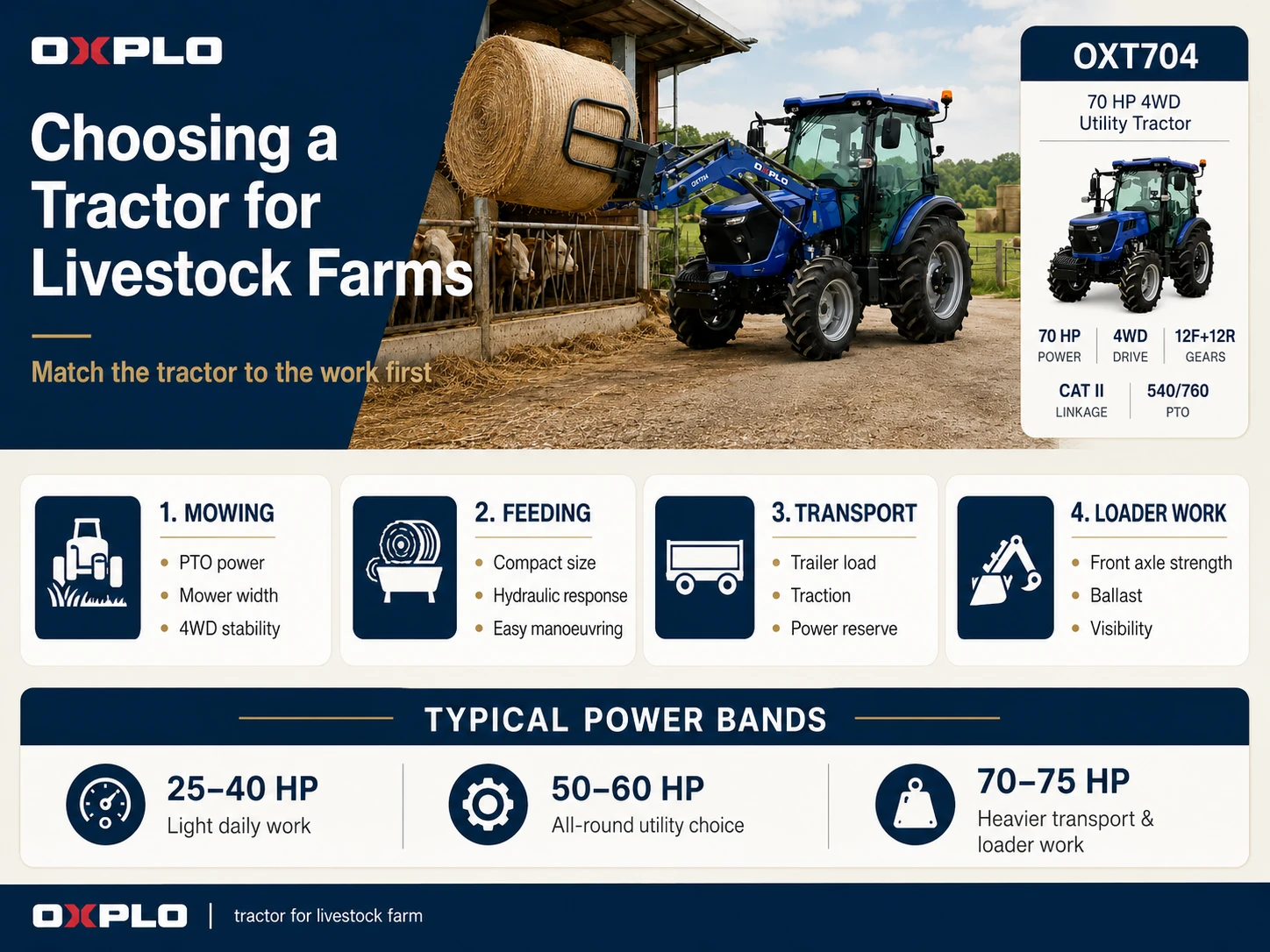
On a livestock farm, a tractor rarely performs only one job. In the morning it may handle hay or silage with a front loader. Later it may mow pasture, tow a trailer loaded with feed, transport bedding materials, or carry out routine yard maintenance around barns and feeding areas. That is why choosing the right tractor for livestock farm use requires a broader selection logic than simply asking, “How much horsepower do I need?”
For modern cattle, dairy, sheep and mixed livestock operations, the best machine is usually not the biggest tractor on paper. It is the tractor that matches the daily workload, the implements already in use, the transport distances, the working surface, and the level of manoeuvrability required around buildings. In other words, a practical livestock tractor must be selected around real farm work.
At OXPLO, we recommend starting with the task mix first, then checking PTO demand, hydraulic performance, linkage category, traction, overall dimensions and power reserve. This work-first method helps buyers choose an efficient utility tractor that can support mowing, feeding, transport and loader work across the agricultural year.
I. Why Livestock Farms Need a Different Tractor Selection Logic
A crop-only farm and a livestock farm may own land of similar size, but their tractor requirements can be very different. A tractor for cattle farm use often spends a large share of its time on repeated daily tasks rather than occasional seasonal fieldwork. That changes the buying criteria completely.
A livestock farm tractor may need to enter narrow barn passages, reverse frequently in feed yards, work with a front loader, tow a trailer on gravel lanes, and still run a mower or topper in grassland. This means visibility, shuttle convenience, tyre choice, compact dimensions and hydraulic responsiveness can matter just as much as engine output.
That is why OXPLO encourages buyers to define the work sequence first: What does the tractor do every day? What does it do every week? Which jobs are seasonal but critical? Once this is clear, the selection process becomes much more accurate and much more practical.
II. Mowing and Grassland Work: Choose a Farm Tractor for Mowing Around the Implement
PTO output matters as much as rated horsepower
Many livestock farms depend on regular pasture topping, grassland maintenance, hay-area mowing or rough vegetation control. For this reason, a farm tractor for mowing should never be selected by engine horsepower alone. Buyers should begin with the mower width, required PTO speed, field conditions and the expected working pace.
A smaller mower working on light pasture may be handled by a compact 25–40 HP machine. However, once mowing width increases, grass becomes denser, or fields become uneven and sloped, the tractor needs more stable PTO performance and a better traction platform. On many livestock farms, a 40–60 HP OXPLO tractor gives a strong balance between efficiency and manoeuvrability for regular grassland work.
Stability and 4WD are critical in pasture conditions
Pasture work often takes place on ground that is softer, wetter and less even than cultivated arable land. A suitable livestock tractor therefore needs good weight distribution, reliable 4WD traction and tyres matched to grassland conditions. A tractor that is too light may lose grip; a tractor that is too large may damage the turf or become unnecessarily awkward in smaller paddocks.
For that reason, OXPLO sees mowing as a balance problem, not only a power problem. The right machine should carry enough PTO reserve for the mower, enough stability for changing ground conditions, and enough agility to work efficiently across the farm.
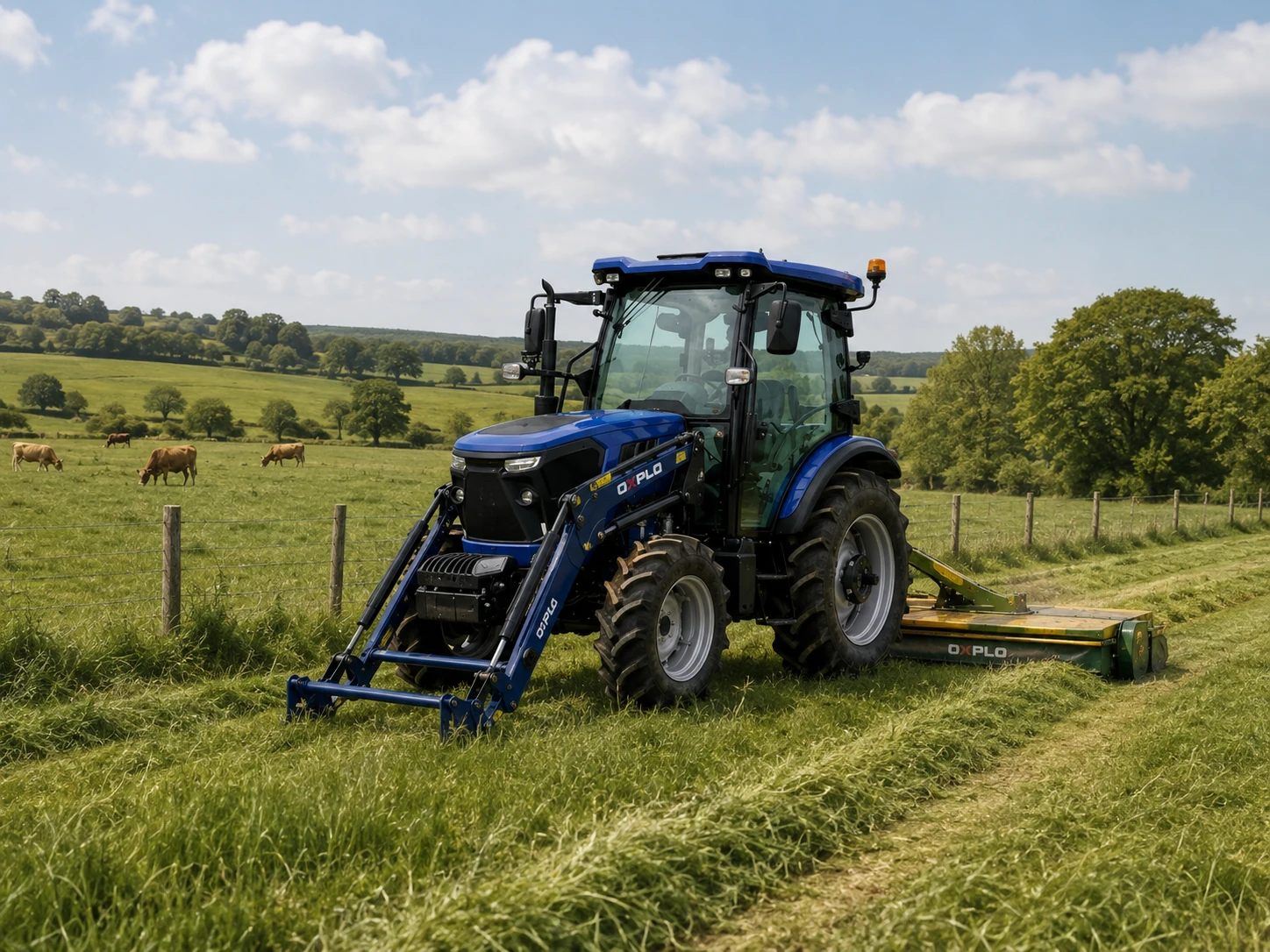
Figure 2. OXPLO tractor in a livestock grassland mowing setting.
III. Feeding and Loader-Based Daily Work: The Core of Many Livestock Operations
A tractor with front loader is often the real workhorse
On many dairy and cattle units, feeding support is one of the most frequent tractor tasks. This includes moving hay bales, handling silage, carrying feed bags, loading bedding, clearing feed areas and moving materials around the yard. In this context, a tractor with front loader is often the most valuable machine on the farm.
For OXPLO, loader suitability is not only about lift capacity. A productive tractor with front loader also needs front axle strength, stable chassis design, appropriate ballast, useful visibility, practical reversing control and hydraulic response that allows the operator to work smoothly and repeatedly throughout the day.
Compact size can outperform raw horsepower
Feeding alleys, barn entrances, cattle sheds and yard passages are often tighter than field workspaces. A large tractor may look powerful, but if it turns poorly or wastes time around buildings, it may not be the best livestock tractor. That is why many farms prefer a mid-range utility tractor with manageable overall dimensions, good cab visibility and easy manoeuvring rather than an oversized machine.
OXPLO buyers looking for a tractor for livestock farm use should therefore assess how often the machine must work around buildings. When daily loader work is important, compact efficiency and hydraulic responsiveness often create more value than simply buying extra horsepower.
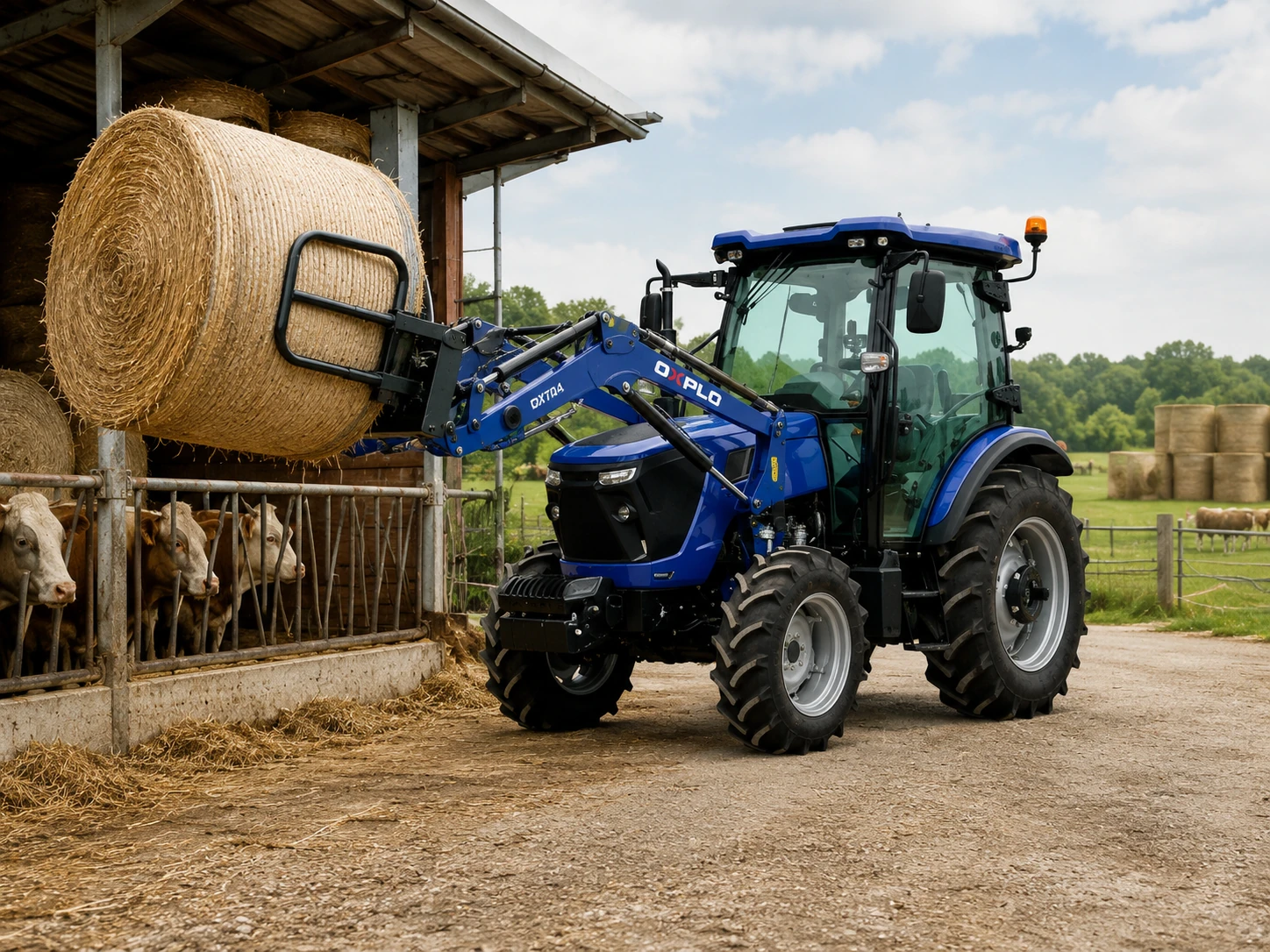
Figure 3. OXPLO tractor with front loader handling hay in a feeding area.
IV. Transport Work: Trailer Load, Traction and Power Reserve
Transport needs can change the whole selection decision
Transport is frequently underestimated in livestock tractor buying decisions. Yet many farms regularly move feed, hay, bedding, manure, tools, fertiliser and other supplies between barns, stores and fields. If the tractor spends significant time towing trailers, transport performance should be considered a primary selection factor.
A practical tractor for livestock farm use must be matched to the heaviest realistic trailer loads, the road or yard surface, and the travel distance involved. A farm working on rolling terrain with loaded trailers will demand more traction, more braking confidence and more power reserve than a flatter farm performing only light yard transport.
4WD and chassis stability help in real-world hauling
When trailer work involves slopes, muddy gateways or rough access tracks, 4WD becomes especially valuable. It improves grip during pulling and helps the tractor remain composed when starting, stopping or manoeuvring under load. OXPLO typically recommends that buyers assess transport work in terms of route, surface and payload rather than simply looking at acreage alone.
For many medium livestock operations, the all-round utility range—often around 50–60 HP—covers mowing, feeding and moderate transport effectively. Where transport is heavier and more frequent, a 70 HP OXPLO platform may provide the useful reserve needed for dependable daily performance.
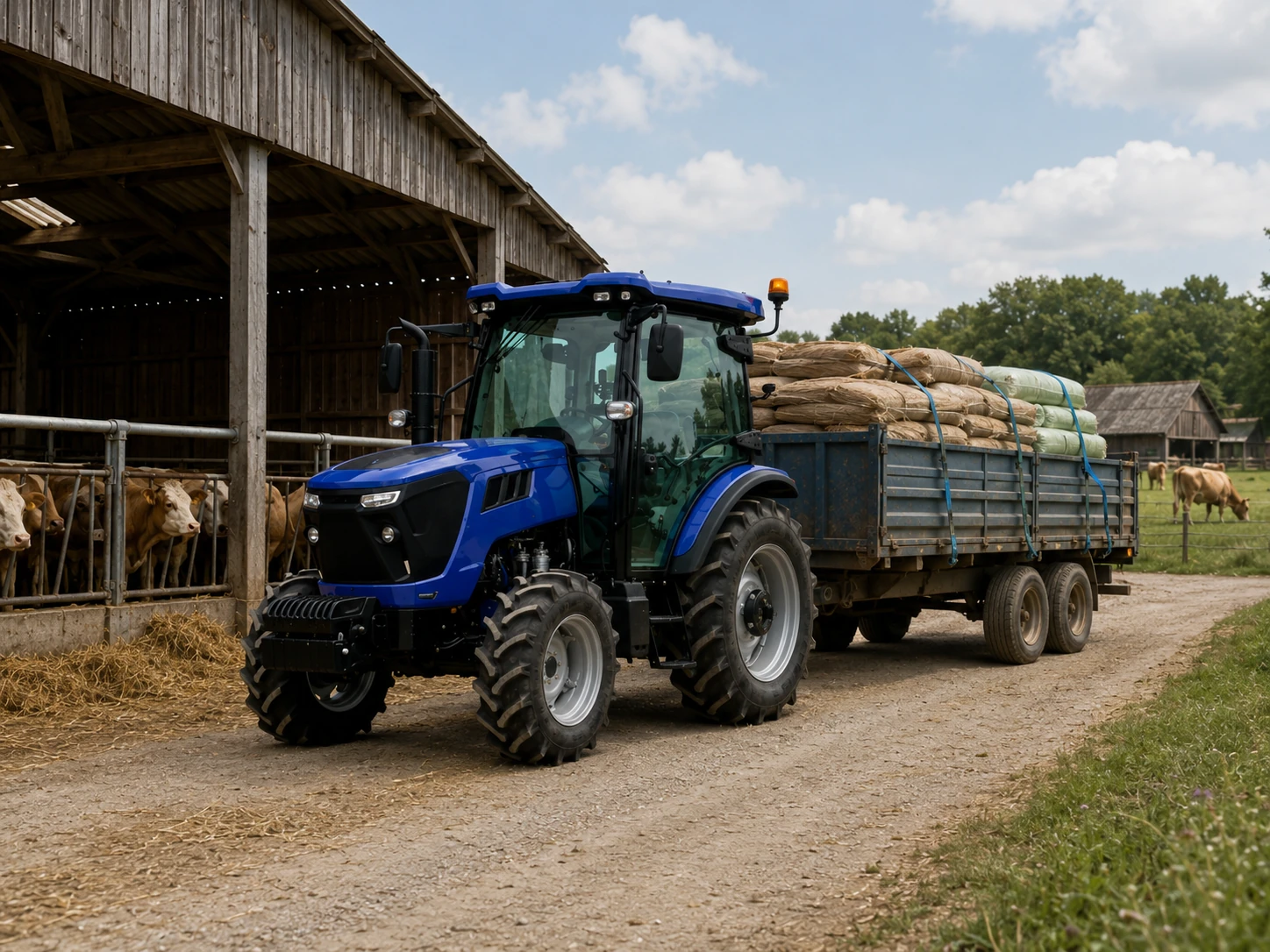
Figure 4. OXPLO tractor supporting transport work on a livestock farm.
V. Power Bands: How Much Horsepower Does a Tractor for Livestock Farm Use Really Need?
25–40 HP: light daily work and small-scale livestock use
This range suits smaller holdings, lighter mowing, basic trailer work, yard maintenance and modest feeding tasks. A compact OXPLO tractor in this category can be a practical choice where access is tight and implement loads are moderate.
50–60 HP: the versatile all-round utility tractor range
For many buyers, this is the sweet spot. A 50–60 HP utility tractor can often support mowing, feeding, loader work, pasture maintenance, spreading and everyday transport. It provides enough working capacity for regular farm use while staying manageable in size. That is why OXPLO often sees this band as the natural fit for many livestock and mixed-farm customers.
70–75 HP: heavier transport, larger implements and more reserve
Where work intensity rises, pasture area is larger, trailer loads are heavier or loader tasks are more demanding, a 70 HP platform becomes especially attractive. It offers stronger reserve for work peaks and can serve farms that need one machine to cover several more demanding roles. OXPLO’s larger utility platforms are especially relevant here for buyers who want more capability without moving to unnecessarily large machinery.
VI. Build the Tractor as a System: PTO, Linkage, Hydraulics and Attachments
A true livestock tractor is not just an engine and a cab. It is a working platform that must connect correctly with the mower, trailer, spreader, loader, bale fork, bucket, pallet fork and other attachments used through the year. That is why OXPLO encourages buyers to think in systems, not isolated specifications.
Check linkage and implement compatibility
Before purchase, farmers should confirm the linkage category, implement weight, PTO requirements, hydraulic demand and working width of their planned attachments. A tractor may have enough power, but still be the wrong fit if the linkage category or hydraulic capacity is not appropriate.
Think ahead to future use
A buyer selecting a tractor for cattle farm work today may later wish to add a front loader, a larger mower, or a different trailer. Choosing a flexible OXPLO utility tractor with suitable PTO and implement compatibility can protect the purchase over the long term and reduce the risk of outgrowing the machine too early.
VII. How OXPLO Supports Livestock Farm Buyers
OXPLO focuses on practical tractor selection for real agricultural work, including grassland management, livestock operations, farm transport and attachment-based applications. Instead of pushing a one-size-fits-all answer, OXPLO encourages buyers to match the machine to the daily workload, implement demands and destination-market requirements.
Buyers can start by exploring the main OXPLO tractor range, then move into product-specific pages according to horsepower and application. For example, the OXT604 and OXT704 platforms are especially relevant for livestock and mixed-farm buyers who need a capable utility tractor with 4WD, PTO flexibility and broader implement compatibility.
Useful OXPLO links: OXPLO Homepage | 25–70 HP Farm Tractors | OXT604 60 HP 4WD Utility Tractor | OXT704 70 HP 4WD Farm Tractor | Attachments & Support | Contact OXPLO
VIII. Conclusion
Choosing the right tractor for livestock farm work is not about chasing the biggest horsepower number. It is about matching the machine to mowing, feeding, transport and loader work in a balanced, realistic way. A good livestock tractor should deliver appropriate PTO performance for grassland work, reliable hydraulic response for daily handling, enough 4WD traction for uneven surfaces, and the manoeuvrability required around barns and yards.
For lighter daily work, a compact OXPLO tractor may be enough. For many farms, a 50–60 HP OXPLO utility tractor offers the most practical balance. For heavier transport, stronger loader work and larger operating demands, a 70 HP OXPLO platform may provide the reserve needed for long-term efficiency.
Most importantly, OXPLO believes the best tractor for cattle farm and livestock use is the one selected around the job, the implement and the working environment—not simply around a headline power figure. Match the tractor to the work first, and the buying decision becomes far clearer.