

A tractor mower can finish an open grass field efficiently, yet leave a contractor spending hours around narrow orchard entrances, drainage banks, tree guards and uneven boundaries. The problem is rarely solved by buying more horsepower. It is that the tractor-and-implement combination cannot complete every part of the site safely or without additional work.
For European orchard owners, rural estates, landscaping contractors and municipal maintenance teams, the Remote Control Mower vs Tractor Mower decision should begin with one question: what work remains after the main mower has finished? That unfinished work determines whether an additional machine can earn its place in the fleet.
A tractor-mounted mower remains a strong choice for accessible grassland. A suitably specified tracked remote-controlled mower may help on restricted ground, but only if it fits the access route, handles the vegetation and operates within verified safety limits. This guide shows how to make that judgment and where OXPLO equipment may be relevant.
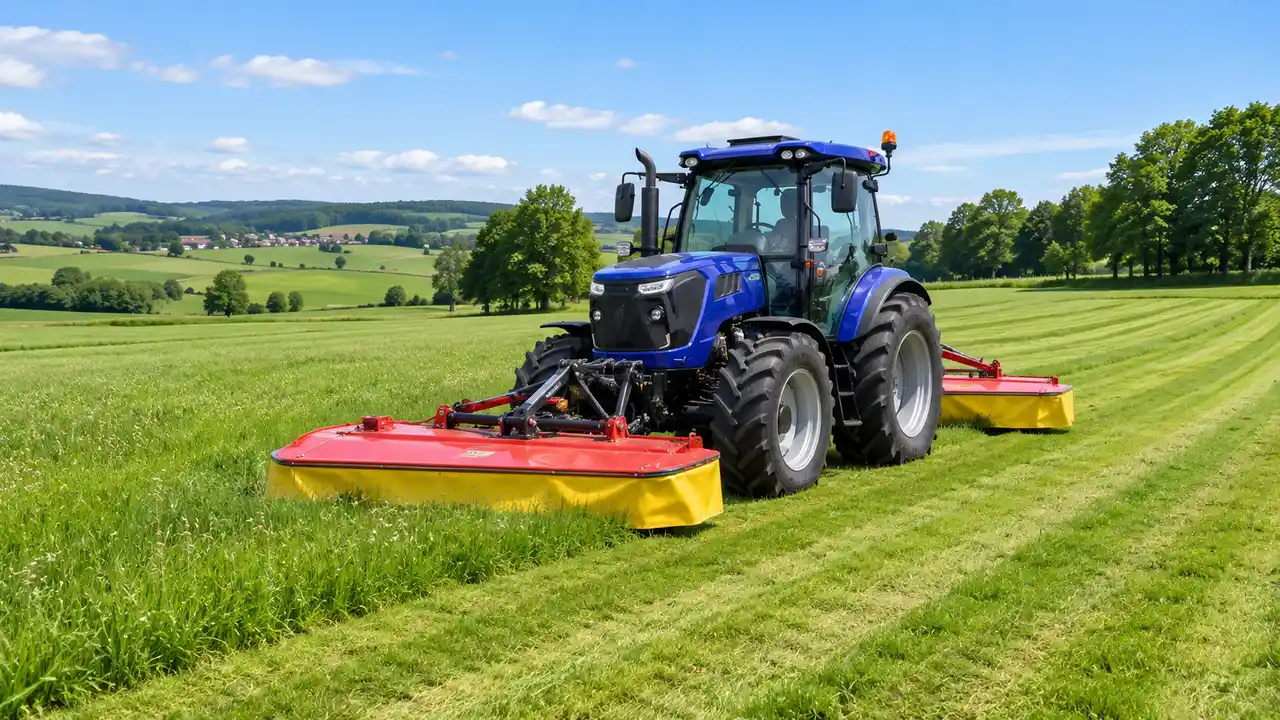
Figure 01 | Tractor maintaining an open field with a mowing implement. Illustration only; attachment availability and model compatibility require confirmation.
I. The Real Problem: The Work a Tractor Cannot Finish
A fast first pass can hide a slow second operation
Imagine an estate contractor maintaining several fields, an orchard and a grassed drainage corridor. The tractor handles the accessible fields in a morning. The crew then changes equipment to cut around posts, gates, trees and the drainage bank. These fragmented sections can consume an unexpectedly large share of the visit because operators repeatedly stop, reposition and work around obstacles.
The invoice covers the entire job, not just the hectares cut by the tractor. Consequently, complete-job time, including unloading, safety checks, secondary trimming and transport, is a better purchasing measure than advertised cutting width alone.
Four recurring constraints usually create the problem: restricted entrances, insufficient turning space, terrain outside the tractor’s safe working envelope and obstacles that force extensive finishing with handheld tools. Adding engine power does not remove any of those constraints.
Why a second mowing method can have commercial value
A dedicated mower is useful when it eliminates a meaningful part of the second operation. It may reduce repeated equipment changes, shorten finishing work or help a contractor service sites that were previously difficult to accept. These are potential benefits, not guaranteed savings: the machine must be proven on the actual ground before its economic value can be calculated.
For an OXPLO customer who already owns a tractor, the most sensible question may therefore be whether to complement that tractor, not replace it. For buyers starting from scratch, the choice depends on the proportion of open ground versus awkward sections and on other agricultural work the tractor must perform.
II. Remote Control Mower vs Tractor Mower: Match the Machine to the Task
A practical comparison for European buyers
Decision factor | Tractor-mounted mower | Tracked remote-controlled mower |
Large, accessible grassland | Usually productive with a suitably wide attachment | Typically takes more passes with a smaller cutting width |
Narrow entrances and headlands | Limited by the full tractor-and-attachment envelope | May suit tighter spaces if overall dimensions allow access |
Irregular slopes | Constrained by tractor, implement and site-specific stability limits | May be useful on approved terrain; track traction is not guaranteed |
Operator arrangement | Operator remains on the tractor | Operator controls the machine from a separate position |
Work beyond mowing | Tractor can operate compatible farm implements | Primarily a dedicated mowing machine |
Main cost driver | Attachment match, labour time and tractor utilisation | Whole-job efficiency, transport, upkeep and remaining manual work |
When the tractor is the better purchase
On large, accessible grassland, a tractor with a compatible mower often offers better coverage and more year-round utility. It may also handle towing, field preparation or property maintenance when appropriately equipped. Buyers should check the attachment’s required PTO power and speed, three-point linkage, hydraulic connections, weight, balance and turning clearance—not just the tractor’s engine horsepower.
OXPLO’s tractor product range provides a starting point for evaluating an agricultural platform, while the OXPLO PTO, hydraulics and three-point hitch guide explains how to verify implement compatibility. A mower attachment is not automatically suitable for every OXPLO tractor configuration.
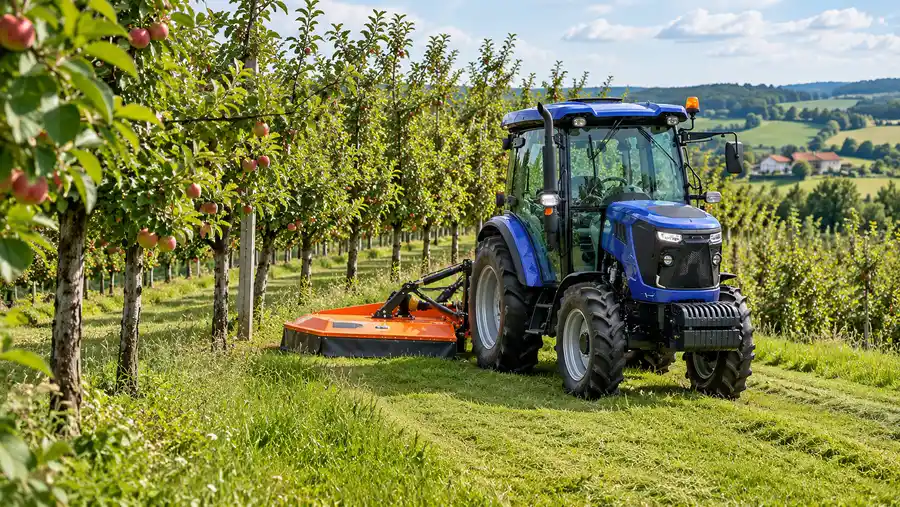
Figure 02 | Tractor working in an orchard lane. Check turning clearance, row width and mower overhang.
When a remote mower becomes a credible tractor mower alternative
Remote-controlled mowing becomes relevant when a conventional tractor cannot enter the work area, manoeuvres inefficiently around obstacles or faces site conditions that make the tractor-and-attachment combination unsuitable. The benefit is not necessarily faster mowing per hectare; it is the possibility of finishing more of the property with fewer separate operations.
OXPLO’s remote-controlled mower category is relevant to buyers comparing this specialised method with tractor-based maintenance. The next step is to test actual access, vegetation and operator-control requirements, rather than assume that all tracked machines can operate on all difficult ground.
III. Four Sites Where the Choice Changes
Orchards and vineyards: measure the whole working envelope
Row spacing on a planting plan is not the same as the clearance available to machinery. Low branches, irrigation lines, trellis posts and tree guards reduce usable width. A tractor may fit between rows yet lack sufficient room to turn with an attached mower.
Record the narrowest gate, the turning area at each headland and the actual distance between permanent obstacles. For remote equipment, compare those measurements with the external machine width, not the nominal cutting width. A 55 cm cutting deck does not prove a machine can enter a 55 cm or even an 80 cm opening.
Where a compact mower can reach previously hand-trimmed sections, an orchard manager may save a separate finishing operation. On wider rows with predictable terrain, the tractor may still be the faster option. OXPLO buyers should send photographs and clearance measurements before discussing a model.
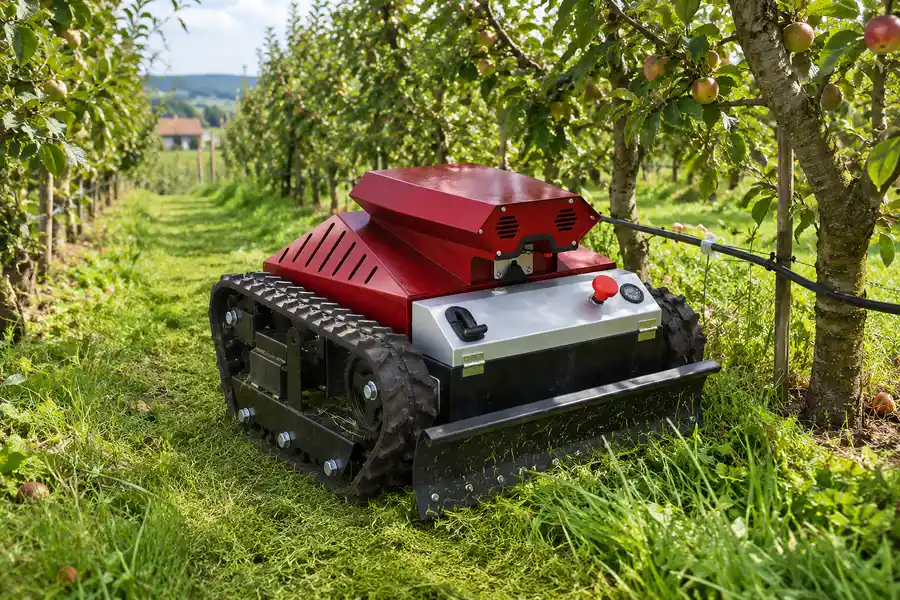
Figure 03 | OXPLO-style tracked remote mower in a tree-lined orchard passage. Compare the machine’s overall width with the narrowest access route.
Drainage banks and slopes: traction is not the same as stability
A bank can be dry, firm and traversable on one visit, then slippery after rainfall. Wet grass over clay, loose stones, hidden ruts and soft drainage edges create different hazards. A tracked chassis may support mobility on some uneven surfaces, but it does not prevent sliding or overturning.
Buyers must distinguish maximum climbing capability from the slope on which continuous mowing is permitted. They also need to distinguish travelling uphill from working across a side slope or turning at the top of a bank. Ask for the manufacturer’s operating limits and ground-condition exclusions for the exact machine.
The separate OXPLO slope-mowing safety guide explores traction, operator positioning and stopping procedures in more detail. No published climbing figure should be used as a universal safe working angle.
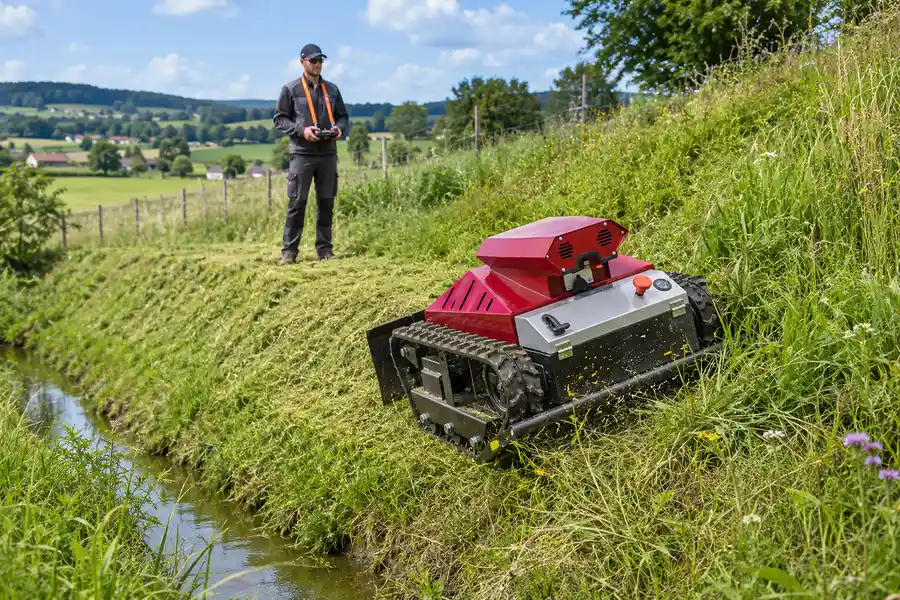
Figure 04 | Remote-controlled mowing beside a drainage bank. Use only within the manufacturer’s approved working limits and site safety plan.
Fences, tree guards and retaining walls: quantify remaining trimming
A main mower may leave narrow margins around posts, fixed structures and trees. A smaller remote-controlled mower may reach some of these awkward areas and reduce brushcutter work. It is not, however, a precision edging tool: a blade housing still needs clearance, and stones or metal fragments create thrown-object and blade-damage risks.
During a trial, measure how many minutes of manual trimming remain after the remote mower has finished. This is more useful than claiming that a compact machine eliminates manual work entirely.
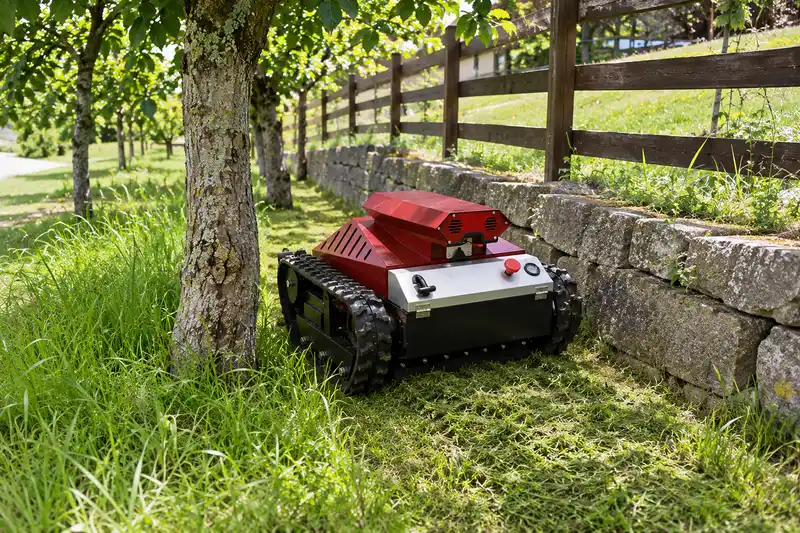
Figure 05 | Remote mower working around a tree and retaining wall. Verify clearance and measure any remaining manual trimming.
Municipal verges and fragmented properties: the working method matters
Roadside and public-area maintenance introduces traffic, pedestrians, concealed debris and restricted sightlines. Remote operation changes the operator’s location but does not eliminate thrown-object hazards or the need to maintain an exclusion zone. A long stated radio range is not a reason to operate without safe visibility.
For estate contractors with several small mowing zones, moving between areas can also dominate the schedule. Check routes, gates, storage access, loading arrangements and machine recovery before assuming that a smaller mower will shorten the workday.
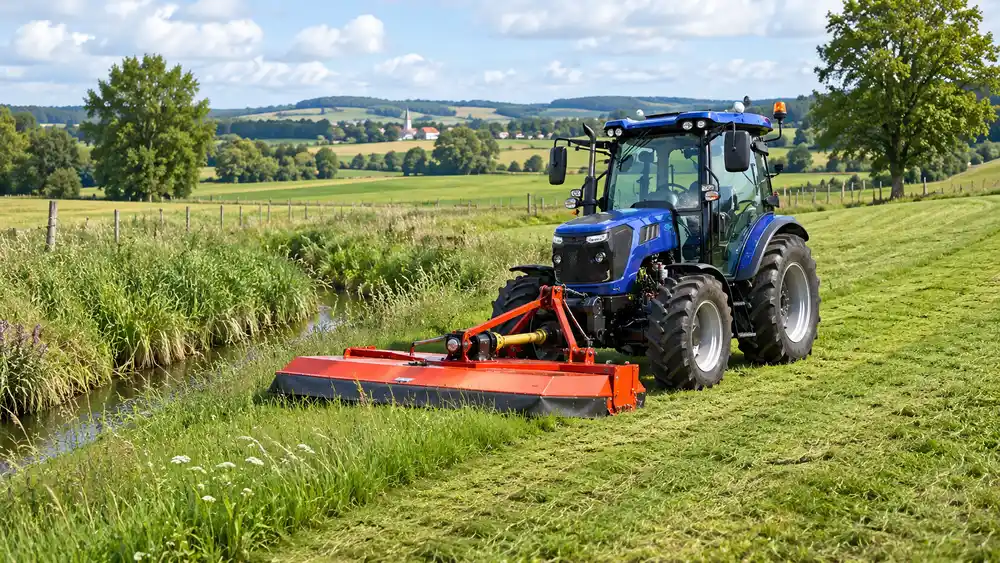
Figure 06 | Tractor mowing beside a drainage corridor. Assess ground support, stability and edge clearance before operating.
IV. Does a Remote Mower Reduce the Total Job Cost?
Compare the existing method with a realistic alternative
For many customers the relevant comparison is tractor plus manual brushcutting versus tractor plus remote mower plus any remaining trimming. The tractor may continue doing the large, open section in both methods.
An effective field-capacity estimate is:
Effective area (ha/hour) = cutting width (m) × actual mowing speed (km/hour) × field efficiency ÷ 10
Field efficiency accounts for overlap, turns, reversing and other interruptions. Actual cutting speed may be much lower than a machine’s published travel speed when vegetation is dense or wet.
Worked example: a recurring restricted-area contract
Assume an estate has 0.24 hectares of restricted grass that the tractor cannot access safely. These figures are illustrative planning assumptions—not measured OXPLO performance.
Variable | Existing manual method | Hypothetical remote-mower method |
Area to complete | 0.24 ha | 0.24 ha |
Assumed effective output | 0.040 ha/hour | 0.070 ha/hour |
Main cutting time | 6.0 hours | 3.43 hours |
Additional setup and finishing | Included in assumption | 0.50 hour |
Estimated total time | 6.0 hours | 3.93 hours |
Under those assumptions, the difference is about 2.07 working hours per visit. At 20 visits per year, that is approximately 41 hours of potentially released labour time. At an illustrative fully burdened labour rate of €30/hour, the gross annual value is around €1,240.
This is not net savings. The buyer must subtract transport, fuel or electricity, blade and track wear, inspections, maintenance, depreciation and financing. If the remote mower cannot cope with the real vegetation or still leaves extensive hand trimming, the calculated benefit may disappear.
The procurement test: will the machine earn its place?
For a landscape contractor, three variables matter most: the number of repeat visits, the proportion of manual work actually replaced and the availability of suitable sites across the customer portfolio. A remote mower used on many recurring jobs may justify ownership; a machine used twice a year may not.
OXPLO should be asked to clarify the cutting-system configuration and support arrangements before the buyer builds a payback model. Buyers should also request representative mowing footage or a supervised field demonstration. Isolated maximum-speed or battery figures do not prove commercial output.
V. What the OXPLO Tracked Mower Actually Offers
Product features linked to real customer problems
The OXPLO Remote Control Crawler Lawn Mower is published in 55 cm and 100 cm cutting-width versions. Both are listed with a tracked undercarriage, two rotary manganese-steel blades and adjustable 30–150 mm cutting height.
Remote operation allows the operator to control the machine from a separate position instead of continuously following immediately behind it. This may be useful for suitable restricted-area work, but verified visibility, exclusion and stopping procedures remain essential.
Tracked mobility may help on certain irregular surfaces by providing a different ground-contact arrangement from wheels. OXPLO does not, however, guarantee universal traction on wet clay, loose soil or steep side slopes.
Adjustable cutting height allows operators to select different cutting positions for appropriate vegetation. It is not proof that the machine can cut woody brush, dense saplings or any arbitrary grass height.
Published configurations: choosing access or coverage
OXPLO published specification | 55 cm configuration | 100 cm configuration |
Cutting width | 55 cm | 100 cm |
Adjustable cutting height | 30–150 mm | 30–150 mm |
Machine weight | 180 kg | 350 kg |
Overall dimensions | 1100 × 920 × 700 mm | 1250 × 1450 × 800 mm |
Listed travel speed | 3–4 km/hour | 3–5 km/hour |
Cutting system | Two rotary blades | Two rotary blades |
Source: OXPLO’s published product page, reviewed November 2026. Confirm the orientation of overall dimensions, the complete power system and the machine’s permitted working conditions. Travel speed is not guaranteed cutting speed.
The 55 cm configuration is a starting point when physical access and manoeuvrability dominate. The 100 cm version may reduce the number of passes on wider, accessible areas. The weight difference also affects ramp capacity, trailer payload, tie-down arrangements and recovery planning.
OXPLO has a separate 55 cm vs 100 cm cutting-width selection guide for buyers comparing the two configurations in greater detail.
Technical claims that require confirmation
OXPLO publishes maximum climbing ability of up to 45° and an unobstructed remote-control range of up to 800 metres. Neither figure establishes a safe continuous mowing slope or permits operation beyond safe visibility. Published motor and battery figures also cannot, on their own, establish blade-shaft output or energy cost per completed hectare.
Commercial buyers should ask OXPLO to confirm operating-slope limits, signal-loss behaviour, emergency-stop functions, complete propulsion/cutting power arrangements and maintenance intervals for the exact supplied configuration. Those answers will determine whether a published feature solves the customer’s particular job.
VI. What European Buyers Should Check Before Importing or Operating
Safety and documentation before the first job
European buyers need machinery suitable for its intended use and the applicable market requirements, not just a specification sheet. Confirm the exact model, required conformity documentation, relevant declarations, operating instructions and language requirements for the destination country.
For EU machinery, the regulatory transition to Regulation (EU) 2023/1230 generally takes effect on 20 January 2027; the applicable requirements depend on the timing and circumstances in which machinery is placed on the market. For non-EU destinations, including Great Britain, check the relevant requirements separately. Do not treat documentation for an OXPLO tractor as evidence of conformity for an OXPLO remote mower.
Before commissioning, establish the approved operating envelope, site risk assessment, guarding and exclusion arrangements, operator training, stopping behaviour, and the recovery method for an immobilised machine. If safe visibility or separation from the public cannot be maintained, choose a different method or time for the work.
Parts and downtime are part of the buying decision
For a professional operator, a mower that cannot work during the maintenance season creates missed visits and contract pressure. Ask about blade and track wear parts, routine inspections, cleaning access, service intervals, diagnosis and replacement-part availability.
OXPLO describes equipment support and attachment sourcing on its support page, but the buyer should still obtain model-specific terms for the remote mower. Confirm what is stocked, what requires ordering, who provides technical assistance and how warranty claims are handled.
When not to recommend a remote mower
A remote mower is not automatically the correct solution when the property is almost entirely open and accessible; when vegetation exceeds the cutting system’s approved capability; when soil or slopes are outside verified limits; or when operators cannot maintain appropriate sightlines and exclusion zones. Honest equipment selection includes identifying these cases before purchase.
VII. A Simple Selection Workflow for Farms, Contractors and Dealers
Step 1: Map the difficult work
Split the site into accessible mowing, restricted passages, slopes and remaining hand-finishing zones. Record the area and frequency of each type of work. Avoid buying a specialised machine for an unmeasured problem.
Step 2: Measure access and describe vegetation
Document the narrowest usable opening, turning space, low obstacles, grass height and density, seasonal wetness and maximum measured gradient. Provide photographs or short videos so OXPLO can understand the operating conditions before recommending a configuration.
Step 3: Choose a working strategy, not just a model
A tractor-only method may be best for accessible farms; a remote-only method may suit some restricted properties; and a combined system may be more practical for mixed sites. Compare the complete job, including transport, setup, trimming and safety controls.
Step 4: Validate on a representative section
Ask the supplier to demonstrate or document a cut on similar vegetation and terrain within approved limits. Record coverage, manoeuvring time, cutting quality, stoppages and remaining manual work. Do not begin by testing the machine on the most hazardous slope.
Step 5: Send a specification-based enquiry
When requesting a quotation from OXPLO, provide: destination country; total and restricted mowing areas; minimum access width; vegetation; slope and surface conditions; expected hours per day; transport arrangements; and quantity. For dealers, add the target customer’s typical application, service expectations and required documentation.
With this information, OXPLO can discuss whether its 55 cm or 100 cm tracked mower is appropriate—or whether a tractor-based solution deserves further evaluation.
Frequently Asked Questions
Can an OXPLO remote mower replace a tractor mower entirely?
Sometimes, but it is not automatically the economical choice. Tractor mowing generally provides efficient coverage on open, accessible ground. OXPLO’s tracked mower may complement it where access or operating conditions make tractor mowing impractical. The best arrangement depends on the total site and the other jobs the tractor performs.
Can a 55 cm mower pass through an 80 cm gate?
Do not assume so. Cutting width and overall machine width are different measurements. Request a dimensioned drawing of the exact OXPLO configuration and allow for fixed obstacles, turning and operating clearance.
Is a remote mower automatically safe on a 45° slope?
No. A maximum climbing specification does not establish a safe continuous mowing gradient, especially for side slopes, wet grass or soft soil. Use the manufacturer’s verified working limits and a site-specific risk assessment.
Will a remote mower eliminate manual brushcutting?
Not necessarily. It may reduce some finishing work, but edges, close obstacles and unsuitable vegetation can still need another method. Measure the manual work remaining after a trial rather than assuming complete replacement.
Which OXPLO mower makes more sense for a contractor: 55 cm or 100 cm?
Choose according to the narrowest access route, typical client-site layout, expected area coverage and transport constraints. The 55 cm cutting-width version prioritises a smaller mowing path; the 100 cm version provides wider coverage. Full machine dimensions and cutting performance still need confirmation.
What should an EU dealer request before placing an order?
Ask for the exact configuration, technical and conformity documents applicable to the destination market, operating instructions, spare-parts details, service procedure, warranty terms, packing and shipping information. OXPLO should also receive the end customers’ typical terrain and workload so the model mix can be evaluated realistically.
Conclusion: Buy the Machine That Finishes the Job
The Remote Control Mower vs Tractor Mower decision is not a contest between old and new equipment. It is a decision about access, operating risk, whole-job productivity and long-term cost.
On open fields, a suitably matched tractor mower often remains the sensible first choice. Where narrow passages, irregular boundaries or approved difficult terrain repeatedly create secondary manual work, a tracked remote-controlled mower may become a worthwhile addition. In mixed properties, using each machine for the tasks it handles well can be more rational than replacing one with the other.
OXPLO’s 55 cm and 100 cm tracked mower options give buyers two configurations to investigate, while the OXPLO tractor range remains relevant for farms needing multi-purpose power and compatible attachments. The appropriate recommendation must be grounded in real measurements, verified operating limits and a complete-cost comparison.
For an application-based recommendation, contact OXPLO with site photographs, access measurements, vegetation details, measured slope, intended workload and destination country. Those details make it possible to discuss the right machine and confirm the technical information before ordering.