
A landscaping contractor buys a wider mower to reduce mowing time, then discovers that it cannot enter several customer gardens. An orchard manager orders a compact mower that fits every row but takes too many passes to maintain the open areas. In both cases, the costly mistake is the same: choosing a cutting width without considering the complete job.
Remote Control Mower Cutting Width affects how much grass a machine reaches in one pass, but the purchase decision also depends on overall machine dimensions, obstacles, ground conditions, vegetation load, transport and finishing labour. For European contractors, estate managers, farms and equipment dealers, the right width is the one that completes more of the contracted work at an acceptable total cost—not necessarily the widest deck.
OXPLO offers a 55 cm and a 100 cm cutting-width configuration in its Remote Control Crawler Lawn Mower. This guide explains where each configuration may be a better starting point, what the manufacturer’s figures do and do not establish, and which checks should precede a B2B purchase.
I. The Hidden Cost of Choosing the Wrong Mower Width
The work left unfinished matters as much as the grass already cut
Consider an estate with open lawn, narrow passages between buildings, and a row of trees beside a fence. The 100 cm cutting path may save passes on the open lawn. If the whole machine cannot enter the narrower sections, however, an operator must bring a second mower or finish them with handheld equipment. Equipment changes, additional staffing, cleaning and loading can consume the theoretical time saving.
The opposite mistake occurs when a 55 cm mower is purchased for a largely open agricultural property. Access may be easy, but more passes and more turns are needed across the same area. The productivity disadvantage becomes significant when mowing is repeated weekly or carried out under a fixed service contract.
Ask a better question than “Which mower cuts faster?”
The purchasing question is: What percentage of the site can this machine finish to specification without a second operation? Buyers should separate the work into open mowing, restricted mowing, trimming, repositioning and transport. A mower that cuts more grass per pass can still cost more per completed hectare if it creates enough extra work elsewhere.
II. 55 cm vs 100 cm: Which OXPLO Machine Actually Fits Your Site?
Cutting width is not the external width of the mower
The 55 cm and 100 cm figures describe nominal cutting paths. They are not the maximum external dimensions of either machine. OXPLO publishes overall size sets of 1100 × 920 × 700 mm for the 55 cm version and 1250 × 1450 × 800 mm for the 100 cm version. The online table does not explicitly identify which dimension is length, width and height; ask OXPLO for a dimensioned drawing that confirms travel orientation and all projecting parts.
An orchard manager should measure the narrowest gate, post-to-post clearance, irrigation obstructions, tree guards, access ramps and headland turning area. A 55 cm cutting path does not mean the equipment can pass through a 60 cm or 80 cm opening. Re-check access at seasonal maximum vegetation growth, not just after pruning.
Published OXPLO configurations
Manufacturer-listed item | 55 cm configuration | 100 cm configuration |
Cutting width | 55 cm | 100 cm |
Adjustable cutting height | 30–150 mm | 30–150 mm |
Published machine weight | 180 kg | 350 kg |
Overall size (orientation to confirm) | 1100 × 920 × 700 mm | 1250 × 1450 × 800 mm |
Listed travel speed | 3–4 km/h | 3–5 km/h |
Listed motor rating | 350 W | 600 W |
Battery capacity | 12 Ah | 20 Ah |
Published working time | 300 minutes | 360 minutes |
Cutting system | Two rotary manganese-steel blades | Two rotary manganese-steel blades |
Chassis | Tracked | Tracked |
Source: OXPLO published mower product page (accessed November 2026). These specifications are not guarantees of field output. The online motor, battery and operating-time figures do not establish blade-shaft power, battery chemistry, or energy consumed per completed hectare. Confirm the complete power configuration with the supplier.
Weight, loading and access are connected
OXPLO lists 180 kg for its 55 cm machine and 350 kg for the 100 cm version. This difference may affect trailer payload, ramp ratings, loading practice, tie-down arrangements, lifting equipment and recovery planning. A lighter machine is not automatically safe to handle without suitable equipment. Conversely, a wider machine that stays on one large property may justify more demanding transport arrangements because it is moved infrequently.
III. How Much Mowing Time Can a Wider Cutting Deck Really Save?
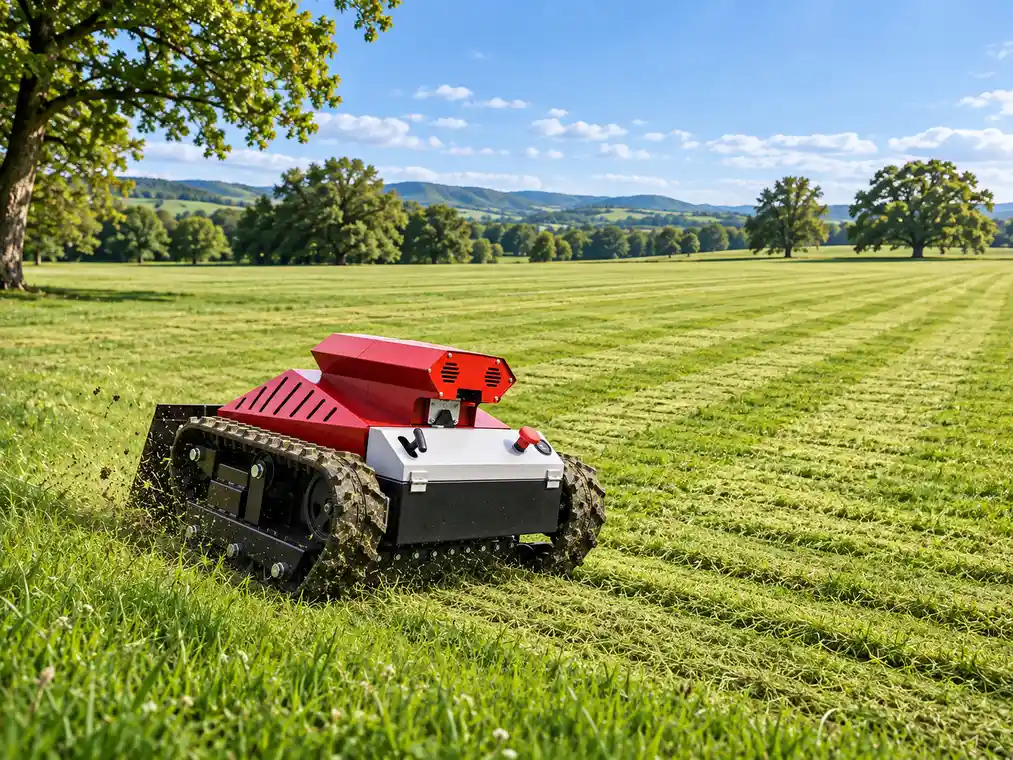
Open, uninterrupted mowing areas can make better use of a wider cutting path.
Use a transparent coverage calculation
A useful planning estimate is: Effective coverage (hectares/hour) = cutting width (metres) × cutting speed (km/hour) × (1 − overlap fraction) × field efficiency ÷ 10. Field efficiency accounts for turning, repositioning and other interruptions while on the site. This is a planning model, not an OXPLO-tested performance rating.
On relatively open ground, assume both machines cut at 2.3 km/h, overlap by 10%, and spend 70% of operating time in productive passes. The 55 cm mower would cover about 0.080 ha/hour, while the 100 cm machine would cover about 0.145 ha/hour. In this example, the wider machine has a meaningful advantage—but only because travel speed and utilisation are assumed equal.
Now consider a fragmented property. Assume the 55 cm mower averages 2.1 km/h, 10% overlap and 65% field efficiency; the 100 cm mower averages 1.4 km/h, 20% overlap and 45% field efficiency because of obstacles and reversing. The indicative outputs are about 0.068 and 0.050 ha/hour respectively. A narrower machine can outperform a wider one under sufficiently constrained conditions. All numbers in these examples are hypothetical.
Include labour, finishing and transport in the calculation
Record how long each visit takes from arrival to departure: unload; assess hazards; mow; turn and reposition; complete any manual trimming; clean; inspect; and reload. For a commercial contract, compare total job cost divided by hectares completed to the required finish. Include labour, fuel or electricity, consumables, transport, service allowances and equipment depreciation. A mower-width choice should be justified with this total-cost measure, not an unsupported percentage improvement in productivity.
Do not confuse published travel speed with cutting speed
OXPLO lists travel-speed ranges, but thick grass, wet vegetation, uneven ground and the cutting mechanism can require slower operation. Ask for a demonstration under a realistic vegetation load. The objective is an acceptable finish and controllable operation, not merely travelling at the machine’s maximum listed speed.
IV. Grass Density, Terrain and Obstacles Change the Decision
Width does not prove suitability for overgrown or woody vegetation
Routine grass maintenance, tall neglected grass and woody brush create different cutting loads and debris hazards. Both OXPLO versions list two rotary manganese-steel blades with a 30–150 mm cutting-height adjustment. That height range concerns the intended cutting position; it does not certify the machine for branches, stones or a particular maximum stem diameter. Before clearing neglected ground, identify vegetation type, debris and obstacles, and request documented limits for the specific cutting system.
Remote operation changes the operator’s position, not the hazard
Remote-controlled mowing may reduce the need for someone to walk directly behind the machine through demanding ground. OXPLO publishes an unobstructed remote-control range of up to 800 m, but that is not a safe operating-distance recommendation. Operators still need a clear view of the machine, an appropriate exclusion zone and a documented response to emergency stop or signal loss. Obtain written descriptions of how propulsion and blades stop and how restarting is controlled.
The advertised climbing figure is not an approved mowing slope
OXPLO lists maximum climbing ability of up to 45° for both configurations. This should not be interpreted as safe continuous mowing on a 45° slope. Side-slope travel, turning, wet soil, vegetation cover and ground failure may introduce different hazards. A 45° slope also corresponds to a 100% grade, not a 45% grade. Verify model-specific working limits and operating procedures, preferably using representative site conditions. For a fuller treatment, read the OXPLO article on steep-slope traction and safe-distance systems.
See: Remote Control Mower for Steep Slopes: Traction, Safe Distance and Stop Systems.
V. Which Width Fits Orchards, Estates and Commercial Contracts?

Orchard access and headland clearance can determine whether a mower is practical on site.
Vineyards and orchards: buy for access first
In vineyards, the nominal planting-row distance can be misleading. Posts, growing vegetation, drip lines, trellis foundations and turning areas all reduce usable space. A 55 cm OXPLO configuration is the more relevant starting point where a smaller machine envelope may unlock access, but only a dimensioned clearance check confirms suitability. A 100 cm version may be attractive in wider lanes where it can maintain long passes without catching crop infrastructure. The buyer should walk and measure the most restrictive route before judging the rest of the property.
Large estates and farms: buy for repeatable coverage
For long, open runs and predictable grass maintenance, the 100 cm OXPLO cutting path can reduce the number of passes. Before ordering, confirm the machine can sustain suitable cutting speeds in the actual vegetation and that access, transport and turning space are adequate. For easy level fields, also compare a conventional ride-on or tractor-mounted mower: a remote-controlled tracked mower is not necessarily the lowest-cost solution for every hectare.
Landscaping businesses: buy for the contract portfolio
A contractor with many small gardens, steep-access parcels and irregular premises may place greater value on compact access than on maximum deck width. A contractor managing several large estates may favour the 100 cm option. Review 10–20 representative jobs, noting the narrowest access, area, obstacles, manual trimming time and trips per day. Then estimate the proportion of contracts that each OXPLO configuration can complete without another machine.
Municipal and roadside work: site controls come first
Road verges, public greenspaces and drainage corridors involve pedestrians, traffic, thrown objects and sometimes limited visibility. Neither 55 cm nor 100 cm width makes an unsafe work method acceptable. Buyers should evaluate approved operating procedures, visibility, stopping behaviour, exclusion zones and site permissions. If traffic or pedestrians cannot be adequately separated, revise the work plan rather than relying on remote operation alone.
VI. How OXPLO’s Two Configurations Address Different Needs
What the 55 cm OXPLO version can offer
The 55 cm OXPLO mower offers a smaller published overall-size set and substantially lower listed machine weight. Its practical opportunity is in restricted or fragmented sites where a wider mower would waste time repositioning or leave inaccessible sections. The key benefit is potential job completeness, not an unverified claim that every narrow vineyard or slope is suitable.
What the 100 cm OXPLO version can offer
The 100 cm OXPLO mower provides about 82% more nominal cutting width than a 55 cm model. On suitable unobstructed ground, that difference creates a real opportunity to reduce mowing passes. The 350 kg listed weight, wider machine footprint and higher published motor rating also mean buyers should pay close attention to access, loading and power-system documentation. Wider cutting width alone cannot guarantee the same proportionate increase in hourly output.
Why having both sizes can matter to dealers
Dealers rarely serve one uniform customer. Orchard owners may ask about row clearance while maintenance companies focus on daily coverage, service parts and reliable transport. The OXPLO range gives dealers two distinct configurations to discuss with those customer groups. An initial order should therefore be based on local customer applications, demonstration findings, spare-parts planning and confirmed documentation—not simply equal quantities of two machines.
Review the current OXPLO remote control mower range before discussing the required model mix or requesting updated technical and commercial information.
VII. What European Buyers Should Verify Before Ordering
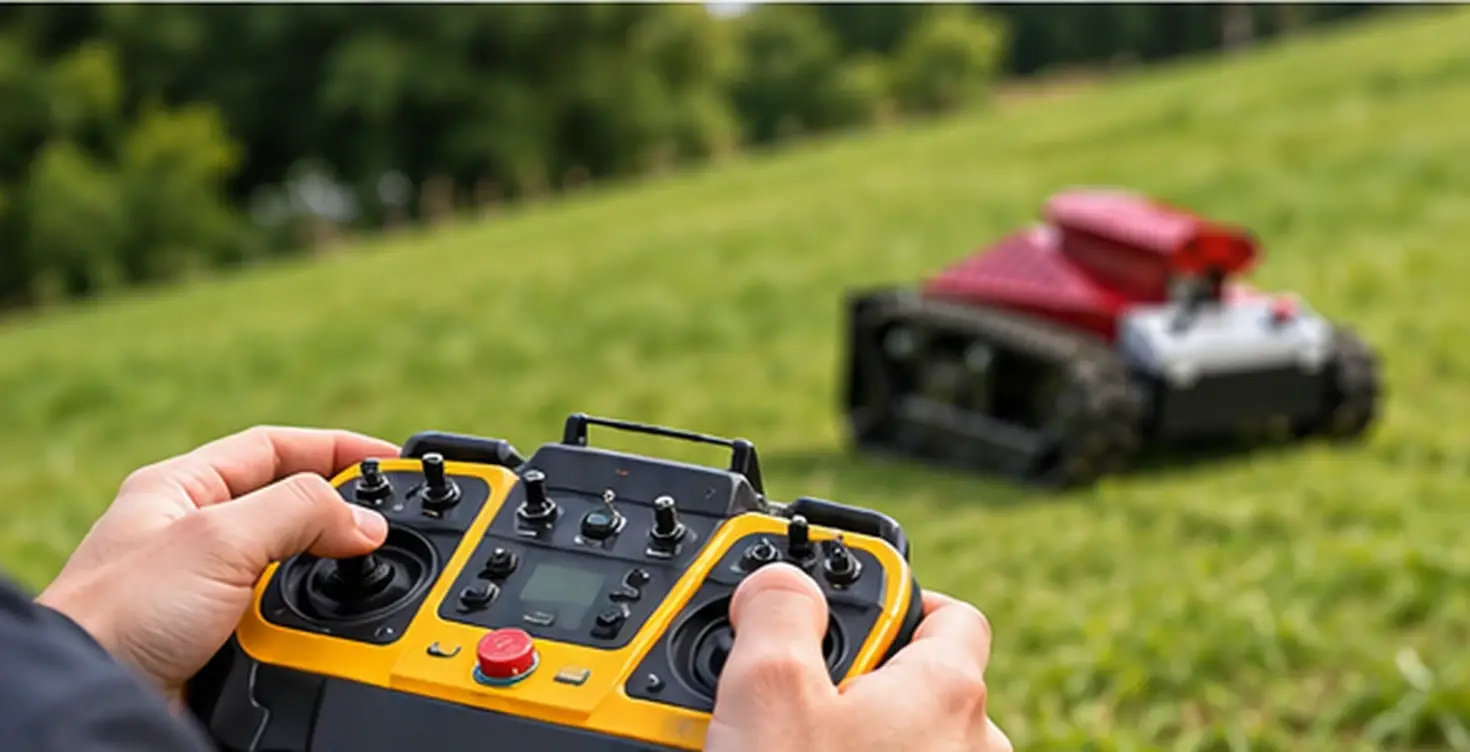
Remote operation changes the operator’s position, but visibility and documented safety controls remain essential. Illustrative scene.
A seven-point buyer’s inspection
- Access survey: smallest gate, minimum usable path, turning space, obstacles and storage dimensions.
- Vegetation survey: normal grass height, seasonal peak, density, debris and any woody growth.
- Terrain survey: measured slopes, soil moisture, travel direction and possible slide or recovery points.
- Cutting demonstration: realistic forward speed, overlap, cutting quality and time lost to repositioning.
- Control verification: line of sight, emergency stopping, signal loss, blade-stop logic and restart requirements.
- Operating support: loading procedure, track and blade replacement, cleaning, routine maintenance and parts lead times.
- Commercial and legal documents: exact model specification, delivery package, relevant conformity declaration, instructions and warranty terms.
Compliance is configuration-specific
For machinery placed on the EU market in November 2026, Directive 2006/42/EC remains the applicable EU machinery framework; Regulation (EU) 2023/1230 becomes generally applicable on 20 January 2027. Importers should obtain the documentation required for the particular mower and destination. Check the declaration of conformity, machine identification, operating instructions in the required language and the correct conformity assessment route. Do not assume certificates held for another OXPLO product also cover this mower. Requirements for Great Britain or other non-EU destinations should be assessed separately.
OXPLO provides general information about technical and parts support, but mower-specific stock, warranty conditions, parts compatibility and service arrangements should be confirmed in writing with the quotation.
What to send OXPLO for a useful recommendation
Send the destination country, order quantity, approximate site area, smallest measured access width, representative photographs, grass type and height, maximum measured slope, working surface, expected daily use and required transport method. These details allow a meaningful discussion of the two cutting-width configurations and any information that still needs to be checked.
VIII. Frequently Asked Questions
Is a 100 cm Remote Control Mower always more productive than a 55 cm mower?
No. It offers a larger nominal cutting path, but frequent turning, restricted access, greater overlap or reduced cutting speed can offset that advantage. Compare finished area per hour under representative conditions.
Can a 55 cm mower pass through a 60 cm gate?
Not on the basis of cutting width alone. A 55 cm cutting path does not describe the external width of the equipment. Ask for a dimensioned drawing and allow appropriate clearance around the full machine envelope.
Does a tracked mower automatically work safely on wet or steep slopes?
No. Track design may help mobility on some surfaces, but traction and stability depend on surface condition, slope direction, machine geometry and approved operating limits. The published climbing capability is not a substitute for a safe-working-slope specification.
Which OXPLO mower size is preferable for a commercial landscaping contractor?
The 55 cm model is a useful candidate for access-restricted and fragmented jobs; the 100 cm model is worth testing for larger, open properties. The right choice depends on your contract mix, labour needed for finishing and total cost per completed job.
Does the 100 cm model necessarily use more energy per hectare?
No conclusion can be drawn from width or nominal motor rating alone. Energy consumption per hectare depends on load, speed, power system, duty cycle and how much area is finished. Request appropriately measured data rather than treating advertised operating times as guaranteed field results.
What should an EU equipment dealer request with an OXPLO quotation?
Request exact configuration details, overall dimension drawings, permissible mowing conditions, stopping and signal-loss information, applicable conformity documentation, language-specific instructions, parts supply arrangements, destination delivery terms and written warranty coverage.
IX. Conclusion: Choose the Width That Completes the Job
The most useful Remote Control Mower Cutting Width is the one that matches a measured worksite and a realistic business workload. On accessible, relatively open ground, a 100 cm cutting path may reduce passes and raise usable coverage. In orchards, gardens and fragmented commercial jobs, the 55 cm OXPLO configuration may be the stronger option if its verified external dimensions unlock more of the worksite.
The choice should never rest on cutting width alone. Grass density, terrain, visibility, machine stability, transport, finishing labour and parts availability may change the economics. OXPLO’s two tracked configurations provide a relevant starting comparison, but the final recommendation should be grounded in actual site measurements and confirmed machine documentation.
For an application-specific comparison, contact OXPLO with your access measurements, mowing area, terrain photographs, vegetation type and expected daily workload. This will help identify the questions to resolve before a commercial quote is finalised.