
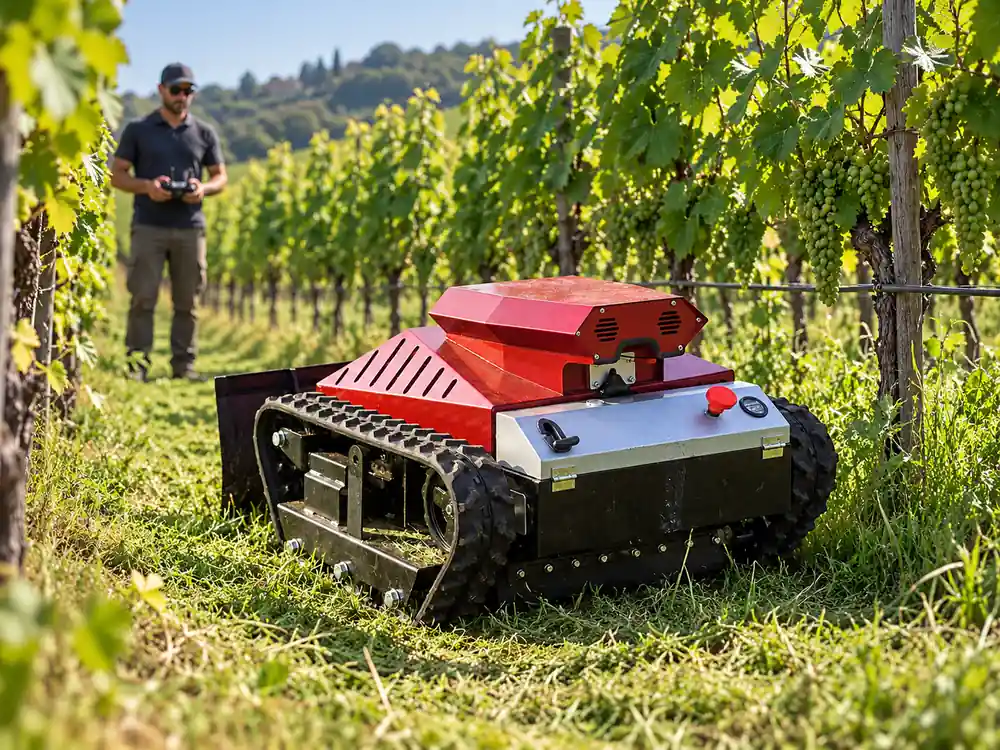
A Technical Buying Guide for Efficient, Safe and Cost-Effective Vineyard Row Mowing
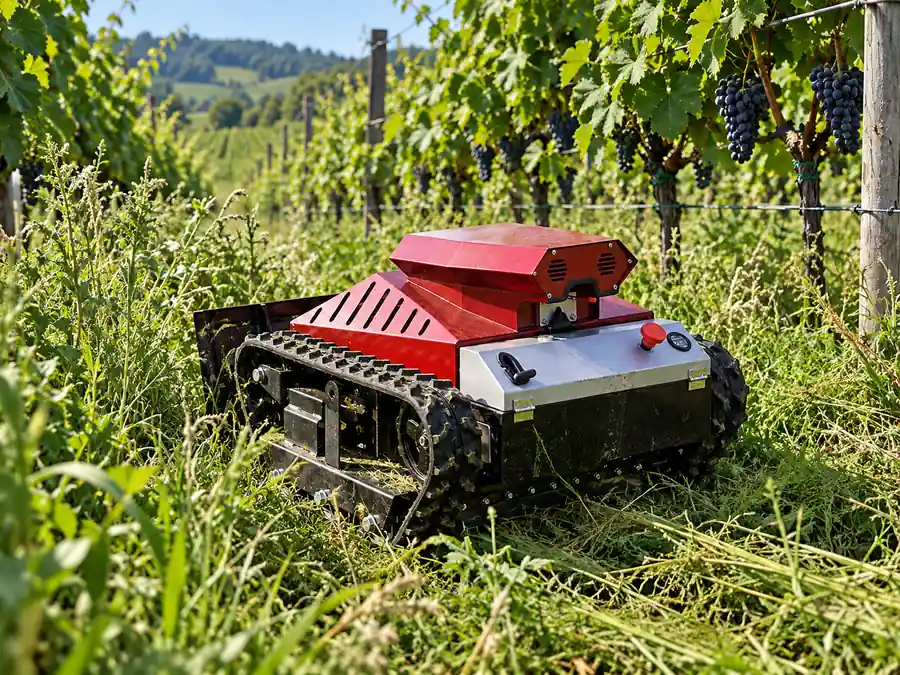
Figure 1. OXPLO remote control mower operating in a vineyard row, showing the compact tracked design used for narrow-row mowing.
Vineyard mowing looks simple until the machine enters the row. Then the real constraints appear: trellis posts, drip lines, uneven soil, cross-slope travel, limited headland space, seasonal vegetation surges and the need to finish maintenance without damaging vines.
That is why choosing a Remote Control Mower for Vineyards should not begin with horsepower, top speed or the longest specification list. The right process starts with the vineyard itself. A machine can have impressive output on open ground and still lose time every day if it is too wide for the narrowest row, unstable on lateral slopes, difficult to turn at row ends or poorly matched to the vegetation load.
This guide uses an engineering-first selection method. It explains what to measure, which trade-offs matter, how to estimate effective productivity and total cost of ownership (TCO), and when a Tracked Mower for Vineyards is more practical than a conventional ride-on or tractor-mounted mowing system.
Practical principle: Do not buy the mower first and then try to make the vineyard fit it. Measure the operating envelope first, then select the machine. |
I. Why Vineyard Mowing Is an Operating-System Problem
A vineyard is a constrained production environment. Mowing equipment does not work in an empty field; it travels through a corridor bounded by trunks, trellis wires, posts, irrigation hardware and living canopy. The terrain under that corridor may change within a single row, especially in hillside vineyards.
The five constraints that usually determine whether a Vineyard Mower works efficiently are:
- Minimum clear row width, not the nominal or average row spacing.
- Longitudinal and cross-slope conditions, including wet-grass and soft-soil periods.
- Headland turning area and the number of tight row transitions per hectare.
- Vegetation density and stem type, from routine grass to tall weeds or woody regrowth.
- Maintenance frequency and the time window available to complete mowing.
These variables interact. A wider cutting deck can reduce passes, but it can also reduce clearance. A heavier tracked platform can improve traction, but it may increase transport effort and ground disturbance during tight turns. A high maximum slope number can look attractive, but it says little about safe, continuous cross-slope work.
II. Start with Vineyard Geometry, Not Mower Horsepower
Before comparing machines, create a simple site sheet. For professional Vineyard Row Mowing, geometry is often the first filter because it determines whether the machine can physically enter, maintain clearance and turn without repeated repositioning.
Measure the narrowest usable row
Do not rely on the planted row spacing in the vineyard plan. Measure the narrowest real working corridor after accounting for trunks, posts, irrigation lines and seasonal canopy growth. An average row width of 1.8 m is not useful if several production rows narrow to 1.45 m.
Build in working clearance
A machine that is only a few centimetres narrower than the row may technically fit but can be slow and risky in real operation. The operator needs margin for steering correction, track movement on uneven soil and lateral drift on a cross slope.
Selection formula: Recommended machine width = minimum clear row width – left safety margin – right safety margin. |
Example input | Value |
Minimum clear row width | 1,400 mm |
Safety margin | 150 mm per side |
Indicative maximum machine width | 1,100 mm |
The numbers above are an example of the method, not a universal vineyard standard. The required margin depends on the site, machine steering behaviour, slope and the grower’s tolerance for plant contact.
III. Cutting Width: Balance Productivity and Passability
Cutting width is one of the most important productivity variables, but ‘wider is better’ is not a reliable vineyard rule. The useful question is: what is the widest cutting system that still fits the narrowest rows and turns efficiently at the headland?
Why width affects real labour hours
If the maintained strip is approximately 1.5 m wide, a compact 550 mm mower may require two or three passes depending on overlap and edge trimming. An 800 mm system may complete the same strip in two passes. A wider deck can reduce passes further, but only if the machine can still enter all rows and manoeuvre without repeated corrections.
Avoid the ‘one wide deck for every block’ mistake
Commercial vineyards often contain blocks planted at different ages, with different row spacing and headland geometry. One oversized machine may perform well in the newest block and become inefficient in the older, tighter block. In that case, the lower theoretical capacity of a compact Remote Control Mower for Vineyards can produce higher whole-farm productivity because it can work everywhere without hand-finishing.
IV. Slope Ratings Are Not the Same as Slope Stability
Slope capability is frequently reduced to a single brochure number. That is a poor basis for a purchase decision. A vineyard operator should separate longitudinal slope, cross slope and surface condition because each creates a different traction and stability problem.
Longitudinal slope
When the machine travels directly uphill or downhill, traction, braking, engine or motor reserve, and the ability to maintain controlled speed are central.
Cross slope
When the mower travels across a slope, the centre of gravity shifts toward the downhill side. Track width, machine height, mass distribution and ground irregularities become more important. Cross-slope operation is often the harder real-world condition because a small rut, stone or wet patch can change the stability margin.
What to ask a supplier
- What is the recommended continuous working slope, not only the maximum test slope?
- Is the rating the same for longitudinal and cross-slope travel?
- What operating conditions reduce the recommended slope – wet grass, loose soil, tall vegetation or attachments?
- What is the machine’s fail-safe behaviour if control communication is lost on a slope?
V. Why a Tracked Mower for Vineyards Often Makes Sense
Tracks do not automatically make a machine suitable for vineyards, but they solve several recurring terrain problems. A continuous contact patch can improve traction on wet grass and soft soil, and a low tracked chassis can offer a more stable operating platform than small wheels on uneven ground.
Where tracks add the most value
- Hillside vineyards where wheel slip interrupts mowing speed.
- Uneven rows where frequent wheel unloading causes loss of traction.
- Soft ground after rain where narrow tyres may sink or spin.
- Sites requiring many small steering corrections in confined rows.
The trade-offs
Tracked machines usually bring additional wear items, more undercarriage inspection and potentially greater transport weight. Sharp pivot turns can disturb soil or turf, so operators should plan wider, progressive turns wherever possible. For flat, wide, firm vineyards, a simpler wheeled or tractor-mounted system may remain the lower-cost solution.
VI. Match the Cutting System to the Vegetation Load
Vineyard area alone does not tell you how hard the mower must work. Ten hectares of regularly maintained clover is a different cutting problem from ten hectares of rain-driven weeds that have been left for six weeks.
Routine grass maintenance
For frequent mowing of soft grass and low weeds, the priority is usually clean cutting, efficient travel speed, low fuel or energy use and predictable maintenance.
Seasonal tall grass
Tall, wet or dense vegetation increases blade load. Operators may need a higher cutting height, slower travel speed or a first rough-cut pass. Selecting only for normal-season grass often produces overload, clogging or repeated passes after rain.
Woody or fibrous regrowth
Once the dominant material includes coarse weeds, brambles or woody stems, the buyer must confirm whether the cutting mechanism is designed for that material. This can change blade type, deck design, power requirement and wear rate.
Better quotation input: Send the supplier current photos or a short video of the heaviest typical vegetation, not only the vineyard area in hectares. |
VII. Treat Remote Control as a Safety Architecture
Remote operation changes the location of the operator. That can be a major advantage on slopes and in tight rows because the person does not need to ride the machine or walk immediately behind it. However, remote control is only useful if the control system fails safely.
Four functions to verify
- Emergency stop: the operator can stop the machine immediately.
- Signal-loss response: travel and cutting behaviour are defined if communication is interrupted.
- Line of sight: the operator can position themselves where the cutting zone remains visible.
- Fail-safe default: a communication or control fault should move the machine toward a safe state, not continue the last command indefinitely.
Remote range should therefore be treated as an operating convenience rather than the primary safety metric. In a vineyard, vine walls, terrain changes and row curvature can reduce visibility long before the theoretical radio range becomes relevant.
VIII. Calculate Effective Productivity, Not Brochure Productivity
A brochure may state an ideal area-per-hour figure. Vineyard work rarely achieves that number because the machine spends part of every hour turning, repositioning, slowing near posts, overlapping passes and moving between blocks.
A practical productivity model
Theoretical field capacity is approximately cutting width × travel speed. Effective capacity is theoretical capacity × field efficiency.
Example: 0.8 m cutting width × 3,000 m/h travel speed = 2,400 m²/h theoretical capacity. At 70% field efficiency, effective capacity is about 1,680 m²/h. The 70% figure is an example only; measure your own turning and overlap losses. |
The purpose of the calculation is not to create a perfect forecast. It is to expose the variables that change labour hours. A slightly slower machine with easier row access may outperform a faster machine that loses time at every headland.
IX. Hidden Costs: Purchase Price Is Only One Line of TCO
For a vineyard manager or equipment buyer, the relevant comparison is total cost of ownership, not invoice price alone.
A useful TCO framework
TCO = purchase + labour + fuel/energy + wear parts + maintenance + downtime + transport + hand-finishing.
Three costs that buyers frequently underestimate
Extra-pass cost: A narrow machine may be easier to access but can require another pass in every row. That labour cost repeats throughout the season.
Oversize cost: A wide mower can post high theoretical capacity but still require hand tools or a second machine in the narrowest blocks.
Downtime cost: Waiting for a belt, blade, bearing or track during fast spring growth can increase the vegetation load before the machine returns to service.
X. Build a Buying Scorecard Before Requesting Quotes
A structured scorecard makes supplier comparisons more useful because every machine is evaluated against the same vineyard conditions. It also prevents the sales discussion from drifting toward whichever specification looks largest.
Decision Area | What to Record |
Site geometry | Minimum row width, normal row width, headland dimensions |
Terrain | Maximum and typical slopes, cross-slope frequency, wet/soft areas |
Vegetation | Grass height, weed density, woody regrowth |
Productivity | Target hectares/day, mowing frequency, number of passes |
Safety | Remote stop, signal loss, visibility, safe operator position |
Service | Blades, belts, bearings, track parts, lead times |
Logistics | Transport vehicle, loading method, storage |
XI. When a Remote Mower Is the Right Tool – and When It Is Not
A Remote Control Mower for Vineyards is particularly useful when operators face narrow access, slopes, uneven ground or areas where riding equipment creates unnecessary exposure. It can also be valuable as a specialist machine for blocks that conventional tractors cannot maintain efficiently.
A remote tracked mower is worth evaluating when:
- The vineyard contains narrow or variable-width rows.
- Slope or rough ground regularly reduces traction.
- Operators need to work from a safer position away from the machine.
- Vegetation maintenance is frequent enough for a dedicated mower to earn its utilisation.
- Manual strimming or repeated hand-finishing is consuming too many labour hours.
A tractor-mounted mower may still be more economical when:
- Rows and headlands are wide and flat.
- A suitable tractor is already owned and used for spraying, transport or PTO work.
- The mowing operation can be completed without excessive plant clearance risk.
- One power unit must perform multiple seasonal jobs.
XII. How OXPLO Fits into Vineyard Mowing Decisions
This is where the selection logic becomes practical for OXPLO buyers. OXPLO’s remote-control crawler mower range is designed around compact access, remote operation, tracked mobility and adjustable cutting height, making it relevant to vineyard, orchard, slope and general vegetation-maintenance applications.
Use the two OXPLO cutting-width options as an access decision
OXPLO product material currently presents 55 cm and 100 cm cutting-width versions. The 55 cm OXPLO configuration is the more compact starting point for narrow access and smaller working corridors, while the 100 cm OXPLO configuration prioritises higher mowing output where row width and turning space allow it. The correct choice should still be verified against the narrowest row and required safety margin rather than selected only by nominal cutting width.
Remote operation and tracked mobility
OXPLO combines crawler mobility with wireless remote operation. For vineyard buyers, the commercial value is not simply that the machine can be controlled from a distance; it is that the operator can choose a safer viewing position while the OXPLO mower works inside the row. As with any remote machine, buyers should confirm final control distance, signal-loss behaviour and emergency-stop logic for the ordered configuration.
Build the OXPLO quotation around the site data
Instead of asking OXPLO for ‘a mower for ten hectares’, send row-width data, slope information, vegetation photos, target mowing frequency and the required daily work window. That gives OXPLO a stronger basis for configuration recommendations and helps avoid a machine that is either unnecessarily large or too slow for the real maintenance schedule.
Useful OXPLO links: Remote Control Crawler Lawn Mower | All Products | Support & Attachments | OXPLO Homepage
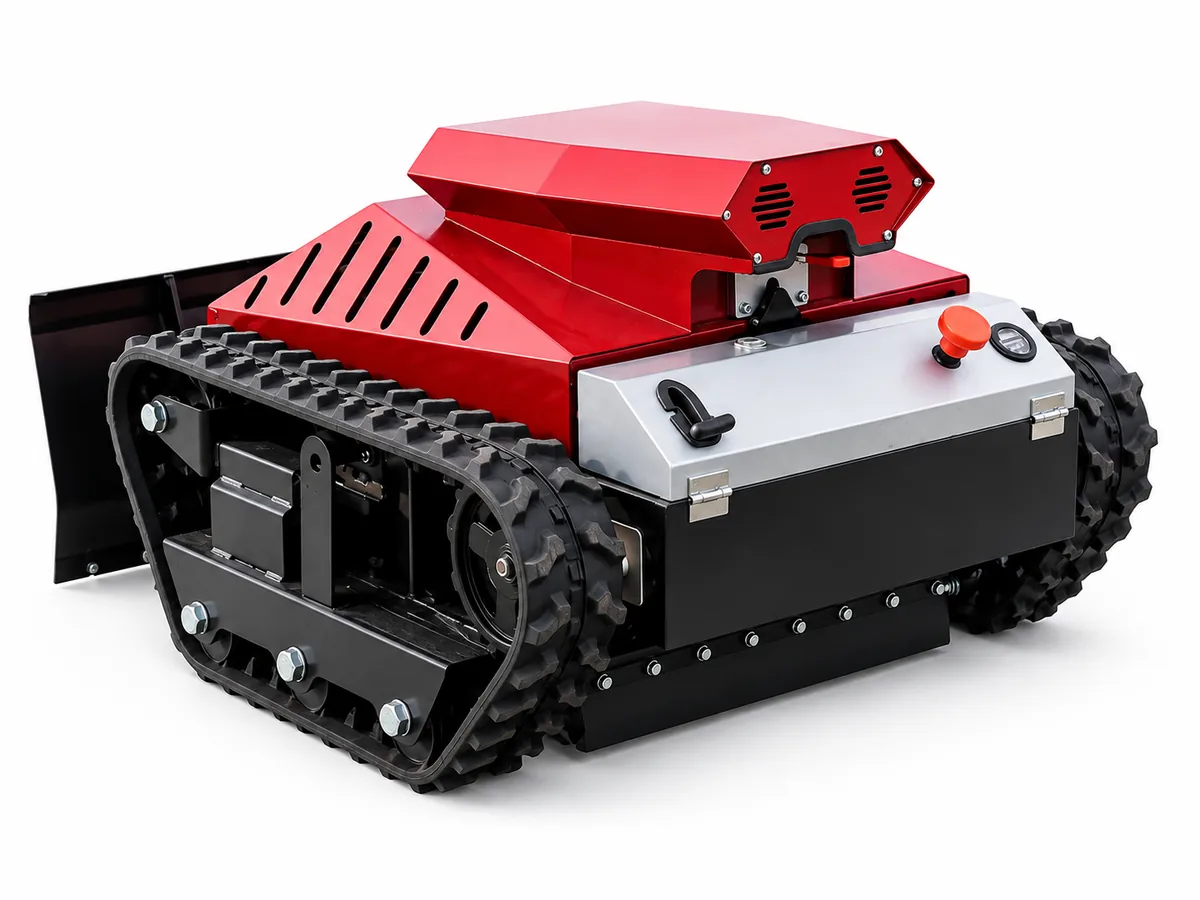
Figure. White-background product image of the OXPLO remote control tracked mower, useful for product-introduction and specification sections.
XIII. A Practical Procurement Checklist for Vineyard Buyers
Before sending a purchase order or dealer enquiry, use the following checklist. It forces the selection discussion back to operating conditions and TCO.
- Measure the minimum clear row width in the tightest block.
- Measure or estimate typical and maximum longitudinal and cross slopes.
- Photograph the heaviest normal vegetation, not only recently cut grass.
- Record the headland length and any rows with difficult turning access.
- Estimate how many mowing cycles are required per season.
- Calculate the cost of an extra pass across every row.
- Confirm blade, belt, bearing and track spare-parts availability.
- Confirm emergency stop and signal-loss behaviour.
- Check loading, transport and storage dimensions.
- Ask for the final OXPLO configuration sheet before ordering and verify dimensions against the vineyard site sheet.
For distributors and agricultural contractors, the same checklist can also be used as a customer-qualification form. It improves quoting accuracy and makes it easier to recommend the right OXPLO Remote Control Mower for Vineyards without relying on vague questions such as ‘How many hectares do you have?’
XIV. FAQ: Remote Control Mower for Vineyards
What is the first specification to check when buying a Remote Control Mower for Vineyards?
Start with the minimum clear row width and the required safety clearance. A machine that cannot pass the tightest row efficiently is the wrong machine regardless of horsepower.
Is a Tracked Mower for Vineyards always better than a wheeled mower?
No. Tracks are especially useful on slopes, soft ground and uneven terrain, but they also add undercarriage wear and can disturb soil during sharp turns. Flat, wide vineyards may not need that complexity.
How should I choose between a 55 cm and 100 cm OXPLO mower?
Choose by access and total workload. The 55 cm OXPLO version is a more compact option for tighter areas; the 100 cm OXPLO version can reduce passes where the rows and headlands provide enough clearance. Confirm the final machine dimensions for the ordered version.
Why is cross-slope operation important?
Cross slopes shift the machine’s centre of gravity toward the downhill side. Stability therefore depends on chassis width, centre of gravity, surface condition and obstacles, not just the advertised maximum slope.
Can an OXPLO remote mower replace a tractor?
Not in every vineyard. A tractor can mow, spray, tow and power multiple implements. An OXPLO remote mower is better viewed as a specialist vegetation-management platform for areas where access, slope or operator position make conventional equipment inefficient.
What information should I send OXPLO before requesting a quotation?
Send the narrowest row width, slope information, vineyard area, vegetation photos or video, cutting frequency, daily work target and any transport limits. This gives OXPLO enough context to discuss a suitable configuration.
XV. Conclusion: Choose the Vineyard System Before the Machine
The right Remote Control Mower for Vineyards is not the machine with the largest horsepower, widest deck or highest single slope figure. It is the machine that fits the vineyard’s geometry, maintains traction and stability on the actual terrain, cuts the real vegetation load, turns efficiently and can be serviced without excessive downtime.
The decision sequence should therefore be: vineyard geometry → slope and ground condition → vegetation → cutting width → machine envelope → control and safety → effective productivity → serviceability → TCO.
OXPLO can then be introduced at the correct point in the process: after the operating conditions are understood. For vineyards, orchards, contractors or equipment dealers evaluating an OXPLO Remote Control Mower for Vineyards, the most useful first step is to send OXPLO the row dimensions, slope conditions and vegetation photos so the discussion starts with the work that must be done, not with a catalogue number.