
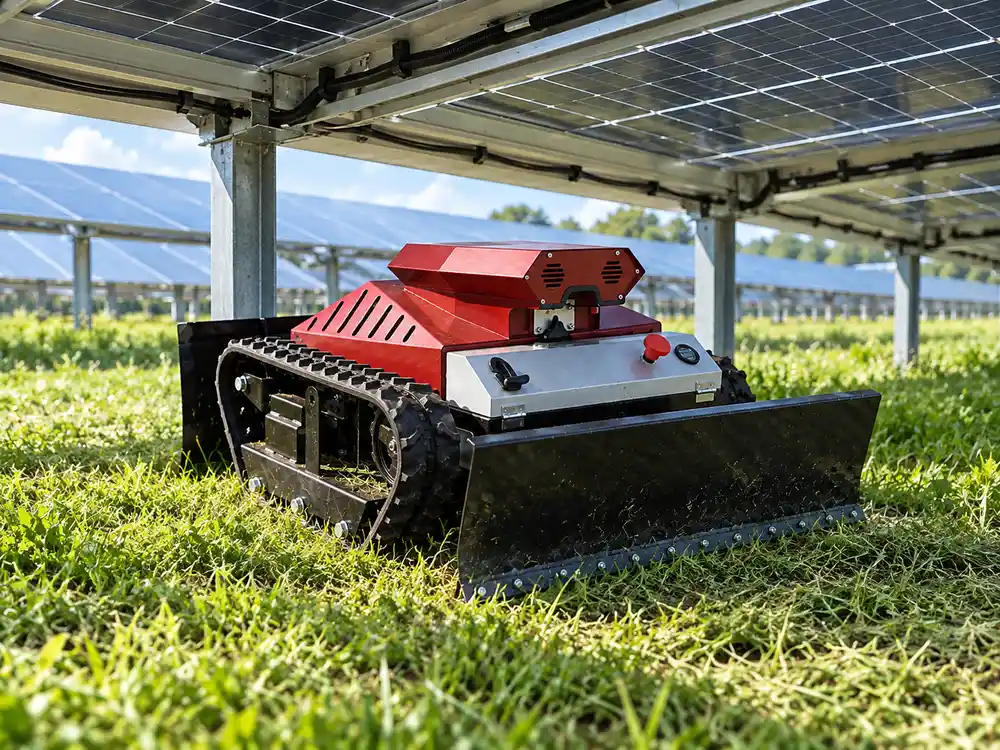
Vegetation control at a solar farm looks simple until the mowing machine reaches the first low panel edge, support pile, cable route, drainage channel or cross-slope. At that point, the job stops being ordinary grass cutting and becomes an access, safety and labour-allocation problem.
For asset owners, O&M contractors and procurement teams, the most expensive mistake is often not buying a mower that cuts too slowly. It is buying a mower that looks productive on a specification sheet but leaves too much work for manual brush cutters. The hidden cost is manual touch-up: the areas under panels, around piles, beside fences and close to electrical infrastructure that conventional equipment cannot efficiently finish.
This guide explains how to assess Solar Farm Mowing Equipment from the site outward. The objective is not to select the widest machine or the highest rated climbing angle. The objective is to reduce total labour hours per hectare while protecting PV infrastructure, meeting vegetation-management requirements and keeping the equipment serviceable over multiple seasons.
I. Why Solar Farm Mowing Costs More Than It Looks
A utility-scale PV site is not an open field. The mowing route is fragmented by rows of modules, steel piles, tracker components, electrical boxes, cable runs, fencing, access roads and drainage features. The operator therefore spends time not only cutting vegetation, but also slowing down, reversing, changing direction, avoiding infrastructure and returning later with handheld equipment.
The hidden cost is not the first pass
A machine may cover most of the visible grass quickly and still produce a poor economic result. If the remaining areas require a second crew with brush cutters, the project has created two workflows instead of one. For contractors, this means duplicated mobilisation, extra safety exposure and more labour scheduling. For the owner, it means the apparent machine productivity does not translate into a lower cost per maintained hectare.
Procurement principle |
Why panel geometry changes the economics
The key constraints are usually the minimum panel-to-ground clearance, the narrowest passage between structures, the distance between support piles, turning space at row ends and the position of cable trays or exposed services. These dimensions determine whether a mower can remain on a continuous route or has to stop and reposition repeatedly.
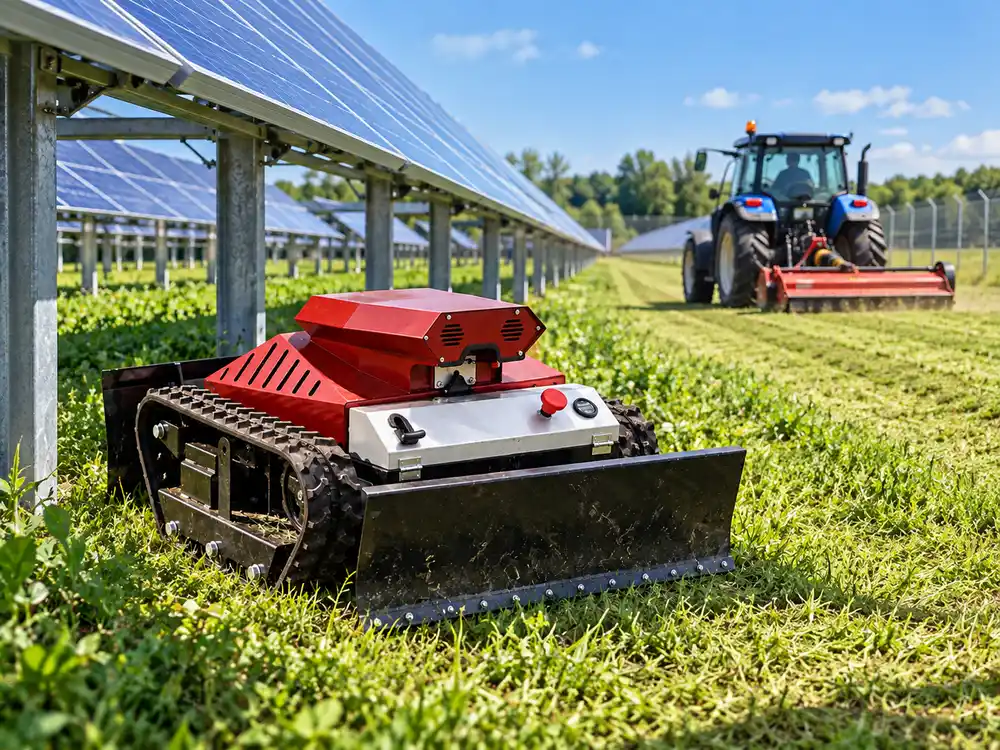
Figure 1. Illustrative solar-farm application: machine height and width must be checked against the lowest panel clearance and the narrowest usable passage.
II. Start With the Site, Not the Machine
Before comparing brands, prepare a short site survey. A good survey converts a vague question — “Can this mower work in a solar farm?” — into measurable pass/fail conditions. The same machine may be suitable for one PV site and inefficient at another because array geometry, soil and vegetation are different.
1. Minimum panel clearance
Use the lowest operational clearance found across the site, not the average panel height. Include an allowance for ruts, bumps and local ground heave. A mower that technically fits under a panel with only a few millimetres of spare height has no useful operating margin.
2. Narrowest access width
Measure gates, row entrances, passages around inverter stations, drainage crossings and any internal bottleneck. The narrowest critical point can be more important than the average row width because it decides whether the machine can reach the rest of the area without an alternative route.
3. Support-pile spacing and turning space
A mower may fit between two rows but still struggle to turn around diagonal bracing, tracker drives or closely spaced piles. Record pile-to-pile distance and the practical turning envelope at row ends.
4. Vegetation type and density
“Grass height” is not enough information. Fine grass, wet grass, fibrous weeds, lodged vegetation and young woody growth create different cutting loads. A site that is mowed every four weeks also behaves differently from one that is serviced only after vegetation has become dense and tangled.
5. Longitudinal and cross slope
Record uphill/downhill slope separately from side slope. Side-slope work creates a different stability problem from straight climbing because lateral slip and weight transfer become more important. Also record the surface condition: dry turf, wet grass, loose soil and gravel can produce very different traction on the same angle.
6. Infrastructure and exclusion zones
Map exposed cables, cable trays, grounding components, concrete bases, inverter pads, drains, rocks and areas where thrown debris would be unacceptable. Solar Farm Mowing Equipment should be evaluated as part of a live energy asset, not as landscaping equipment operating in an empty field.
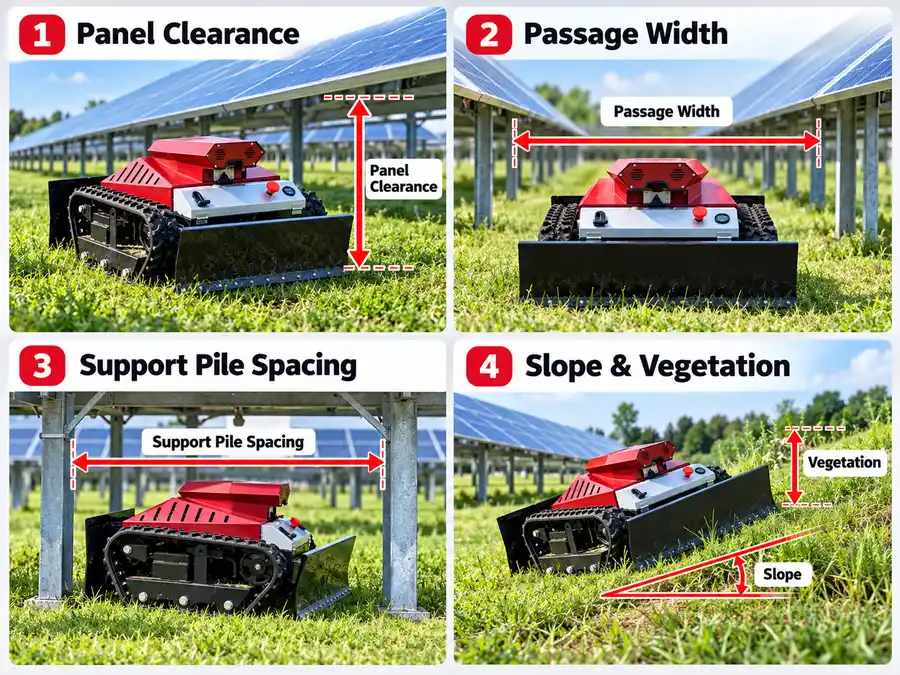
Figure 2. Site-assessment checklist: clearance, passage width, pile spacing, vegetation, slopes and the remaining manual touch-up zones.
III. Separate Rated Capability From Continuous Operating Capability
Specification sheets are useful, but they are often read too literally. Three figures are especially easy to misinterpret in remote mower procurement: maximum climbing ability, remote-control distance and travel speed.
Maximum climbing angle is not the same as a safe working slope
A rated maximum climbing ability normally describes capability under defined or suitable conditions. It should not automatically be treated as a continuous safe operating angle for cross-slope mowing, wet vegetation or loose ground. Buyers should ask for recommended operating conditions and, where possible, test the machine on a representative slope with the vegetation load expected at the site.
The question to send a supplier is not only “What is the maximum angle?” A better question is: “What slope, direction, surface and vegetation conditions do you recommend for continuous mowing, and what changes when the surface is wet?”
Remote-control range is not a productivity target
Long remote-control range can be useful, but a solar farm contains expensive structures and numerous line-of-sight interruptions. A long unobstructed signal specification does not mean that an operator should routinely control the mower from the maximum stated distance. In practice, safe visual supervision, obstacle awareness and rapid stop capability can matter more than headline range.
Travel speed is not mowing speed
Travel speed can be measured with little cutting load. Dense or wet vegetation may require a lower operating speed to maintain cut quality and avoid repeated passes. For procurement, ask for site-tested throughput or carry out a pilot block test rather than converting maximum travel speed directly into hectares per hour.
IV. Calculate Real Productivity: Hectares per Hour Are Only the Start
A useful first-pass formula for theoretical field capacity is:
Theoretical capacity (ha/h) = cutting width (m) × travel speed (km/h) ÷ 10
For example, a 1.0 m cutting width operating at 3 km/h gives a theoretical capacity of 0.30 ha/h. A 0.55 m cutting width at the same speed gives 0.165 ha/h. These figures are mathematical ceilings, not guaranteed job-site output.
Real productivity must then account for row-end turns, reversing, overlap, obstacle avoidance, slow operation under panels, inspection, cleaning and the time spent repositioning the operator. If a contractor uses a 60% field-efficiency factor for planning, a theoretical 0.30 ha/h becomes 0.18 ha/h. That 60% is an example planning assumption, not a measured product-performance claim.
The better KPI: total labour hours per hectare
For solar O&M, the most useful number is often total labour hours per hectare rather than machine hectares per hour. Add machine operating time, operator repositioning, manual trimming, cleaning, routine maintenance and any extra crew time required to finish the block.
A wider mower may complete the open strip faster but create more manual finishing around narrow structures. A narrower mower may move more slowly in open space but reach more of the awkward areas. The correct decision is the one that reduces the total finished-job labour, not the one that wins a straight-line speed comparison.
V. European Solar Sites Need Vegetation Management, Not “Bare-Ground Mowing”
European solar projects increasingly consider biodiversity and land-use outcomes alongside energy production. SolarPower Europe’s land-use and biodiversity guidance emphasises that utility-scale solar can be planned and operated in ways that support nature conservation and ecosystem objectives. For mowing teams, that means vegetation height is not merely a cosmetic setting; it can be part of the site-management strategy.
Reference: SolarPower Europe — Solar, Biodiversity, Land Use: Best Practice Guidelines
Why cutting height matters operationally
Cutting too low can increase blade-to-ground contact, soil disturbance and the risk of stones or debris being struck. Cutting too high may fail to meet the site’s vegetation-control objective or may leave fast regrowth close to equipment access areas. The correct setting should therefore reflect vegetation type, fire and access requirements, biodiversity objectives, surface conditions and the frequency of maintenance.
For Solar Farm Mowing Equipment, an adjustable cutting-height range is valuable because the same site can contain different zones: routine rows, perimeter areas, drainage corridors and locations where a higher first cut is preferable before a lower maintenance cut.
VI. Remote Mower vs Tractor: Divide the Site, Not the Argument
A remote mower does not automatically replace a tractor. On many large sites, the lowest-cost strategy is to assign different machines to different zones.
Where a tractor still makes sense
Open perimeter strips, wide access areas and grassland outside the PV arrays can favour a tractor-mounted mower because the tractor can cover large areas quickly and may already exist in the contractor’s fleet. A 50 hp tractor can be a practical multi-purpose platform for mowing and general property work, while a 70 hp tractor can support heavier implements and larger daily workloads where the site geometry allows it.
For buyers searching phrases such as farm tractor Poland or 4wd tractor Poland, the important procurement question is often not whether to replace the tractor. It is which zones should remain tractor-operated and which zones create too much manual follow-up because the tractor cannot safely or efficiently enter the array.
Where a remote mower earns its place
Inside the PV rows, machine height, width, turning space and operator position become more important than engine horsepower. Remote-control tracked equipment is most valuable when it can take over work that would otherwise require repeated manual walking, brush cutting or a second finishing pass.
Hybrid fleet logic |
Figure 3. A hybrid mowing strategy can assign tractors to open areas and remote mowers to PV rows, reducing the amount of manual touch-up.
VII. Safety, Documentation and European Procurement Questions
European buyers should treat compliance documentation and control-system behaviour as part of the technical specification, not as paperwork to check after the order is paid.
As of September 2026, machinery placed on the EU market before 20 January 2027 must comply with Machinery Directive 2006/42/EC. Machinery Regulation (EU) 2023/1230 becomes mandatory on 20 January 2027. Buyers should therefore confirm the applicable conformity route, declaration, instructions and safety information for the actual model and destination market at the time of purchase.
Current EU reference: European Commission — Machinery
Questions worth asking before a remote mower is approved
- What happens if the remote-control signal is lost?
- Is an emergency-stop function provided, and where is it located?
- How are travel and cutting functions stopped in a fault or loss-of-control event?
- What operating manual, labels and conformity documents are supplied for the destination market?
- What limitations are stated for slope, surface condition and safe operating distance?
- Which wear parts should be stocked locally for commercial use?
- What information is needed for remote troubleshooting or a parts claim?
Do not assume that a generic CE statement on a supplier’s website automatically covers every mower configuration. Confirm the documentation for the exact machine being ordered. This is especially important when optional equipment, control systems or market-specific configurations change.
VIII. Applying the Framework to the OXPLO Remote Control Crawler Lawn Mower
Once the site survey is complete, the selection framework can be applied to the current OXPLO Remote Control Crawler Lawn Mower range. OXPLO lists two cutting-width versions: 100 cm and 55 cm. Both provide a 30–150 mm adjustable cutting-height range, remote control, crawler mobility and two rotary manganese-steel blades.
OXPLO product page: Remote Control Crawler Lawn Mower | Remote Control Mower Category
Specification | OXPLO 100 cm | OXPLO 55 cm |
Cutting width | 100 cm | 55 cm |
Cutting height | 30–150 mm | 30–150 mm |
Motor | 600 W | 350 W |
Battery capacity | 20 Ah | 12 Ah |
Charging time | 6–8 h | 4–6 h |
Specified working time | Up to 360 min | Up to 300 min |
Machine weight | 350 kg | 180 kg |
Overall size | 1250 × 1450 × 800 mm | 1100 × 920 × 700 mm |
Maximum climbing ability | ≤45° | ≤45° |
Travel speed | 3–5 km/h | 3–4 km/h |
Remote-control distance | Up to 800 m unobstructed | Up to 800 m unobstructed |
Table 1. Current OXPLO mower specifications. Actual performance depends on terrain, vegetation, load and operating conditions.
OXPLO 100 cm: coverage-oriented configuration
The OXPLO 100 cm version is the more logical starting point when the solar site has sufficient clearance and relatively regular row geometry. Its 100 cm cutting width reduces the number of passes in open or semi-open areas, and OXPLO specifies up to 360 minutes of working time. However, its 1450 mm overall width and 800 mm height must be checked against the site survey before productivity is assumed.
In other words, OXPLO’s 100 cm model should not be selected only because the project is large. A large solar farm with narrow passages or low module edges can still favour a more compact machine.
OXPLO 55 cm: access-oriented configuration
The OXPLO 55 cm version is 920 mm wide, 700 mm high and 180 kg. The smaller footprint can be more useful where the array contains narrow entrances, lower panel clearance or more frequent turning around piles. Its 55 cm cutting width means more passes in open areas, but the access advantage can reduce the area that must be finished manually.
This is why OXPLO’s two versions should be viewed as two different operating strategies rather than simply a large model and a small model: the 100 cm version prioritises coverage, while the 55 cm version prioritises access.
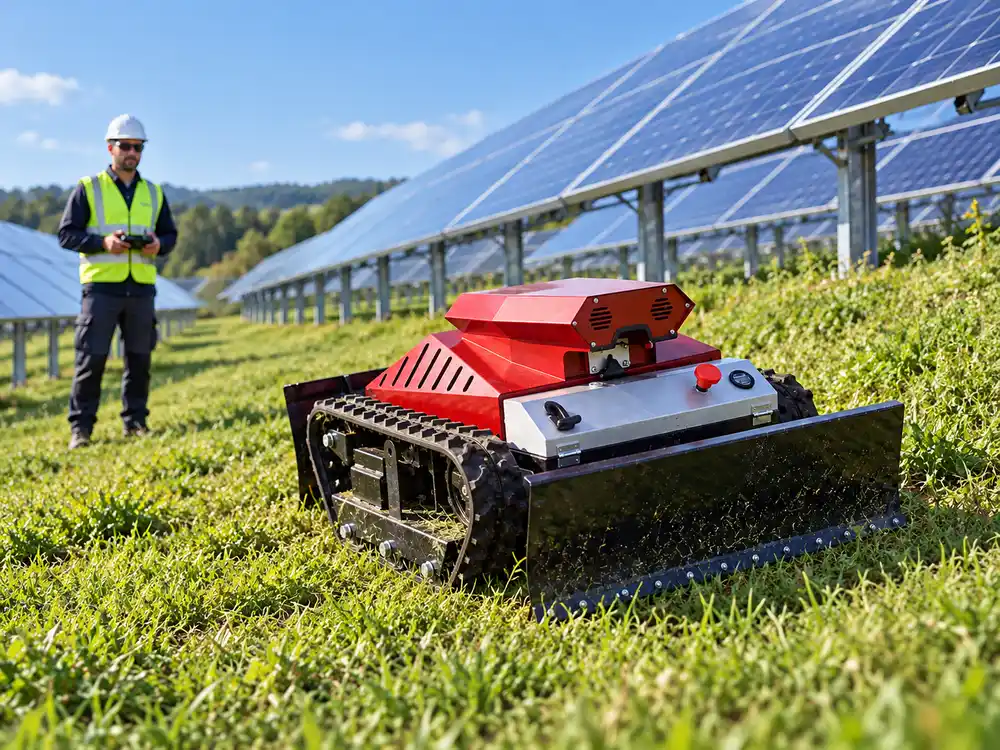
Figure 4. Illustrative remote-control mowing on a solar slope. Rated climbing capability should still be verified against actual surface, slope direction and vegetation load.
IX. What Problems Can OXPLO Solve in a Solar-Farm Workflow?
The useful way to evaluate OXPLO is not to list features one by one. Start with the operational problem and ask whether an OXPLO configuration removes a step, reduces a labour-intensive zone or makes the site easier to finish in one mowing cycle.
Site problem | Hidden cost | How an OXPLO configuration may address it |
Low panel clearance or restricted passages | Large equipment cannot enter; manual brush cutting increases | OXPLO 55 cm version: 700 mm height, 920 mm width |
Large, regular mowing zones | Too many passes with narrow equipment | OXPLO 100 cm cutting width for higher coverage per pass |
Uneven or sloped terrain | Walk-behind operation becomes physically demanding | OXPLO remote control plus crawler undercarriage |
Different vegetation-management zones | One fixed cut height is unsuitable across the site | OXPLO 30–150 mm adjustable cutting height |
Long commercial mowing shifts | Frequent interruptions reduce crew productivity | OXPLO specifies up to 360 min / 300 min working time by version |
Remote B2B project with downtime risk | Waiting for wear parts can stop the maintenance schedule | OXPLO buyers can confirm blades, track-related parts and service needs before shipment |
Table 2. Translate mower features into operating outcomes before comparing purchase prices.
OXPLO also supplies farm tractors from 25–70 HP, so buyers managing both open areas and PV-array interiors can evaluate a mixed fleet rather than treating the remote mower and tractor as competing categories. OXPLO’s current tractor range includes 50 HP and 70 HP models for mowing, transport and broader farm or property work.
Related OXPLO links: All Products | 25–70 HP Tractor Configurations | Support & Parts
X. OXPLO Solar Farm Mower Assessment Matrix
Before requesting a quotation from OXPLO, complete the following matrix. It turns the purchasing discussion into an application review and helps OXPLO determine whether the 100 cm or 55 cm version is the better starting point.
Evaluation item | Your site data | Decision check |
Minimum panel clearance | _____ mm | Compare with 800 mm / 700 mm machine height |
Narrowest usable passage | _____ mm | Compare with 1450 mm / 920 mm machine width |
Support-pile spacing | _____ mm | Check turning and obstacle clearance |
Typical vegetation height | _____ mm | Confirm cutting load and first-pass strategy |
Required cutting height | _____ mm | OXPLO range: 30–150 mm |
Maximum longitudinal slope | _____° | Provide surface condition and vegetation details |
Maximum cross slope | _____° | Do not assume it equals maximum climbing rating |
Required mowing area per day | _____ ha/day | Use site test, not theoretical speed alone |
Current manual touch-up | _____ h/ha | Baseline for labour-saving calculation |
Transport / loading limit | _____ kg | OXPLO 100 cm: 350 kg; 55 cm: 180 kg |
Destination country | _____ | Confirm applicable documents and shipment requirements |
Spare-parts plan | _____ | Confirm blades, track components and service consumables |
Table 3. Copy this matrix into an RFQ or site-survey form before asking OXPLO for a model recommendation.
XI. Frequently Asked Questions
What is the most important specification for Solar Farm Mowing Equipment?
There is no single winning specification. Start with minimum panel clearance, narrowest passage, pile spacing, slope direction, vegetation type and the amount of manual touch-up you want to remove. Cutting width matters only after the machine can safely access the work zone.
Is the OXPLO 100 cm version always better for a large solar farm?
No. OXPLO’s 100 cm version is coverage-oriented, but its 1450 mm width and 800 mm height must fit the actual array. A large site with tight geometry may still achieve lower total labour with the more compact OXPLO 55 cm version.
Does OXPLO’s ≤45° maximum climbing ability mean continuous mowing is safe on a 45° side slope?
That should not be assumed. Maximum climbing capability and continuous safe cross-slope operation are different questions. Provide OXPLO with the actual slope, direction, soil condition and vegetation so the operating conditions can be reviewed.
How should I compare an OXPLO remote mower with a 50 hp tractor or 70 hp tractor?
Compare them by zone. A 50 hp tractor or 70 hp tractor can remain efficient in open perimeter areas and wide access strips. The OXPLO remote mower becomes valuable inside PV rows, on restricted passages and where reducing manual brush cutting is the main objective.
Why is the 30–150 mm OXPLO cutting-height range relevant to solar sites?
Because a solar farm may need different vegetation heights in different zones. The adjustable range gives the operator room to balance vegetation control, ground contact, debris risk and site-management objectives rather than using one fixed height everywhere.
How far can the OXPLO remote controller operate?
OXPLO currently specifies up to 800 m under unobstructed conditions for both mower versions. For solar-farm work, treat this as a technical capability, not a target operating distance. Maintain appropriate visual supervision and follow the operating instructions for the actual site.
What should a European buyer confirm with OXPLO before ordering?
Confirm the exact mower version, destination country, applicable conformity documentation, manuals, safety functions, spare-parts package, shipping method and the site conditions that affect machine suitability. OXPLO’s support information also recommends confirming documentation and configuration before shipment.
What information should I send OXPLO for a useful quotation?
Send OXPLO the total mowing area, minimum panel clearance, narrowest access, pile spacing, vegetation type and height, required cutting height, maximum longitudinal and cross slope, daily workload, quantity and destination country. This allows OXPLO to discuss the 100 cm and 55 cm options against the actual application.
XII. Conclusion: Optimize the Whole Mowing Workflow, Not One Specification
The right Solar Farm Mowing Equipment is not automatically the machine with the widest deck, the longest remote range or the highest climbing figure. Solar O&M is a system problem: access geometry, vegetation condition, slope, infrastructure risk, manual finishing, transport, spare parts and documentation all affect the final cost per hectare.
For European projects, start by mapping the site and defining the work that currently consumes the most labour. Keep tractors where they are efficient. Use remote mowing where array geometry or terrain turns conventional mowing into repeated manual work. Then validate the chosen machine in a representative block and record total labour hours, not only machine run time.
OXPLO’s two Remote Control Crawler Lawn Mower versions give buyers a useful trade-off to evaluate: the OXPLO 100 cm model focuses on higher coverage, while the OXPLO 55 cm model focuses on access with a lower and narrower machine body. The correct OXPLO choice depends on the site measurements, not on project size alone.
To discuss a solar-farm mowing application, review the OXPLO Remote Control Mower, explore the OXPLO product range, or send your site data through OXPLO for application-based model selection.