
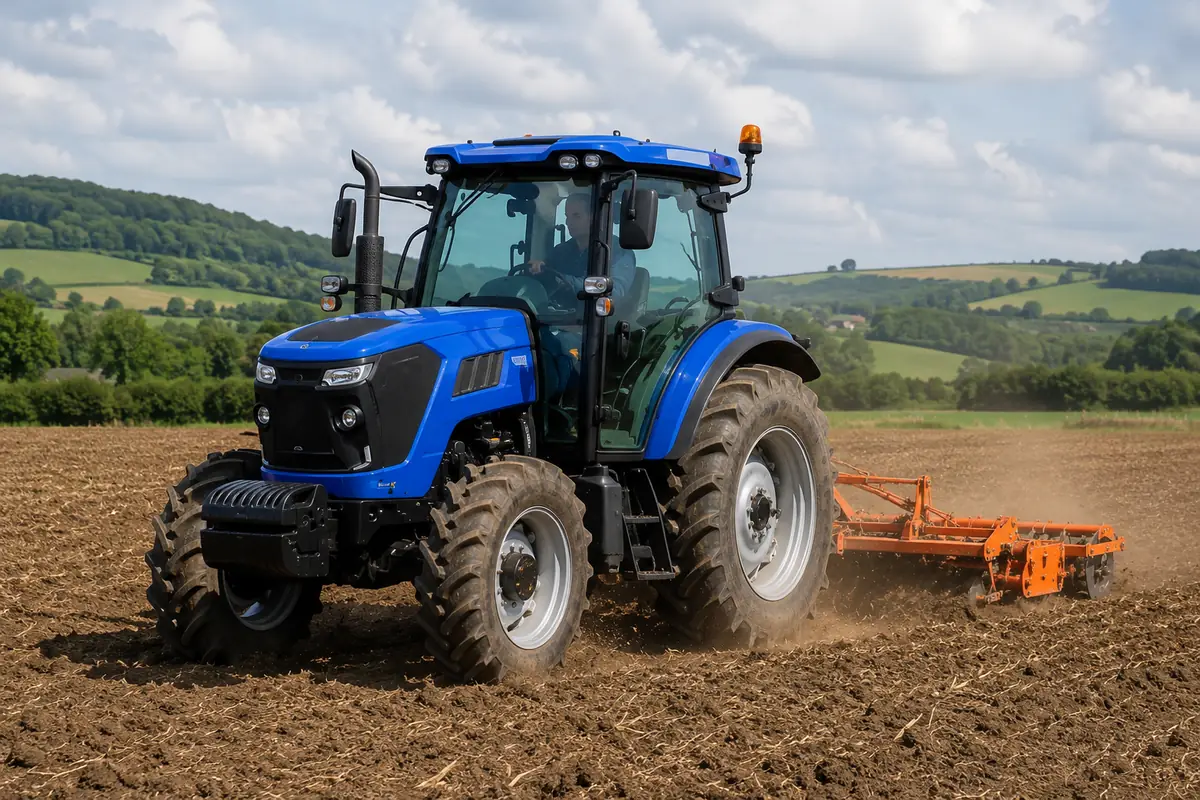
A practical guide to matching tractor horsepower, PTO demand, traction, implements, field capacity and total cost of ownership.
For many small and medium farms, 70 HP sits in an awkward but useful part of the tractor market. It is clearly more capable than a compact 25–50 HP machine, yet it is still far from the weight, cost and scale of a high-horsepower field tractor. That is exactly why buyers often ask the wrong question: “Is 70 HP big enough for my acreage?”
Farm area matters, but it does not define the load. A 40-hectare grassland operation that mainly mows, hauls and spreads fertilizer may find a 70 HP tractor comfortably capable. A 25-hectare farm working heavy clay with deep soil-engaging implements can push the same tractor much harder. Loader work introduces a different constraint again: hydraulic flow, axle loading and ballast may matter more than five or ten extra engine horsepower.
The useful buying question is therefore not whether 70 HP sounds large. It is whether the tractor can run the farm’s most demanding recurring implement at a practical speed, in the real soil and terrain, while keeping enough reserve for seasonal pressure. A tractor that can technically pull an implement but must spend all day in a low gear near full load is not necessarily the economical choice.
Quick answer For mixed farming, livestock work, grassland, general soil preparation, farm transport and routine loader work, a 70 HP tractor is often enough. For sustained deep tillage, wider high-draft implements or high PTO-demand equipment, the deciding factors are usable PTO power, traction, operating weight, hydraulic capacity and the time available to finish the job – not engine horsepower alone. |
I. Is a 70 HP Tractor Enough? Start With the Workload
The quickest way to make a poor tractor purchase is to start with acreage and stop there. Farm size tells you how much work exists; it does not tell you how hard that work is. The same number of hectares can produce very different power requirements depending on soil, slope, crop, implement width and the number of workable days available in the season.
Use the table below as a first filter. It is not a substitute for checking implements, but it helps identify where a 70 HP tractor normally sits comfortably and where the decision needs more engineering detail.
Farm / Application | 70 HP Fit | What Actually Decides |
Mixed farm | Very suitable | One tractor must cover tillage, mowing, transport and loader work. |
Livestock farm | Very suitable | Bale handling, feed movement, trailers, loaders and year-round utility work. |
Grassland | Suitable | PTO mower demand, field size, transport and seasonal hours. |
General soil preparation | Suitable | Implement width, working depth, soil resistance and target speed. |
Heavy clay tillage | Depends | Traction, ballast, tyre setup and sustained draft demand. |
Orchard | Depends on access | Overall width, turning space and canopy clearance can dominate the decision. |
Vineyard | Often too large for narrow rows | A smaller compact tractor may be more productive even with less HP. |
Large-scale deep tillage | Often undersized | Long high-load hours and wide implements may justify a larger platform. |
The last variable deserves more attention than it usually gets: the working window. Two tractors may both operate the same implement, but if one can hold the correct working speed and the other must slow down whenever soil resistance rises, their seasonal output can be very different. During mowing, cultivation or seedbed preparation, that lost time can matter more than a small difference in purchase price.
II. Why 70 HP Is Not 70 HP at Every Work Point
A tractor specification sheet normally puts rated engine power near the top. It is easy to compare and useful for placing the machine in a broad class. It is not, however, the amount of power available at every implement or at the ground.
Engine Horsepower Is the Starting Point
Engine horsepower describes rated engine output. From there, power must pass through the drivetrain before it reaches the PTO shaft or the wheels. That is why a buyer should not read “70 HP” on a tractor page and assume that a PTO-driven implement requiring 60 HP automatically has a comfortable margin.
PTO Horsepower Must Be Checked Separately
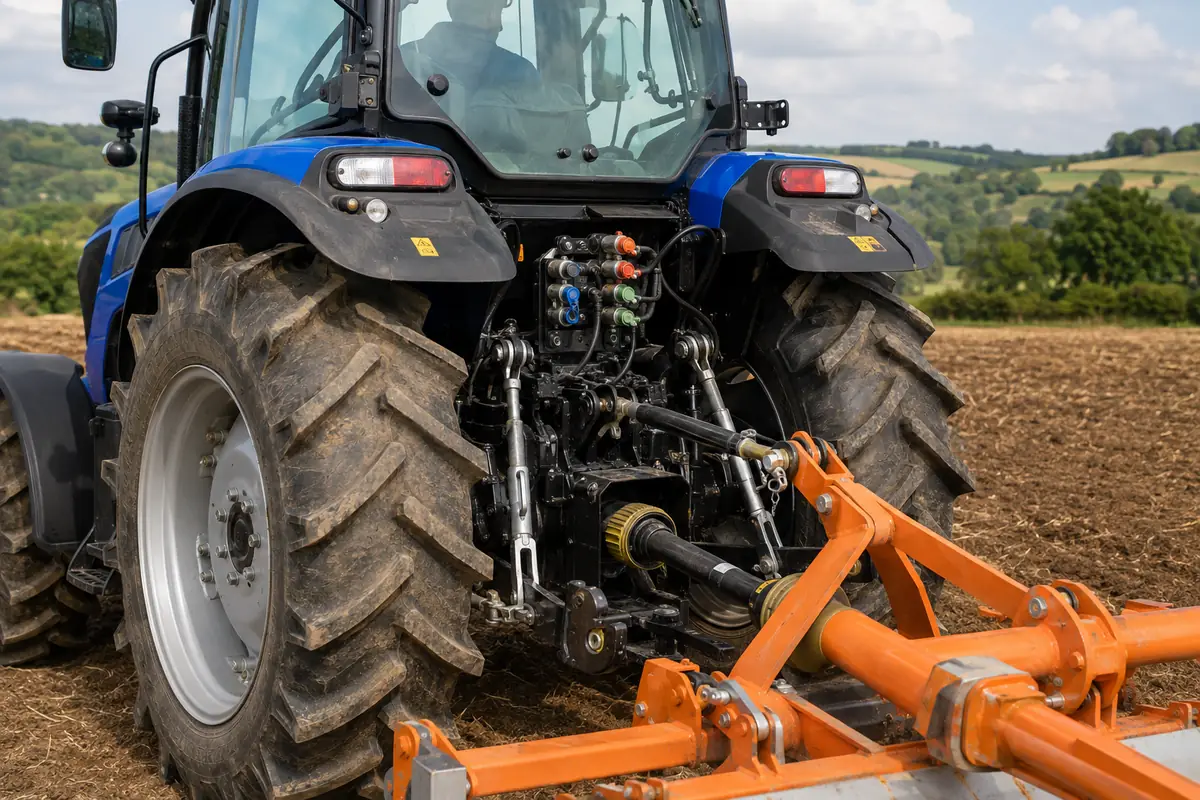
Rotary tillers, mowers, balers and other PTO-driven equipment are constrained by the power available at the PTO shaft and by the required PTO speed. If an implement manufacturer specifies a minimum PTO horsepower, compare that number with confirmed tractor PTO output. Do not substitute engine horsepower unless the tractor supplier has explicitly confirmed the relevant PTO figure.
The same applies to PTO speed. “The tractor has PTO” is not enough. Check the required rpm, spline arrangement and driveline requirements of the implement you already own or plan to buy.
Drawbar Performance Depends on Traction
Ploughing, discing and other draft work add another layer. Engine power only becomes useful field work when the tyres can transfer it to the soil. If wheel slip climbs, more throttle may simply turn fuel into tyre slip and soil disturbance instead of hectares per hour.
This is why 4WD, tyre size, inflation pressure, ballast, axle load distribution and soil condition can matter as much as another 10 HP in difficult ground. A heavier tractor is not automatically better either. Too much ballast increases rolling resistance and compaction. The aim is usable traction, not maximum machine weight.
III. How Large an Implement Can a 70 HP Tractor Handle?
Buyers often ask for a fixed answer: how wide a plough, rotary tiller or disc harrow can a 70 HP tractor handle? A single width is attractive because it makes purchasing simple. It can also be misleading.
For Soil-Engaging Implements, Width Is Only One Variable
A plough or cultivator’s demand changes with working width, working depth, soil type, moisture, residue and target speed. A machine that feels comfortable in dry, previously worked loam can become a much harder load in wet clay. Even a modest increase in working depth can materially raise draft demand because the implement is moving more soil.
For that reason, a supplier should not confirm implement compatibility from width alone. The better process is to provide the implement model, weight, width, expected depth, typical soil and intended operating speed. If the supplier only answers with a fixed “maximum width” and asks nothing about the field condition, treat the answer as an estimate rather than a working guarantee.
For PTO Implements, Read the Implement Plate First
Before ordering a mower, rotary tiller, baler or powered spreader, record the implement manufacturer’s minimum PTO power, required PTO speed, weight and linkage category. If hydraulics are involved, add required flow, pressure and number of remote valves. This information is far more useful than asking whether a tractor can “use a mower” in general.
Implement Data | Why It Matters |
Minimum PTO power | Determines the usable power requirement at the PTO rather than at the engine. |
PTO speed | Confirms whether the tractor and implement can run at the required rpm. |
Implement weight | Affects hitch capacity, ballast, axle loading and transport stability. |
Linkage category | Determines whether the implement can be mounted correctly without unsuitable adapters. |
Hydraulic demand | Critical for cylinders, loaders and hydraulically driven attachments. |
Working width and depth | Defines much of the draft requirement for soil-engaging equipment. |
Field Capacity Shows the Cost of Running Too Close to the Limit
A tractor can keep moving and still be undersized for the business. A simple field-capacity estimate makes this visible. Effective field capacity is approximately working width multiplied by travel speed and field efficiency, divided by 10 when width is in metres and speed is in km/h.
Take a 2.5 m implement at 75% field efficiency. At 6 km/h, effective capacity is about 1.13 ha/h. If the tractor must slow to 4.5 km/h under load, capacity falls to roughly 0.84 ha/h. Covering 30 hectares then takes about 26.5 hours in the first case and 35.7 hours in the second – more than nine additional operating hours even though both combinations technically “work.”
That difference shows up in operator time, engine hours, fuel, maintenance intervals and the risk of missing the best weather window. It is one reason implement matching should be based on productive speed, not simply whether the tractor can move the implement once.
IV. 60 HP vs 70 HP vs 75–80 HP: Where the Extra Power Matters
Once a farm has moved beyond compact tractors, the real buying decision is often not 30 HP versus 70 HP. It is whether the farm should stop around 60 HP, choose 70 HP, or move one step higher. The difference cannot be judged from engine output alone because chassis size, tyres, hitch category, transmission and implement strategy may change with the power class.
When 60 HP Is Usually Enough
A 60 HP tractor can be the better commercial fit when most annual hours are mowing, spreading, light-to-medium cultivation, livestock support and normal trailer work, and the existing implements sit comfortably inside the tractor’s PTO, hitch and traction capability. If heavy soil work is occasional and the farm has no aggressive expansion plan, there is little value in buying unused capacity just for reassurance.
Where a 70 HP Tractor Becomes More Comfortable
The step to 70 HP makes more sense when the same machine has to do many different jobs: soil preparation in the morning, trailer work later in the day, loader work around livestock buildings, then mowing or seeding in another season. Here, the value is not one spectacular capability. It is a broader operating margin across recurring medium-duty jobs.
A 70 HP tractor can also make sense when the farm is moving into heavier Category II implements, needs more transport reserve or has started to find that a 50–60 HP tractor spends too much time near its practical limit.
When 75–80 HP or More Is the Safer Decision
Move up another class when heavy tillage is a core part of the business rather than an occasional job, when the soil consistently creates high draft resistance, when wider implements are already planned, when PTO demand is high for long periods, or when a short weather window makes field capacity critical. The question then is no longer whether 70 HP can pull the implement. It is whether you want the tractor operating near that limit for several seasons.
V. Where a 70 HP Tractor Fits Best – and Where It Does Not
Mixed Farms: One Tractor, Many Different Jobs
Mixed farms are one of the strongest cases for a 70 HP tractor because utilisation matters more than maximising one specialist task. The same tractor may handle cultivation, mowing, seeding, fertilizer spreading, trailer transport and material handling at different points in the year. A platform that accepts the required implements without becoming cumbersome in daily use can generate more value than a larger machine that only proves its advantage a few days each season.
Livestock Farms: Hydraulics Can Matter More Than Another 5 HP
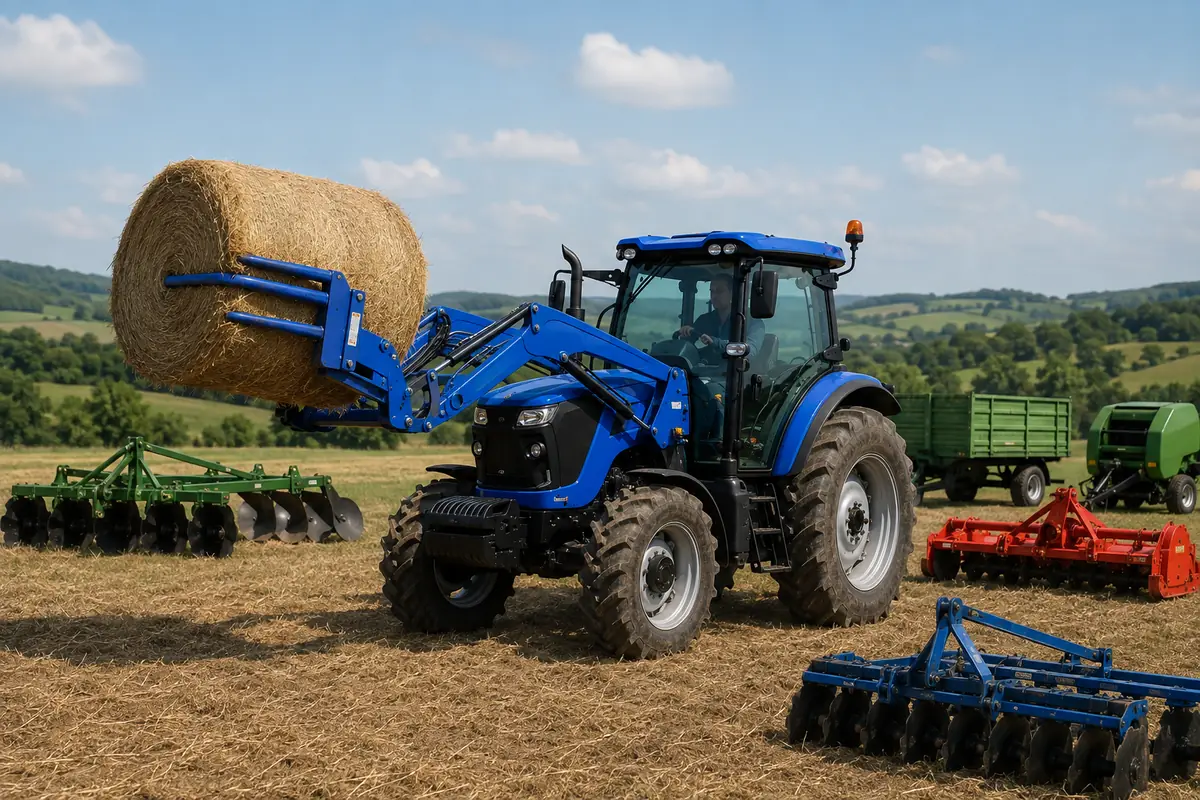
Livestock operations often look light on paper because they do less deep tillage. In practice, a tractor may spend hundreds of hours moving feed, handling bales, cleaning yards and operating a front loader. In that workload, hydraulic flow, loader cycle time, front axle capacity, counterweight and forward/reverse control deserve more attention than a small difference in engine rating.
Front-loader capacity should also be treated as a complete stability problem. A heavy load held high and forward changes the tractor’s centre of gravity and axle loading. More horsepower does not correct poor ballast or an unsuitable loader setup.
Grassland and PTO Work: Usually a Natural Fit
Mowing, pasture maintenance, spreading and general grassland transport sit naturally in this power range for many farms. The limiting factor is normally the actual PTO requirement of the implement and the hectares that must be completed within the available time, not a generic “recommended farm size.”
Heavy Soil Preparation: Watch the Duty Cycle
A 70 HP tractor may complete occasional heavy cultivation by reducing speed or working width. That can be acceptable if the job represents only a small part of annual use. It becomes less attractive when the tractor spends much of the season at high engine load, low field speed and elevated wheel slip. At that point, more tractor capacity may reduce cost per hectare even if hourly fuel consumption rises.
Vineyards and Orchards: Dimensions Can Overrule Horsepower
A 70 HP tractor may have more than enough power for orchard-floor maintenance and spraying, yet still be the wrong machine if it is too wide, tall or difficult to turn at the row end. Measure the narrowest row, gate, storage opening and turning area before comparing horsepower. A 40–50 HP compact tractor that fits every working area can be more productive than a larger tractor that spends time manoeuvring or simply cannot enter part of the farm.
VI. Total Cost of Ownership: Cost per Hectare Beats Fuel per Hour
Fuel consumption per hour is useful, but it is a poor standalone buying metric. A smaller tractor may burn less fuel each hour and still cost more to complete a hectare if it has to travel more slowly, make more passes or operate for longer hours.
What an Undersized Tractor Really Costs
Suppose Tractor A has a lower hourly operating cost but completes 20% less area per hour with the farm’s main implement. Tractor B costs more each hour yet maintains the intended field speed. The meaningful comparison is operating cost per hour divided by effective field capacity. Once operator time and seasonal delay are added, the cheaper hourly machine can become the more expensive production tool.
Undersizing also adds engine hours. More hours mean earlier maintenance events, more operator labour and less flexibility when weather changes. These costs are rarely visible in the purchase quotation, but they are paid every season.
Oversizing Has Its Own Cost
Buying larger “for the future” can be sensible when expansion is real and near-term. Buying larger because it feels safer is different. Excess capacity can bring a higher purchase price, larger tyres, more storage space, a wider turning envelope and extra machine mass. On soft or sensitive ground, that additional weight may also raise compaction risk.
Working Window Should Be Part of the TCO Calculation
Consider a 40-hectare job. One tractor-implement combination needs 30 productive hours; another needs 42. If the farm realistically has eight workable hours per day, the first can finish inside four days while the second needs more than five. During a stable period this may not matter. When rain is forecast, it can be the difference between finishing on time and carrying the job into poorer soil conditions.
A useful TCO comparison therefore includes purchase cost, fuel, maintenance, tyres, operator hours, annual utilisation, field capacity, depreciation, downtime risk and implement compatibility. The lowest hourly fuel figure should never be allowed to dominate the whole decision.
VII. A Practical Buying Workflow for a 70 HP Tractor
A good quotation starts before the supplier quotes anything. If you send only “70 HP tractor price,” the supplier has almost no basis for checking whether the machine fits the work. A short workload sheet produces a much better technical discussion.
Step 1: List Every Recurring Job
Write down the jobs the tractor performs during a normal year: ploughing, rotary tilling, mowing, seeding, bale handling, front-loader work, fertilizer spreading and trailer transport. Add approximate annual hours where possible. This quickly shows whether the tractor is primarily a field machine, a loader tractor or a general utility machine.
Step 2: Separate the Heaviest Job From the Highest-Frequency Job
They are often different. A farm may have 15 hours of heavy cultivation and 300 hours of loader and transport work. Buying an oversized tractor purely for those 15 hours may not be the most economical option. In some businesses, outsourcing the rare extreme job is cheaper than owning extra capacity all year.
Step 3: Build an Implement Sheet
For each existing or planned implement, record working width, weight, PTO power and speed, linkage category, hydraulic requirement, typical working depth and recommended operating speed. This sheet should drive the tractor shortlist.
Step 4: Compare the Tractor Platform, Not Just the HP
Now compare 60, 70 and 75–80 HP options against the implement sheet. Look at drive configuration, transmission ratios, rear linkage, operating weight, tyre size, PTO, hydraulics, ground clearance and dimensions. A 70 HP engine on the wrong chassis or linkage system does not solve the farm’s problem.
Step 5: Measure Access With a Tape Measure
Check barn doors, gates, orchard rows, storage height, trailer loading width and turning space. Brochure dimensions can differ by only 100–200 mm and still determine whether a machine is convenient every day or frustrating every day.
Step 6: Confirm the Missing Data Before Payment
Ask for the actual PTO specification, hydraulic flow and pressure, rear-linkage lift capacity and where that lift value is measured, available remote valves, tyre configuration, loader specification, recommended ballast, cab or ROPS arrangement, lighting and destination-market documentation. If road registration matters, confirm the requirements for the destination country before the tractor is shipped.
VIII. How to Evaluate the OXPLO OXT704 70 HP Tractor
Only after the workload, implements and access limits are clear does a specific model become useful to discuss. If the selection process points to a 70 HP, 4WD, Category II utility platform, the OXPLO OXT704 is one configuration worth comparing with the farm’s actual implement list.
You can review the OXPLO OXT704 70 HP tractor and compare it with the broader OXPLO tractor range.
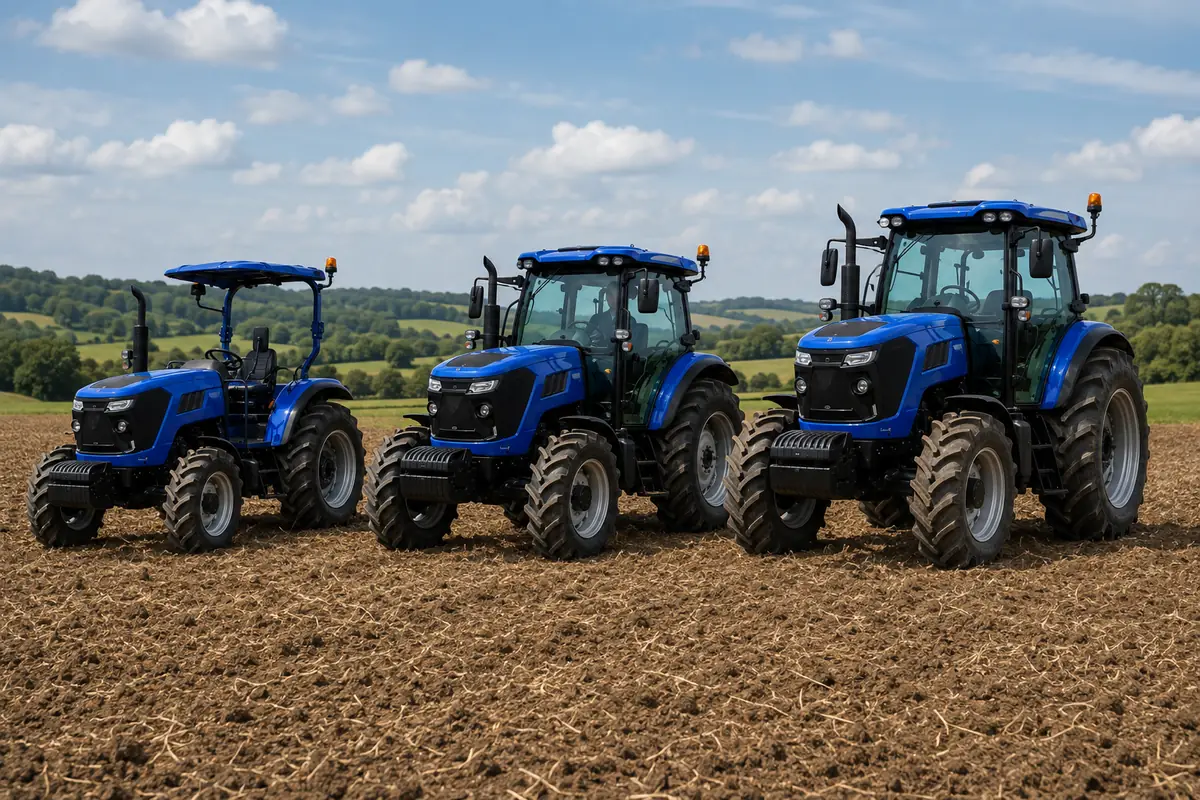
OXPLO currently lists the OXT704 at 51.5 kW / 70 HP with 4WD, a 12-forward + 12-reverse transmission, Category II rear linkage, a six-spline PTO and 540/760 rpm PTO speeds. The published platform has a 2,010 mm wheelbase, approximately 2,500 kg listed weight and overall dimensions of 3,980 × 1,760 × 2,800 mm.
Specification | OXPLO OXT704 |
Rated power | 51.5 kW / 70 HP |
Rated engine speed | 2,400 rpm |
Drive configuration | 4WD |
Transmission | 12 Forward + 12 Reverse |
Rear linkage | Category II |
PTO shaft | 6 splines |
PTO speed | 540 / 760 rpm |
Overall dimensions | 3,980 × 1,760 × 2,800 mm |
Wheelbase | 2,010 mm |
Minimum ground clearance | 308 mm |
Listed weight | Approx. 2,500 kg |
Front / rear tyres | 8.3-20 / 12.4-28 |
Where the OXPLO OXT704 Makes Sense
Within the current OXPLO tractor range, the OXT704 sits at the 70 HP end of the lineup and moves into a larger Category II utility platform. OXPLO positions the 60–70 HP class for more demanding soil preparation, mixed-farm transport, bale handling, material handling and front-loader work where the job genuinely needs more capacity than the compact 25–50 HP range.
That makes the OXPLO OXT704 most relevant when a buyer needs one tractor for several recurring jobs, already owns or plans to buy Category II implements, needs 4WD traction, uses trailers regularly or wants more operating reserve than a 50–60 HP compact platform can provide.
What OXPLO Should Still Confirm for Your Order
The public OXPLO OXT704 page does not publish every number needed for every attachment. For serious PTO work or frequent loader use, ask OXPLO to confirm the actual PTO output, hydraulic flow and pressure, rear-linkage lift capacity, available hydraulic outlets and any loader-specific capacity and ballast requirements for the exact configuration being quoted.
This is deliberate procurement discipline, not a weakness in the buying process. OXPLO can only confirm implement compatibility properly when the buyer provides the implement weight, PTO requirement, linkage category, hydraulic demand and working conditions. The same applies to tyres, cab or ROPS, lighting, emissions configuration and destination-specific documentation.
For buyers who want OXPLO to configure the tractor around the farm rather than around a single horsepower figure, use the OXPLO tractor configuration page. For implement options and compatibility questions, review OXPLO tractor attachments and support.
IX. FAQ: Common 70 HP Tractor Buying Questions
Q1. Is a 70 HP tractor enough for a 50-acre farm?
Often, yes – but 50 acres alone cannot determine horsepower. A 50-acre grassland or livestock operation may be comfortable with 70 HP, while 50 acres of frequent heavy cultivation can demand more. Check the main implement, soil resistance, required field speed and the time available to complete the work.
Q2. What can a 70 HP tractor do?
Typical work includes mowing, general soil preparation, seeding, fertilizer spreading, trailer transport, bale handling, loader work and mixed-farm utility tasks. The exact attachment still has to match PTO power and speed, linkage, implement weight and hydraulic demand. OXPLO uses the same application-first logic when discussing an OXT704 configuration with a buyer.
Q3. How much PTO horsepower does a 70 HP tractor have?
Do not calculate PTO horsepower directly from the 70 HP engine rating. PTO output is a separate performance figure. If your implement has a minimum PTO horsepower requirement, ask the tractor supplier to confirm actual PTO output for the model and configuration under consideration. OXPLO buyers should request this figure when PTO demand is close to the working limit.
Q4. Is a 70 HP tractor too large for a small farm?
It can be. On vineyards, orchards, older farmyards and other confined sites, overall width, turning radius, height and machine weight may matter more than engine output. OXPLO offers smaller horsepower classes for buyers whose primary constraint is access rather than power.
Q5. Should I buy a 60 HP or 70 HP tractor?
Choose 60 HP when it already runs the main implements at the required speed with a sensible reserve and the farm is not likely to expand its workload soon. Choose 70 HP when the 60 HP option is repeatedly near its practical limit, when Category II implements or heavier transport are part of the plan, or when faster completion inside a short seasonal window has real value.
Q6. Is 70 HP enough for ploughing?
For many medium-duty ploughing applications, yes. The answer still depends on plough type, number of bottoms or working width, depth, soil, tractor weight, tyres, ballast and desired speed. OXPLO should confirm the intended plough against the exact OXT704 configuration rather than treating all ploughs of the same width as equal loads.
Q7. Is 4WD important on a 70 HP farm tractor?
It is particularly valuable for tillage, soft ground, slopes, wet grassland and other high-draft work because it helps convert available engine power into usable traction. The OXPLO OXT704 is listed as a 4WD tractor, but tyre choice, ballast and soil condition still determine how effectively that traction is used.
Q8. Where can I compare OXPLO tractor models and attachments?
Start with the OXPLO tractor category to compare available horsepower levels. For broader application-based configuration, visit the OXPLO 25–70 HP tractor configuration guide, or return to the OXPLO official website for the current equipment range.
X. Conclusion: Size the Working System, Not Just the Engine
A 70 HP tractor is a useful middle-ground machine for many mixed farms, livestock operations, grassland businesses and general field work. It gives more operating reserve than a compact 40–50 HP tractor without automatically moving the farm into a much larger machinery class.
That does not make 70 HP a universal answer. If the tractor spends most of its life doing work that a 40–50 HP machine could perform easily, the farm may be paying for unused capacity. If it can only complete the farm’s most important job at low speed, high slip and sustained high load, it is probably too small for that duty cycle.
The more reliable sequence is: application → implement → PTO and hydraulic demand → soil and traction → working speed → weather window → annual hours → tractor configuration. Horsepower comes after those questions, not before them.
For buyers whose requirements point toward a 70 HP, 4WD, Category II platform, OXPLO can compare the OXT704 against the actual implement list and destination requirements. Send OXPLO your country, farm type, terrain, main jobs, implements and required attachments. OXPLO can then check PTO, linkage, hydraulics and the final configuration before quoting.